
Montjoi Diving Center
Beachfront PADI/FEDAS/CMAS dive centre inside the Cala Montjoi resort near Roses, running its own boat to Cap de Creus sites and a seasonal freediving course.
PADI / FEDAS / CMAS / SSI4 services4 languages
Also known as: Clot del Boc (RNP), El Clot del Boc, El Salt del Boc
A rocky Cap Norfeu wall and tunnel dive, where a passage opens into a small cave at 12 m sheltering large schools of sardines.
Last updated September 2026
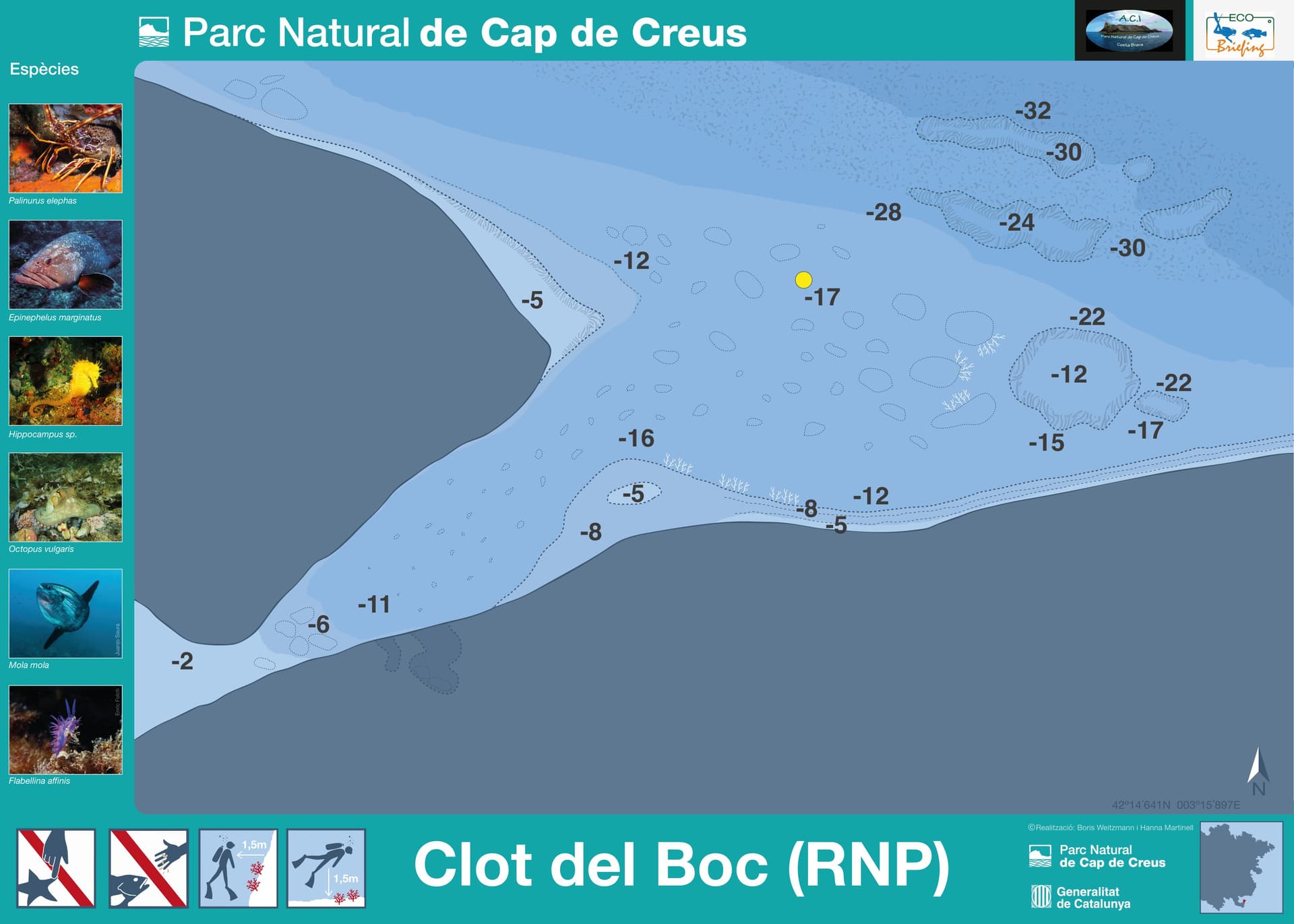
A tunnel-and-cave entrance near 12 metres and the park's own shallow marked point near 17 metres sit at the top of a rocky ridge that runs south from in front of Cala Jòncols, part of Cap Norfeu's submerged mountain range.1 Past that shelf, the wall and slope continue over rock mixed with sand and patches of red coral. Two operators that dive the fuller route follow the same ridge down to a working maximum between 30 and 35 metres; a separate account of this exact site instead describes a shallower drop-off, from about 5 to 20 metres, ending in a canyon.
A tunnel near the base of the wall opens into a small cave at 12 metres, where large schools of sardines gather. The park's own species panel for this point is headed by the spiny lobster, alongside dusky grouper, seahorse, common octopus and the violet nudibranch Flabellina affinis.1 Dusky grouper works this stretch of rock at every depth divers describe here, from the shallow shelf to the deeper ridge. Both operators that dive here frame the site as part of the Cap Norfeu circuit, though neither the site's own sheet nor the park's separate index states which of the park's three marine reserves this point falls under.
Roses Sub, based in Roses, and Sotamar, based in Cadaqués, are the two operators confirmed to run trips here. The shallow shelf near the tunnel stays within Open Water limits; the deeper route some operators run past 30 metres needs Deep Diver training. The site's own eco-briefing sheet asks divers to stay 1.5 metres clear of both the reef and the seabed, and to leave fish, invertebrates and any fishing gear untouched. Hold that same buoyancy discipline through the tunnel: the sardines sheltering inside it are covered by the same no-touch rule as the rest of the point. Independent divers must give the park prior notice and stay within its cap, applied per boat, not per diver: six dives a day, thirty a week, a hundred and twenty a year.2
What makes this dive site stand out.
Opens near 12 m, where large schools of sardines gather
Six illustrated species, headed by spiny lobster and dusky grouper
Runs south from Cala Jòncols along Cap Norfeu's submerged mountain range
Protected inside one of the park's three marine RNPs
42.2440°N, 3.2649°E
No season specific to this point is documented. As an exposed part of the Cap Norfeu headland, it follows the area's general pattern: the Tramontana wind can shut boat access to outer sites like this one for days at a time, most often over winter.
The shallow shelf near the tunnel and the park's marked point suit Open Water divers; the deeper route some operators run past 30 m needs Deep Diver training.
Summary
Easy on the shallow shelf and through the tunnel near 12 m; advanced on the deeper route past 30 m.
Safety considerations
What can go wrong here, and what divers do about it. Conditions change - take the briefing from the operator on the day.
Book a guided dive at this site.
Beachfront PADI/FEDAS/CMAS dive centre inside the Cala Montjoi resort near Roses, running its own boat to Cap de Creus sites and a seasonal freediving course.
PADI 5-Star dive center in Roses running three decades, with its own 16m catamaran to Cap de Creus Natural Park sites.

SSI Instructor Training Center in Cadaqués running guided dives to 25+ Cap de Creus Natural Park sites and a blue shark snorkeling program.

Get in touch to add or claim your dive center listing on DiveCodex.
Dive centres in Catalonia must require insurance from every diver on their dives, and must be able to offer a policy to anyone who has none.
It depends on which depth you plan. The park's own marked point sits near 17 m, within Open Water limits. Two operators run a fuller route along the same ridge to 30-35 m, which needs Deep Diver training. A separate account describes the same site instead as a shallower 5-20 m drop-off; check with whichever operator you book to know which profile you will actually dive.
A different operator, based further along the coast, names a wall dive by that title in the same bay, with a canyon-and-tunnel feature entered around 12-20 m, close enough to this site's own tunnel entrance that the two may describe the same or a neighbouring feature. Neither reading is confirmed, so book by the exact name your own operator uses and treat the two as potentially different dives until you know otherwise.
No. They are two separate, separately surveyed government itinerary points roughly 12 km apart, on different stretches of the park's coastline. 'Boc' is simply Catalan for a billy-goat, a common element in local place names along this coast.
Log your dives - notes, photos, conditions and the marine life you saw - and share them as one public diver profile. What you share helps the next diver, too.
Log every detail
Depth, duration, conditions, gear, buddy, notes — all in one place. Import from Suunto and other dive computers.
Track marine life
Record species sightings on each dive. Build a personal catalogue of everything you've seen underwater.
Your public dive profile
Share your dive history, stats, and experiences with a profile page you control. Show the world where you've been.