
Cap de Creus Dive
PADI 5-Star center in El Port de la Selva with brand-new Aqualung gear, max 4 divers per guide, and year-round boat diving in Cap de Creus Natural Park.
PADI / SSI10 services4 languages
Also known as: Encalladora, S'Encalladora
A government-buoyed reef point at 17 m in Cap de Creus, sitting beside the park's no-dive Integral Reserve on the same island.
Last updated September 2026
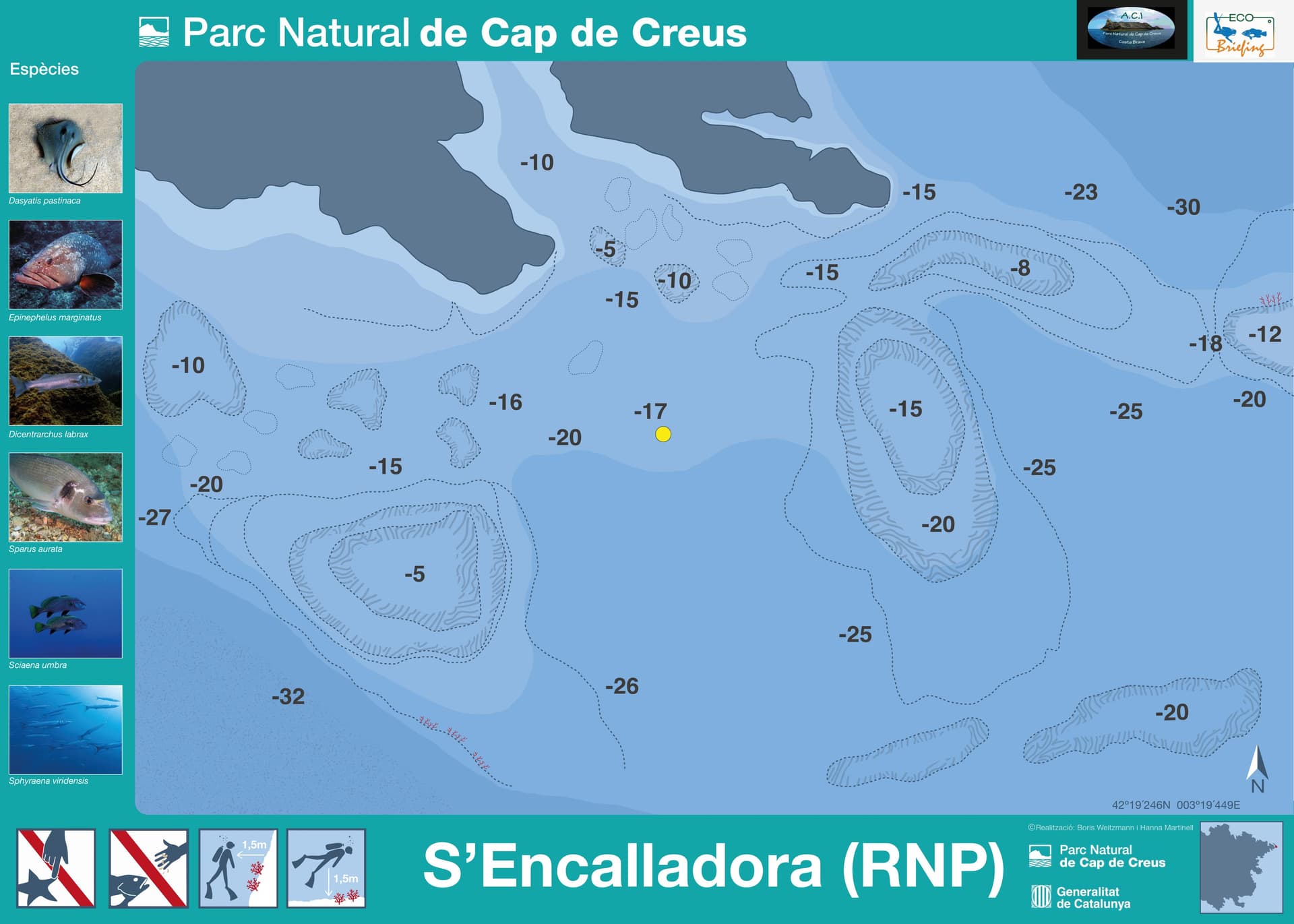
The park's own dive buoy for S'Encalladora sits at 17 metres, over a stretch of rocky reef that the government's chart contours from about 5 metres, on rock platforms either side of the buoy, out to 32 metres at the mapped area's furthest corner.1 Six species headline the same eco-briefing sheet for this exact point: common stingray, dusky grouper, European seabass, gilthead seabream, brown meagre and yellowmouth barracuda.1 Getting there means crossing the Freu de Sa Clavaguera, the roughly 50-metre channel that separates the island from the Cap de Creus mainland and gives the crossing some shelter from the Tramuntana.
L'Encalladora's defining feature is a boundary: the buoyed S'Encalladora (RNP) itinerary sits directly beside the park's only marine Integral Nature Reserve, RNI Nord de S'Encalladora, a separate zone on the same island where diving, swimming and anchoring are prohibited outright.2 The park's current regulation, in force since August 2025, draws that closure specifically around the reserve; everywhere else in the park, including this buoyed point, diving continues under the ordinary rules.2 A local nature-writing account separately credits the island as roughly 600 metres end to end, with a dark schist base topped by paler pegmatite blocks that give the rock a visibly banded look.
Independent divers need to notify the park in advance and stay within its cap of six dives a day, thirty a week and 120 a year, applied per boat rather than per diver; night dives and baptism or first-level courses need the park's own special authorisation on this Partial Nature Reserve point.2 The more immediate line to know before getting in the water: this buoy sits right next to the adjacent no-dive Integral Reserve, so stay inside the signed S'Encalladora itinerary and check the boundary with your centre if you are ever unsure which side of it you are on.
What makes this dive site stand out.
The buoyed route sits right next to a separate, no-dive Integral Reserve zone on the same island
The park's own itinerary sheet marks the dive buoy at 17 metres
The sheet illustrates six species for this exact point, from stingray to barracuda
Reached by boat across the Freu de Sa Clavaguera, which gives some shelter from the Tramuntana
42.3208°N, 3.3241°E
No season is documented specifically for this point; like the rest of this stretch of the park, the Tramuntana can close boat access for days.
The park's own 17 m buoy sits within Open Water depth limits; a deeper reading of more than 40 m, if it describes the same dive, would call for Deep certification.
Summary
Graded from the park's own 17 m buoy depth; the wider site is also described elsewhere as exposed to currents and suitable only for experienced divers.
Safety considerations
What can go wrong here, and what divers do about it. Conditions change - take the briefing from the operator on the day.
Book a guided dive at this site.
PADI 5-Star center in El Port de la Selva with brand-new Aqualung gear, max 4 divers per guide, and year-round boat diving in Cap de Creus Natural Park.
SSI-affiliated dive centre in Llançà, the Cap de Creus Natural Park's northern access point, with air-only fills and a one-instructor-per-diver baptism dive.
PADI/CMAS/FFESSM centre in El Port de la Selva, running since 1994; daily boat dives across ~20 Cap de Creus sites including Massa d'Or, April-October.

SSI Instructor Training Center in Cadaqués running guided dives to 25+ Cap de Creus Natural Park sites and a blue shark snorkeling program.

Get in touch to add or claim your dive center listing on DiveCodex.
Dive centres in Catalonia must require insurance from every diver on their dives, and must be able to offer a policy to anyone who has none.
Not on the buoyed dive point this page describes. General tourism and geology write-ups about the island often describe the whole thing as a closed Integral Reserve, but the Park's current regulation (Order TER/130/2025) draws the closure specifically around RNI Nord de S'Encalladora, the reserve on the island's seaward side. Everywhere else in the park, including the signed 'S'Encalladora (RNP)' dive point at 17 metres, diving is permitted under the ordinary Cap de Creus rules.
Only if that catalogue figure describes the same dive as the park's own buoy. The park's own itinerary sheet marks a single dive point at 17 metres, within Open Water limits, with printed contours in the surrounding area running from about 5 to 32 metres. A separate commercial catalogue puts the site's range at 12 to more than 40 metres, a figure the park's own survey does not confirm. If a centre is running the deeper profile, Deep certification applies; the park's own buoyed point stays within Open Water depths.
Both names refer to the same island and the same dive point. 'S'Encalladora' is the spelling the park's own itinerary sheet and most current official material use; 'L'Encalladora' uses an alternative form of the Catalan definite article for the same name.
Log your dives - notes, photos, conditions and the marine life you saw - and share them as one public diver profile. What you share helps the next diver, too.
Log every detail
Depth, duration, conditions, gear, buddy, notes — all in one place. Import from Suunto and other dive computers.
Track marine life
Record species sightings on each dive. Build a personal catalogue of everything you've seen underwater.
Your public dive profile
Share your dive history, stats, and experiences with a profile page you control. Show the world where you've been.