
Adventure Divers
PADI and SSI center operating from Cabo de Palos port and La Manga Club resort, 25 years in the area.
PADI / SSI2 languages
Also known as: El Naranjito, Isla de la Gomera, Isla Gomera, Magurio, Nadir, Pecio Naranjito
Intact 52m cargo wreck at 26-42m outside the Cabo de Palos reserve, sunk in 1943 with a hold of oranges. Penetrable engine room, dense resident marine life.
Last updated May 2026
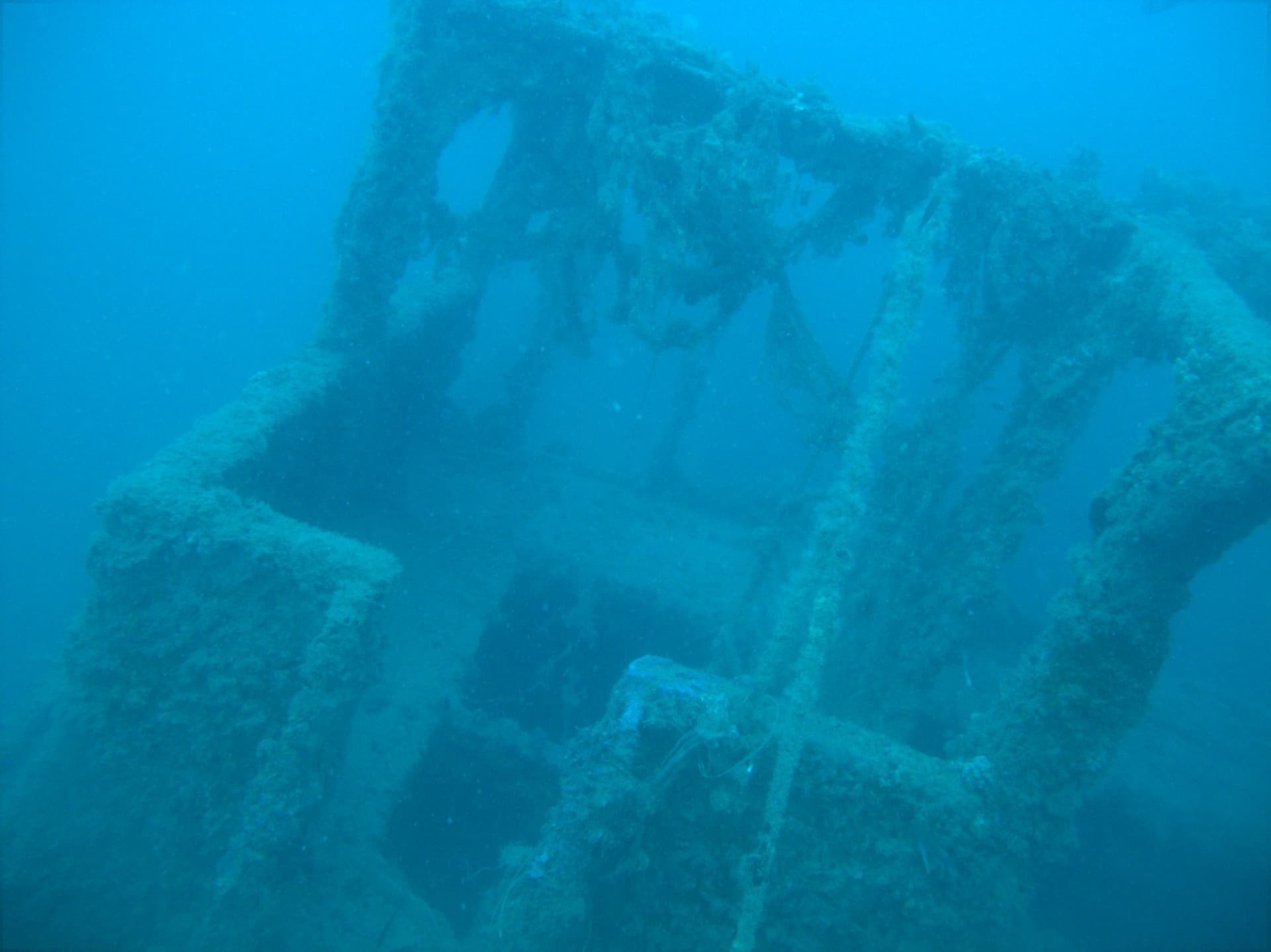
The mooring line is fixed to the bow winch at 26 metres. The wreck appears below as a dark silhouette on light sand, 52 metres of intact hull lying upright and heeled slightly to starboard. From the bow, the route passes the bridge and enters cargo hold 1 before reaching the engine room at around 35 metres. Inside, the triple expansion boiler is intact, with moray eels coiled in the machinery and conger eels retreating into catholes as a torch beam passes. A starboard door leads back out. Past hold 2, the stern drops to the deepest point of the dive - a four-bladed propeller and a rudder colonised by gorgonians, sitting at 42 metres on a clam-shell bed. The return follows the deck upward, dentex circling the superstructure and groupers holding position in the lifted bow. On calm days experienced divers invert the route, dropping straight to the stern and working up to the bow so the deepest section comes first.
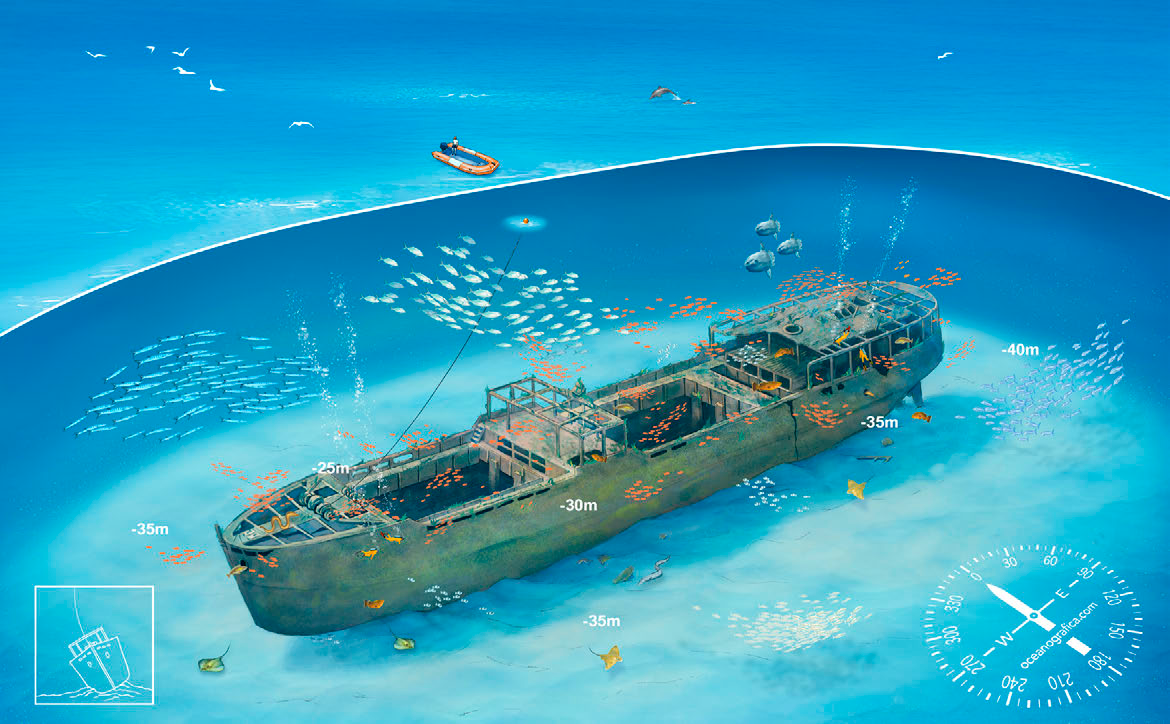
Illustration: © Oceanográfica (2021). Guía de Inmersiones de Cartagena - Cartagena Diving Guide. Boyra, A., C. Fernández-Gil, D. Balcarcel, A. Cánovas y M. A. G. Gallego.
Oranges sank this ship. On 13 April 1943, a starboard hull failure mid-voyage from Cartagena to Barcelona caused the cargo to shift, and the vessel went down inside a minute. The fruit drifted ashore for weeks until locals gave the wreck its nickname. Eighty years later the hull is still legible from propeller to bow winch in a single dive, and unlike the reserve bajos nearby this site sits outside the protected zone - no permit, no daily cap, no 15-day notice. Local Cabo de Palos divers built a Sunday rhythm around it: market in the morning, then a boat to the Naranjito. Several centres run trips to the wreck most days, and the compact 52-metre hull with multiple exits in the engine room makes it a wreck that builds confidence rather than testing it.
The ship was launched on 18 November 1918 in Cadiz as Nadir, renamed Magurio in 1926, and renamed again to Isla Gomera in 1935 - three identities before its final voyage. The sinking came on a route from Cartagena to Barcelona with a hold of oranges. The captain's later account is the standard version: the ship suddenly tilted, began to sink with its bow, and was gone in under a minute. Eight of the eighteen people on board survived, several by holding on to floating crates of oranges in the dark. The chief engineer's wife reportedly did not survive. For years afterwards the identity of the wreck on the seabed was unknown locally; it was a Cabo de Palos diver who investigated and published the research that connected the oranges story to the ship's three names. A 3D photogrammetric model of the wreck was completed in April 2025, useful for dive planning and now circulating in the wreck-diving community. The same survey noted visible cracks at the stern and engine-room area, with structural concern that the wreck may eventually break in half as it settles further into the seabed.
Fishing tackle tangles in the mooring cable. Hooks and line have snagged more than one diver during descent, so carry a cutting tool. Currents are the main variable: strong-flow days mean the dive is cancelled, and even moderate current means holding the mooring line through the safety stop. Thermoclines hit hard at depth - a 26C surface in summer drops to 15-18C on the wreck, and the shift can be abrupt. Dress for the deepest point of the dive, not the surface; 7mm wetsuit minimum at wreck depth, drysuit in winter. At 43 metres on air, no-deco time runs out around five minutes, which is the practical reason local divers talk so much about respecting the stops. Nitrox extends that window and is available at most centres for around 6 EUR. Most boats leave at 08:00 and return within two hours; book ahead on weekends, when local Spanish divers fill the boats.
What makes this dive site stand out.
Whole ship visible bow to stern in one dive, deck at 26m and propeller at 42m on sand.
Triple expansion boiler intact, multiple exits, suited to AOW with wreck specialty.
No permit, no quota, no 15-day notice. Bookable on short notice when conditions allow.
Sunk April 1943 carrying oranges; cargo washed ashore for weeks and named the wreck.
Local rhythm of Cabo de Palos market in the morning then a Naranjito boat trip.
37.6213°N, 0.6832°W
Water still warm at 20-24C surface, best visibility, fewer crowds. May-June is the second window and the best chance of sunfish.
Single-dive prices range across local centres. Equipment rental ~16 EUR, nitrox ~6 EUR, light ~17 EUR. Multi-dive packages reduce per-dive cost.
Advanced Open Water (PADI AOW / CMAS 2-star / FEDAS B2) minimum. Deep Diver and Wreck Diver specialties recommended for full-depth and penetration. Centres typically request 20-30 logged dives.
Summary
Depth to 42m near recreational limits, frequent currents, sharp summer thermocline, variable visibility, overhead environment during penetration
Safety considerations
What can go wrong here, and what divers do about it. Conditions change - take the briefing from the operator on the day.
Book a guided dive at this site.
PADI and SSI center operating from Cabo de Palos port and La Manga Club resort, 25 years in the area.

Long-running multi-agency dive centre in Cabo de Palos running daily boats into the Islas Hormigas Marine Reserve and the local technical wrecks.
Cabo de Palos dive centre operating since 2004, boating divers into the Islas Hormigas reserve and onto the namesake Naranjito wreck.
SSI and PADI dive centre off the main strip in Cabo de Palos, with a 140 m² shorefront base and small-group RIB trips into the Islas Hormigas marine reserve.

PADI 5-Star Career Development Center on the Cabo de Palos harbour, run by Dutch course-director couple Martin and Brenda van Gestel since March 2023.

Nature-and-education dive center in Cabo de Palos, the first National Geographic Dive Center in Spain and the first Avelo center in Europe.

British-run PADI 5-Star centre on La Manga Strip with multi-agency teaching, small-group reserve diving, technical and cavern training at Cueva del Agua.
Get in touch to add or claim your dive center listing on DiveCodex.
The ship was officially named Isla Gomera when it sank on the night of 13-14 April 1943, carrying oranges from Cartagena to Barcelona. After a starboard hull failure the ship listed and went down fast. Crates of oranges drifted ashore along the Cabo de Palos coastline for weeks, and locals attached El Naranjito - the little orange - as a nickname that outlasted the real name. A Cabo de Palos dive centre opened around 2002 took the same name.
Yes. The engine room with its triple expansion boiler is accessible and has multiple exits, and both cargo holds can be entered. Experienced wreck divers describe it as a starter for penetration - challenging enough to develop the skill, with exits visible on all sides. Wreck specialty training and a light are required. The hull also has a deck-roof ventilation hatch that lets you see the boilers from outside without going in.
No. The wreck sits outside the Reserva Marina de Cabo de Palos e Islas Hormigas, roughly two kilometres from the harbour. No reserve permit, no daily diver cap, and no 15-day advance notice apply. Centres can book it on short notice on any day conditions allow, which is part of why it is the area's most-visited wreck.
The default route descends along the mooring line to the bow winch at 26m, works through bridge, hold 1, engine room view (or interior), hold 2, then to the stern propeller and rudder at 42m, before tracking back along the deck to the line. On calm days experienced divers invert this and drop straight to the stern, working up to the bow - cleaner deepest-first profile.
After 80 years on the seabed, the hull supports dense resident populations. Groupers shelter in the lifted bow section and holds. Moray eels dominate the engine room, with free-swimming individuals seen in hold 2. Conger eels occupy machinery crevices. Dentex and barracuda schools patrol the deck. In May and June, sunfish visit the wreck area, sometimes in groups of six or more.
Single-dive prices range across local centres, with multi-dive packages reducing the per-dive cost. Budget roughly 16 EUR for full equipment rental, 6 EUR for nitrox, and 17 EUR for a light. A personal dive computer is mandatory at most centres. Departure is typically at 08:00, with the full trip lasting about two hours.
The deck at 26m is within AOW limits and the exterior can be explored without penetration. The engine room at 35m and propeller at 42m push toward recreational limits, currents are frequent, and the summer thermocline is sharp. Local centres typically request 20-30 logged dives; one centre asks for 100. Discuss your experience with the operator before booking.
September and October are the consensus best window in Cabo de Palos: surface water still 20-24C, the visibility cleaner than summer, and fewer divers in the water. May and June are second-best and offer the best chance of sunfish on the wreck. April is widely avoided locally - cold and quiet. Winter dives still happen when the sea state allows, with bottom temperatures of 13-15C.
Log your dives - notes, photos, conditions and the marine life you saw - and share them as one public diver profile. What you share helps the next diver, too.
Log every detail
Depth, duration, conditions, gear, buddy, notes — all in one place. Import from Suunto and other dive computers.
Track marine life
Record species sightings on each dive. Build a personal catalogue of everything you've seen underwater.
Your public dive profile
Share your dive history, stats, and experiences with a profile page you control. Show the world where you've been.