
Mistral
36m, 22-guest steel liveaboard with a dedicated camera room and gas-blending deck, running the Brothers, Daedalus, Deep South and Fury Shoal weeks.
Liveaboard22 guestsHurghada
Also known as: Numidia Wreck, SS Numidia
A British cargo steamer wrecked in 1901, fused into Big Brother's north wall from train wheels at 8 m to a stern beyond 80 m.
Last updated July 2026
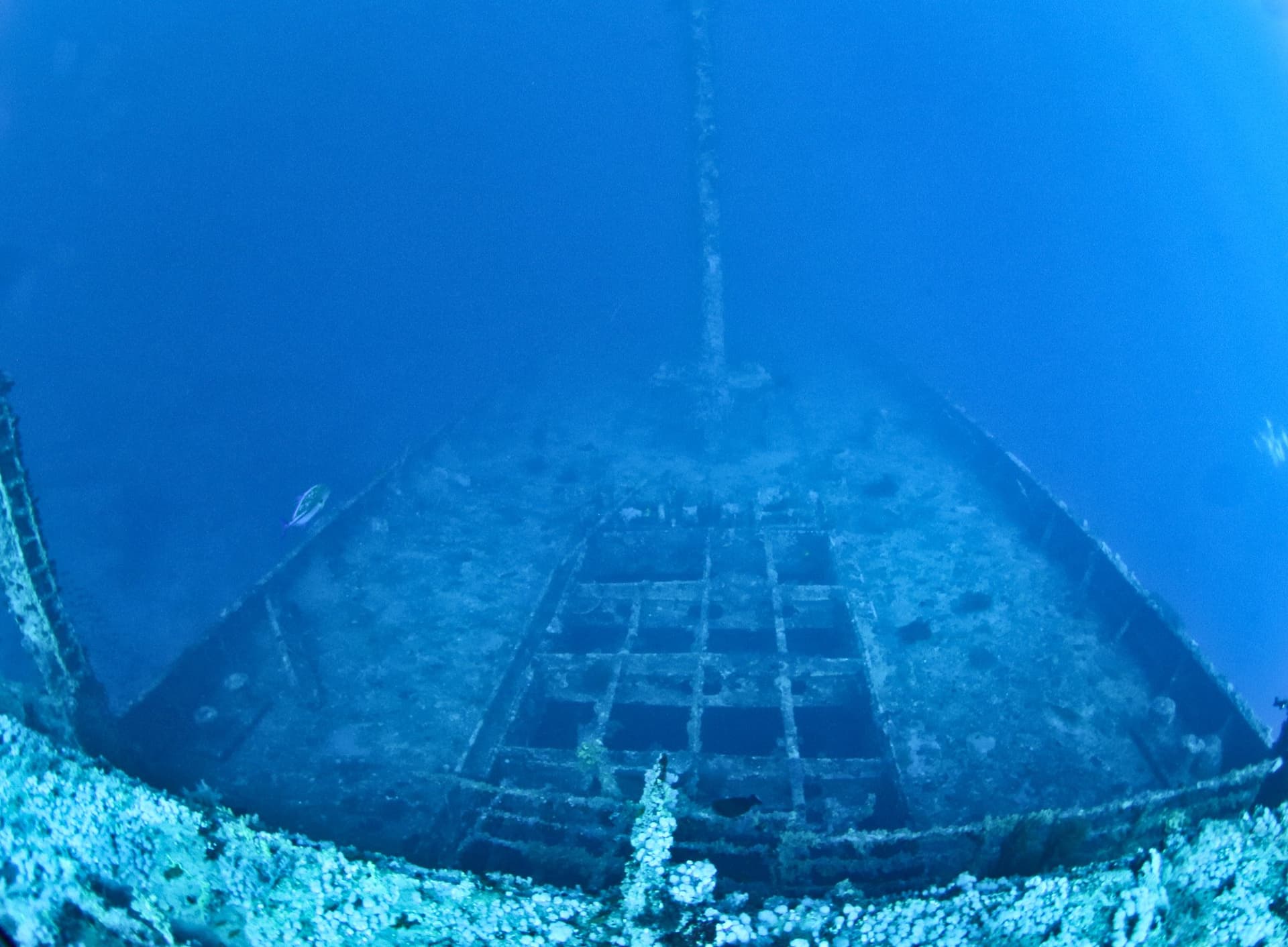
A Numidia dive is a wall dive with a wreck draped down it. You drop fast onto the steel near Big Brother's north tip to get out of the current before it sweeps you off, then settle on the sheltered side of the hull and use it as a windbreak. What you see depends entirely on how deep you choose to go. A recreational dive lingers in the bright upper third: the train wheels and axles in the shallow holds at 8 to 12 metres, the wreck's signature and the detail everyone photographs, then the encrusted cabins and funnel around 20, every surface furred with coral and crowded with glassfish and anthias. Morays and lionfish hang in the dark recesses, and a friendly Napoleon wrasse often comes along for the dive.
Push deeper and the dive changes register. The triple-expansion engine room opens up near 40 metres, the holds and mast base around 46 to 50, and the stern, rudder and propeller lie deepest of all near 80, far from the surface and from land. That is technical and decompression water, not a casual extension of a recreational dive. Throughout, keep one eye on the open blue off the wall. This is among the most reliable oceanic whitetip water in the Red Sea, and the sharks tend to show once you have eased away from the steel. The wreck holds more coral-grown detail than one dive can absorb, which is why the advice is to dive it twice, shallow on one tank and deeper on the next.
Of Big Brother's two wrecks, the Numidia is the one divers come for in its own right. It is the deep one. It offers something the more compact Aida cannot, real depth and historical weight on the same dive. A single descent takes a recreational diver past century-old locomotive wheels in clear shallow water, then lets a technical diver carry on down to the engine room and the stern far below. One piece of wreckage covers the whole sport, from an 8-metre photo subject to an 80-metre objective.
The train-wheel cargo is the detail divers remember: identifiable railway wheels and axles, a tangible link to the voyage that ended here. Add the coral that has all but swallowed the hull, the dense resident fish life, and the oceanic whitetips cruising the blue alongside, and the Numidia becomes a wreck dive, a wall dive and a shark dive at once. That combination is why it earns a reputation apart from the island it lies on.
The Numidia was a brand-new ship when she was lost. A British cargo steamer built on the Clyde by D. and W. Henderson for the Anchor Line1, she was on only her second voyage, bound from Liverpool to Calcutta with general cargo that included railway wheels and axles for an Indian railway. In the small hours of 20 July 1901 she ran straight onto Big Brother's northern reef. The lighthouse above the dive had been raised to warn ships off exactly this hazard, and she struck it anyway. The reef won.
What followed was a slow loss rather than a sudden sinking. The crew was rescued and much of the cargo salvaged over several weeks before the damaged hull broke in two and slid down the steep wall to the position it holds today, stern deepest2. A British Anchor Line steamer lost on her second run to India with railway cargo, she is a coral reef in her own right now.
Plan the Numidia around the current. Drop quickly onto the wreck, tuck onto its lee side out of the flow, then work up the structure and ride the drift back toward your safety stop. The wall can pull you down without warning, so keep buoyancy in hand. Time of day changes the wreck: it sits in shade in the morning and turns vibrant in the afternoon as the sun reaches the wall, so ask for the slot that suits what you want to see.
Bring a computer and a DSMB with a reel on every dive, and a torch for the darker holds. Nitrox pays off across a rotation of repeated deep dives. The line between recreational and technical is the one to respect here. Advanced divers belong on the bright upper wreck; the engine room, holds and stern need proper training, gas and kit, and are no place to push limits.
What makes this dive site stand out.
Railway locomotive wheels and axles still lie in the shallow holds at 8 to 12 m.
One descent runs from an 8 m photo subject to an 80 m stern, advanced through technical.
A century of coral has grown the hull into the wall until steel and reef blur together.
The open blue off the north wall is among the most reliable whitetip water in the Red Sea.
The broken hull hangs down a sheer face rather than sitting on a flat seabed.
26.3130°N, 34.8470°E
October to November is the sweet spot; mid-November to March brings rougher crossings. Long deep time on a shaded wall feels colder than the surface figure suggests.
Dived only as part of a liveaboard safari; marine-park fees are bundled into the trip price.
The recreational upper wreck suits Advanced Open Water with a solid dive history. The engine room and stern from ~40 m down are technical only.
Summary
Depth, persistent current and downcurrent risk on a remote offshore wall; technical for the full descent.
Safety considerations
What can go wrong here, and what divers do about it. Conditions change - take the briefing from the operator on the day.
Multi-day safari boats with this site on their itinerary.
36m, 22-guest steel liveaboard with a dedicated camera room and gas-blending deck, running the Brothers, Daedalus, Deep South and Fury Shoal weeks.

138ft (42m), 26-guest Aggressor liveaboard out of Port Ghalib running two Saturday-to-Saturday southern itineraries: Brothers-Daedalus-Elphinstone, and St John's-Daedalus, across offshore plateaus and the Marsa Alam and St John's reefs.

44m, 28-guest wooden liveaboard and the Sea Serpent Fleet's technical flagship, running the fleet's shared Egyptian Red Sea route pool: offshore Brothers-Daedalus-Elphinstone, northern wrecks and the Strait of Tiran, and southern St John's and Fury Shoals.

Teak-finished 42m, 24-guest liveaboard running Seawolf's full Egypt catalog from Hurghada and Port Ghalib, from northern wrecks and the Strait of Tiran to the Brothers, Daedalus, Elphinstone and the Deep South.

40m, 26-guest wooden liveaboard (SS Glorious Miss Nouran) running the Sea Serpent Fleet's shared Egyptian Red Sea pool: Brothers-Daedalus-Elphinstone, northern wrecks and Tiran, St John's and Fury Shoals, with a panoramic suite and rebreather support.
34m, 20-guest steel liveaboard running Tornado's full Egypt spread, from northern wrecks through the Brothers and Daedalus to a Deep South St John's week.
It hangs down a wall, so depth tracks position along the hull. The train wheels sit shallow at 8 to 12 metres, the cabins and funnel around 20, the engine room near 40, and the stern and propeller deepest of all close to 80 metres. Recreational divers stay in the upper band; the lower hull is technical territory.
Yes, the upper wreck. Advanced Open Water divers with a solid dive history can explore the train wheels and superstructure in the 8 to 30 metre range. Going to the engine room and stern below 40 metres needs technical and decompression training, gas and kit, and should never be improvised.
She was a British Anchor Line cargo steamer, launched in early 1901 and lost on 20 July of the same year, on only her second voyage from Liverpool to Calcutta. She ran onto Big Brother's northern reef in the dark and, after the crew and cargo were taken off, broke up and slid down the wall.
Railway locomotive wheels and axles, part of the general cargo she was carrying to India. They still lie in the shallow holds near 8 to 12 metres, the wreck's signature detail and the thing most divers remember and photograph.
The Numidia is the deep one. Its interest runs from 8 metres down past 80, so it draws both recreational divers on the upper wreck and technical divers on the lower hull. The Aida, about 100 metres away, is shallower and more intact, a recreational wreck dive in the 25 to 40 metre band.
Log your dives - notes, photos, conditions and the marine life you saw - and share them as one public diver profile. What you share helps the next diver, too.
Log every detail
Depth, duration, conditions, gear, buddy, notes — all in one place. Import from Suunto and other dive computers.
Track marine life
Record species sightings on each dive. Build a personal catalogue of everything you've seen underwater.
Your public dive profile
Share your dive history, stats, and experiences with a profile page you control. Show the world where you've been.