

7 Mares
PADI 5-Star Instructor Development Center by Las Canteras beach in Las Palmas de Gran Canaria, with twice-daily boat and van trips.
PADI6 services4 languages
Also known as: Arona Wreck, Carmen M. de Pinillos, El Arona, El Arona Wreck
Advanced wreck dive off NE Gran Canaria: a 1968 refrigerated cargo ship lost to fire in 1978, lying on sand at 36m with a resident barracuda shoal.
Last updated October 2026
A refrigerated cargo ship 96.7 metres long lies on her starboard side on the sand, and the way to her is a fixed line from a surface buoy into open blue water, with no reef or shore in sight. The buoy has been tied to one of the wreck's loading-crane gantries since about 2021. The descent is direct and always on the line, and so is the ascent, because conditions on the bottom can differ a lot from the surface.
One route goes first to the bow and down to the sand at 36 metres, to look under the curve of the starboard hull. It then climbs to the deck line, shallower than 30 metres, and passes through short stretches of the open holds, where black coral grows on the walls, and beside the three deck cranes. These are brief passes through open spaces, not the long interior corridors or the engine room, which are for divers trained in wreck penetration. The route leaves toward the stern and finishes along the port rail at 20 to 25 metres. Another operator keeps the whole dive shallower: it starts on the deck at about 15 metres, heads for the bow and ends by leaving the hull for blue water, where the barracuda are. Which version you get depends on the operator, so ask for its depth plan.
The barracuda are the animals of this dive: a resident group of large fish, sometimes hundreds strong, circling in open water at about 15 metres depth, well above the sand. Around the wreck hangs a thick cloud of bogue, and amberjack hit it from time to time. On the sand beside the hull lie angelsharks and rays, and morays use the plating.
The wreck keeps changing. Winter storms in 2007, 2014 and 2026 each took sections. Stern deck, engine room and much of the aft superstructure have collapsed, leaving a wide gap between the stern and the rest of the hull. The bow penetration into the first hold fell in during April 2026, when the bow cracked and tilted about 15 degrees onto the sand, and other penetrations that were once safe have become very dangerous. An average dive on the standard profile runs about 39 minutes.
Barracuda gather by the hundred in the open water over a 96-metre cargo ship that burned and sank in 1978, a resident shoal that draws most divers here.
By one specialist's account, it became the island's main wreck dive when the older wrecks in the Rada Norte off Puerto de la Luz lost diver access in November 2013, after the quay at La Esfinge was built. The Arona suited the role: a ship of good size, close to Las Palmas, at a depth divers can reach, with many corners to explore. Operators from Las Palmas, Telde and the north coast run it.
Two fish from the Gulf of Guinea, the Monrovia doctorfish and the sergeant major, appeared on the wreck in July 2014, and arrivals of this kind are attributed to offshore oil platforms.
She was built at the ASTANO yard in El Ferrol, launched on 26 May 1967 and delivered on 15 February 1968 as the refrigerated cargo ship Carmen M. de Pinillos, 1,758 gross tonnes, 96.70 metres long and 13.80 metres in beam. Her first voyage opened the first refrigerated banana line between the Canary Islands and mainland Spain. In 1974 she was sold to Naviera del Sur and sailed from then as Arona.
In April 1978 she reached Las Palmas from Abidjan on the 17th to load frozen fish for Lagos, Nigeria. An engine-room fire broke out at sea after she sailed again. The crew of 24 abandoned ship, a Dutch ship and a Spanish trawler came to help, and the trawler took her in tow. The fire flared again with explosions on 23 April, and she sank that evening off Punta Jinamar.1 One account adds that the tug Tamaran asked the owner for permission to beach her at Bocabarranco and was refused.
Line cutters matter here: non-professional rod fishing is permitted in the area, and Buceo Norte makes a cutter or knife mandatory on its dives. It also requires a surface marker buoy, to be launched before any emergency ascent away from the fixed line. Current is moderate to strong and can reverse, and the sea can be very hard. From Taliarte the crossing is quick but usually rough in wind and swell, and seasickness is a real possibility.
With 80 bar or more left in a 12-litre cylinder, a second dive at the shallow Cueva de los Chuchos de Jinamar cavern is possible from the same boat.
Ask the operator for the wreck's current state before using any older route description, and keep to the holds it confirms.
What makes this dive site stand out.
Sometimes hundreds strong, patrolling in open water at about 15m depth.
A 1968 refrigerated freighter lying on her starboard side on sand at 36m.
Short routes through the holds and past three deck cranes; the bow entry has collapsed.
Launched 1967, lost to an engine-room fire on 23 April 1978.
28.0334°N, 15.3849°W
Four operators set the minimum at Advanced Open Water; Leagues Ahead Diving alone adds the Deep Diver specialty. The sand is at 36m, so ask how your operator plans bottom time.
Summary
Open-sea line descent, current that can reverse, 35-36m on the sand and storm-damaged structure.
Safety considerations
What can go wrong here, and what divers do about it. Conditions change - take the briefing from the operator on the day.
Book a guided dive at this site.
PADI 5-Star Instructor Development Center by Las Canteras beach in Las Palmas de Gran Canaria, with twice-daily boat and van trips.
PADI 5-Star IDC dive center in Puerto Rico, south Gran Canaria, running boat and shore trips to seven local sites since 2015.

SSI Diamond dive center in San Agustín, Maspalomas, run by a multinational trio since 2022, diving El Cabrón, Sardina del Norte, and Las Palmas wrecks.

SSI Instructor Training Center at Puerto de Sardina, Galdar, guiding about twenty mapped shore and boat dives on Gran Canaria's northwest coast.

French-run family dive center at Playa de Arinaga, next to El Cabrón, running small (max 3 divers/instructor) shore and boat dives all around Gran Canaria.
PADI 5-Star center at Casa Limón, Arinaga, the longest-established dive operator at El Cabrón, run by owner-instructor Brian Goldthorpe since the 1990s.

PADI 5-Star IDC centre in Maspalomas running small-group two-dive trips on Atlantis, which it bills as Gran Canaria's only rigid-hulled dive boat.
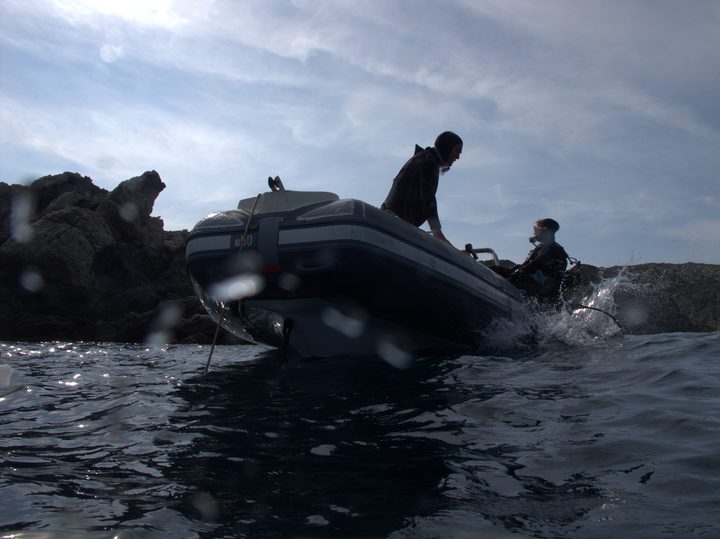
Get in touch to add or claim your dive center listing on DiveCodex.
Dive centres in the Canary Islands check that you hold the certification the dive needs.
Four operators set the minimum at Advanced or Advanced Open Water, and Leagues Ahead Diving alone asks for the Deep Diver specialty as well. The sand lies at 36m, so book against the requirement of the centre you dive with and ask how it plans the descent and bottom time.
1978. A municipal chronicler working from press archives and a specialist account built on April 1978 clippings both date the loss to that month, and one operator gives 23 April. The 1972 date appears on a few operator and tourism pages and is wrong.
She was built as the Carmen M. de Pinillos and kept that name until she was sold in 1974. The new owner renamed her Arona, the name she carried when she burned, and the wreck has been known as El Arona since.
Accounts differ: about 100 nautical miles south of Gran Canaria in one, about 140 nautical miles south of Las Palmas in another. Both agree she was under way after leaving Las Palmas, and she sank off Punta Jinamar days later.
Log your dives - notes, photos, conditions and the marine life you saw - and share them as one public diver profile. What you share helps the next diver, too.
Log every detail
Depth, duration, conditions, gear, buddy, notes — all in one place. Import from Suunto and other dive computers.
Track marine life
Record species sightings on each dive. Build a personal catalogue of everything you've seen underwater.
Your public dive profile
Share your dive history, stats, and experiences with a profile page you control. Show the world where you've been.