

7 Mares
PADI 5-Star Instructor Development Center by Las Canteras beach in Las Palmas de Gran Canaria, with twice-daily boat and van trips.
PADI6 services4 languages
Also known as: Playa de Sardina del Norte, Sardina, Sardina Bay
Sheltered bay at a Gran Canaria fishing village, dived as eight shore routes over volcanic rock, sand and maerl, with angel sharks and garden eels.
Last updated October 2026
Los Jardines de Sardina starts as a navigation exercise: about seven minutes at 5 metres, then a controlled descent without a visual reference. What follows is a sandbank where yellow gorgonians are the visual centrepiece and a garden-eel colony seems to have no end, with rays and small sharks lying flat on the sand and morays and shrimp on the way back. The route lasts about an hour, and when the current is running the guide turns it into a circuit with the current behind you.
The other seven routes differ more in character than in depth. La Cuevita, at 10 m, is a slow macro route among small corals and little animals, and Paso del Sargo works with backlight through arches where juvenile fish take refuge. Los Cañones threads lava arches and canyon-like folds, and El Faro Hundido follows the cliff.
Las Anclas is the one with a story: it crosses a maerl bed to old traps and anchors that have grown over into an artificial reef of sponges and corals, with a fangtooth moray as its flagship. Rocas Pareidolias is named for rock shapes that read as a petrified turtle, a whale's tail and King Solomon's table, and is butterfly ray and trumpetfish ground. The night dive comes last, when angel sharks and butterfly rays hunt and slipper lobsters sit out in the open.
On the six routes from the second mole, the entry is a giant stride from the dock at low tide, or the stairs down into the water at high tide.
Eight differently shaped dives share one bay, so the route you pick decides the day: a sandbank garden, lava arches, a maerl bed laid over old fishing gear, rock shapes, a backlit passage, a night dive. The bay stays diveable almost all year, including when other parts of the island cannot be dived, and a single centre can send the same divers out on consecutive days without repeating a dive. Angel sharks, critically endangered, are most active on the night dive, and seahorses have been seen sitting around the rocks. Afterwards you surface beside a fishing village with a promenade, bars and restaurants.
Sardina's port ranked as a first-rank commercial harbour, a puerto de Primera Mar, and was the island's main export port until the port of Las Palmas was built. A former warehouse there is now the Aula del Mar maritime museum. On the headland at Punta de Sardina a monument put up by Gáldar's town council states that Columbus left La Pinta on Gran Canaria for rudder repairs on 11 August 1492 while he sailed on to La Gomera. The monument calls this the majority view of historians, and local press frames it as a hypothesis against a rival claim for Maspalomas.
Non-professional rod fishing is permitted near the bay, and on Los Jardines de Sardina a line cutter or knife is mandatory. Enter and exit at the designated point, and send up a signalling buoy on any emergency ascent, because boats and motors work around the entry. Current is the variable between routes: nil to low on El Faro Hundido and La Cuevita, medium on four others, decisive enough at Los Jardines to change the route. Paso del Sargo and the night dive are graded Advanced by Buceo Norte.
What makes this dive site stand out.
Each route has its own depth, current and character, from a sandbank to a night dive.
A colony on the Los Jardines de Sardina route that seems to have no end.
Angel sharks are most active on the night dive; seahorses sit around the rocks.
Las Anclas crosses a maerl bed to gear now colonised as an artificial reef.
The bay can be dived even when other parts of the island cannot.
28.1536°N, 15.6992°W
Buceo Norte grades Paso del Sargo and the night dive Advanced and lists the other six routes for all levels; Leagues Ahead Diving gives Open Water as the minimum for the site.
Summary
Six routes sit between 10 and 18 m with a stairs or giant-stride entry; the operator grades Paso del Sargo and the night dive Advanced.
Safety considerations
What can go wrong here, and what divers do about it. Conditions change - take the briefing from the operator on the day.
Book a guided dive at this site.
PADI 5-Star Instructor Development Center by Las Canteras beach in Las Palmas de Gran Canaria, with twice-daily boat and van trips.

SSI Diamond dive center in San Agustín, Maspalomas, run by a multinational trio since 2022, diving El Cabrón, Sardina del Norte, and Las Palmas wrecks.

Dive centre operating since 1996 from the Muelle Deportivo marina in Las Palmas de Gran Canaria, teaching SSI and PADI and running marina wreck dives.

SSI Instructor Training Center at Puerto de Sardina, Galdar, guiding about twenty mapped shore and boat dives on Gran Canaria's northwest coast.
French-run family dive center at Playa de Arinaga, next to El Cabrón, running small (max 3 divers/instructor) shore and boat dives all around Gran Canaria.
PADI 5-Star center at Casa Limón, Arinaga, the longest-established dive operator at El Cabrón, run by owner-instructor Brian Goldthorpe since the 1990s.
Hotel-based PADI 5-Star center inside Hotel Cordial Mogán Playa, running daily two-boat-dive trips across SW Gran Canaria since 2007.
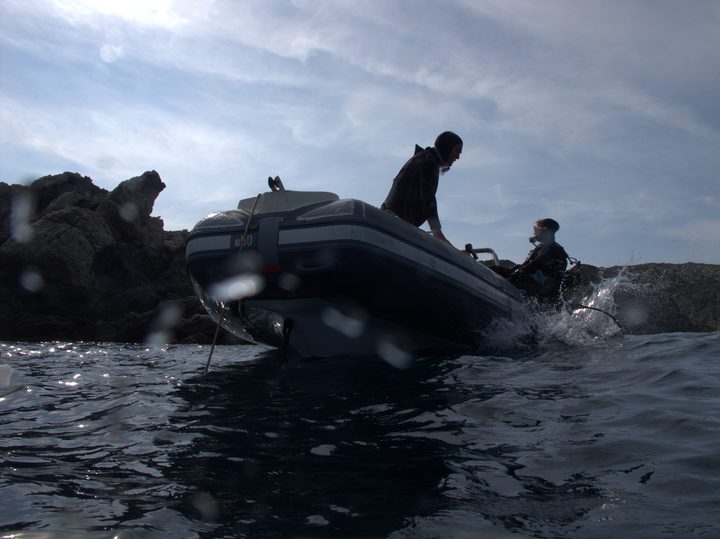
Get in touch to add or claim your dive center listing on DiveCodex.
Dive centres in the Canary Islands check that you hold the certification the dive needs.
No. The monument, put up by Gáldar's town council in 1996 and replaced in 2006, gives 11 August 1492 and calls the stop the majority view of historians. Local press presents it as a live hypothesis, with scholars split between Sardina and Maspalomas as the place where the ship was repaired. It is a local claim tied to a real monument at the dive site, not a documented fact.
El Faro Hundido, at 16 m, is open to all levels, and angel sharks, garden eels and seahorses are its flagship animals. The night dive is when angel sharks and butterfly rays are most active, and Buceo Norte grades that route Advanced, so it is not the one to book on an Open Water card.
Log your dives - notes, photos, conditions and the marine life you saw - and share them as one public diver profile. What you share helps the next diver, too.
Log every detail
Depth, duration, conditions, gear, buddy, notes — all in one place. Import from Suunto and other dive computers.
Track marine life
Record species sightings on each dive. Build a personal catalogue of everything you've seen underwater.
Your public dive profile
Share your dive history, stats, and experiences with a profile page you control. Show the world where you've been.