
Diving Portlligat
SSI-listed dive centre inside the Carpe Diem Cadaqués complex, running since 2008 with three daily boat departures across 15 named Cap de Creus sites.
SSI / PADI8 services5 languages
Also known as: Ses Orgues (RNP)
Expert-rated Cap de Creus wall at the mouth of Cala Fredosa, descending through a pre-coralligenous corridor to coralligenous communities near 40 m.
Last updated September 2026
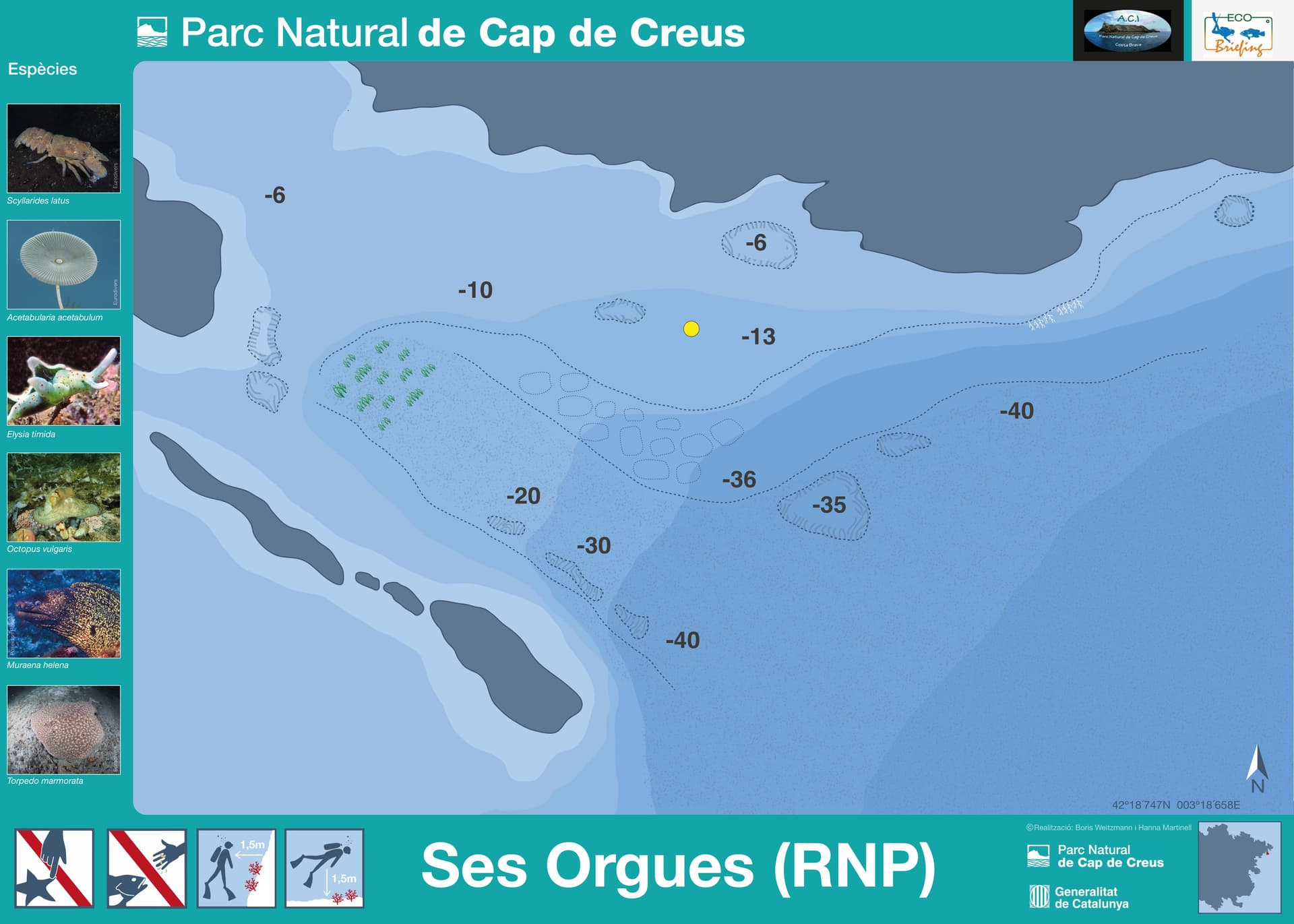
The park's own underwater-itinerary chart plots a shallow shelf close to shore, from about 6 to 13 metres, where a Posidonia patch grows on the western side and the mooring buoy sits at 13 metres.1 From there the ground steps down through 20, 30 and 35-36 metres to a mapped 40 metres off the point and along the eastern islet chain. The route as guided works a single deep profile: one Cadaqués operator describes it as a pre-coralligenous corridor leading into coralligenous communities around 40 metres, and the region's eco-guided dive-route registry gives the working band as 35 to 43 metres and rates the whole route Expert, consistent with a dive that spends most of its time well below 30 metres rather than circling a shallow reef.
An abandoned mica mine, the Mina de ses Orgues, sits on the cliff directly above this dive. An aerial-photo analysis shared in a hobbyist mineral-collecting forum tracks the cliff's pegmatite dike: narrow at the top, wide at sea level, and, the analysis notes, apparently narrow again in the submerged section. The dive is the underwater continuation of the same seam the mine once worked, not a separate feature that happens to share a name. The park's own itinerary sheet illustrates six species for this exact point: the Mediterranean slipper lobster, the parasol-shaped green alga Acetabularia acetabulum, the sacoglossan sea slug Elysia timida, common octopus, Mediterranean moray and marbled electric ray.1 Tagged (RNP) on that same sheet, the site sits inside one of Cap de Creus's three marine Partial Nature Reserves, though the sheet itself does not say which.
Access is by boat from Cadaqués only; no shore-entry option is documented. Because the guided route has no shallower fallback, decide your gas and no-decompression limits for the full 35-43 m working depth before you leave the surface. At that depth this dive works well below the area's own summer thermocline, close to 15 metres, where bottom temperatures drop toward 14°C: budget for a heavier exposure suit than the area's shallow-water default. Night diving between sunset and sunrise needs special park authorisation here, and initiation, first-level or baptism dives are barred in the park's no-fishing sectors.2 Independent divers must give the park prior notice and stay within its cap, applied per boat, not per diver: six dives a day, thirty a week, a hundred and twenty a year.2
What makes this dive site stand out.
The wall continues an onshore mine's rock seam into the submerged section
The region's eco-guided route registry rates the whole dive Expert
Tagged (RNP) on the park's own itinerary sheet
Slipper lobster, moray, octopus and electric ray headline six named species
42.3124°N, 3.3110°E
No season specific to this point is documented; the area's general window is the working guide for a boat-only, exposed route like this one: spring and early summer for the biggest marine-life sightings, August-September for the steadiest conditions, and the Tramontana wind limiting boat access to outer sites in winter.
Graded from the profile itself: this route runs one continuous depth band with no shallower version to fall back on, so deep certification is the realistic entry point, not just the cautious one.
Summary
Rated Expert by the region's eco-guided dive-route registry, for a route that spends most of its time below 30 metres.
Safety considerations
What can go wrong here, and what divers do about it. Conditions change - take the briefing from the operator on the day.
Book a guided dive at this site.
SSI-listed dive centre inside the Carpe Diem Cadaqués complex, running since 2008 with three daily boat departures across 15 named Cap de Creus sites.

SSI Instructor Training Center in Cadaqués running guided dives to 25+ Cap de Creus Natural Park sites and a blue shark snorkeling program.

Get in touch to add or claim your dive center listing on DiveCodex.
Dive centres in Catalonia must require insurance from every diver on their dives, and must be able to offer a policy to anyone who has none.
No. All three are separately surveyed points on the same stretch of coast near Cadaqués, and each carries its own park itinerary sheet with its own coordinate and its own species panel: Es Forcats sits at the mouth of Cala Jugadora, Ses Ielles between Cala Bona and Cala Jugadora, and Ses Orgues at the mouth of Cala Fredosa. This page covers Ses Orgues alone; nothing here should be read across to the other two.
Log your dives - notes, photos, conditions and the marine life you saw - and share them as one public diver profile. What you share helps the next diver, too.
Log every detail
Depth, duration, conditions, gear, buddy, notes — all in one place. Import from Suunto and other dive computers.
Track marine life
Record species sightings on each dive. Build a personal catalogue of everything you've seen underwater.
Your public dive profile
Share your dive history, stats, and experiences with a profile page you control. Show the world where you've been.