

Adventure Divers
PADI and SSI center operating from Cabo de Palos port and La Manga Club resort, 25 years in the area.
PADI / SSI2 languages
Also known as: Pecio Stanfield, SS Nitsa, SS Nitza, Standfield
Steamship sunk in 1916, 120 m long and upright on sand off Cabo de Palos, with a 5 m propeller covered in gorgonians. A technical dive.
Last updated October 2026
A 120-metre steamship lies upright on the sand, bow a little higher than the stern, in the position she sailed in. The main deck is at 45 to 50 metres and the sand at 61, which splits the ship into two dives that divers plan separately. The deck route covers the holds, the intermediate bridge and the length of the ship. The lower route goes down alongside the ship to the propeller, four blades and five metres across, which one diver logged at 62.3 metres without touching the sand.
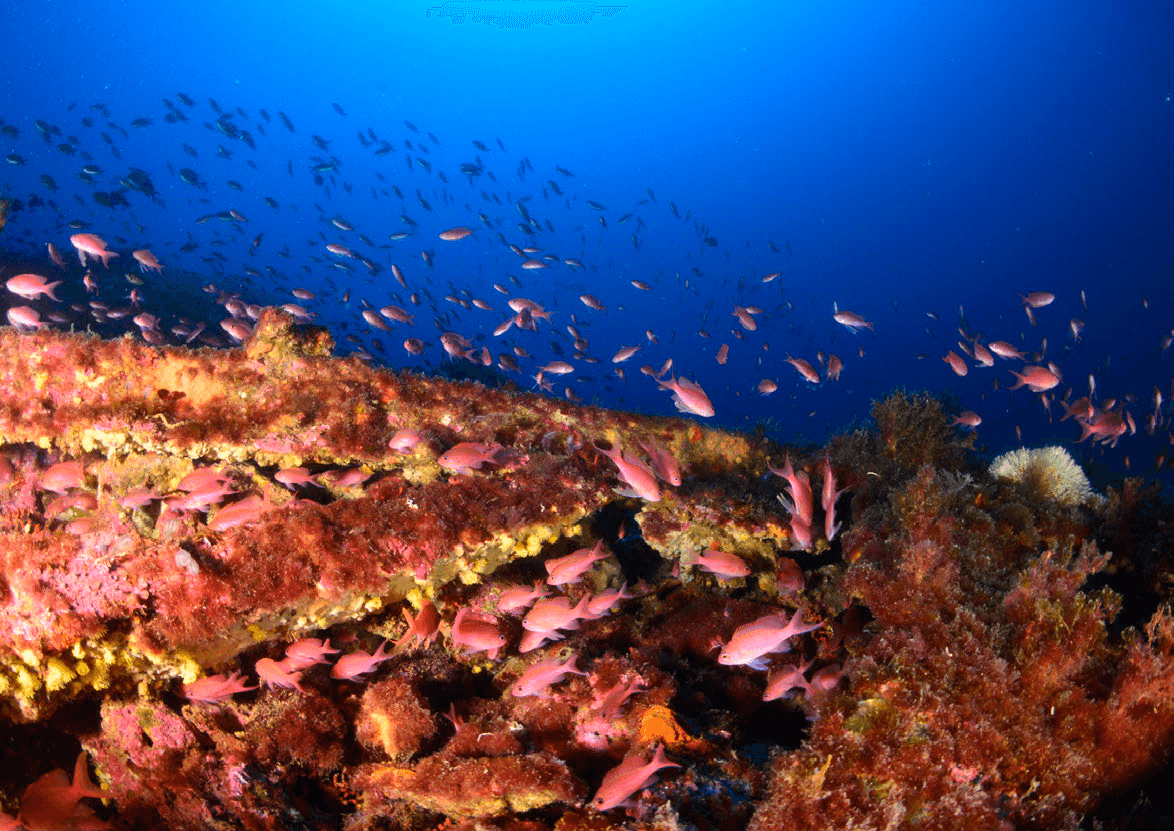
Gorgonians cover the propeller and grow along her sides, thick enough in places to narrow the passages between decks. Large dusky groupers move through the ship's chambers and big conger eels sit in the recesses. The ship is too big for a single visit: divers who know her describe covering her in parts over several dives.
Only the starboard side is damaged; the rest of the hull is intact, so the ship still reads as a ship, with holds, an intermediate bridge and a propeller fringed with gorgonians. Choosing between the deck and the propeller is a choice between the ship's scale and its most photographed detail, made with the gas plan before the boat leaves the harbour.
She was reportedly built at Southampton in 1896 as the Standfield, and by 1916 she sailed under the Cypriot flag as the Nitsa, also written Nitza. She sailed from Norfolk, Virginia, for Savona in Italy with coal for the Italian army1. At 23:30 one night in the summer of 1916 she went down off Cabo de Palos, on 25 June by one account and on 25 July by another1. Every person aboard was saved, picked up by the steamer Alba1.
The cause is unresolved. The version on record is a German submarine's torpedo, and damage on the starboard side fits it, but the wreck does not settle the matter. Other accounts name a collision with the reef at Bajo de Fuera or with another ship sailing without lights. She lies in waters where German submarines sank about fifty ships between 1915 and 1918.
Divers who have done the dive describe twin tanks, a back gas other than air and decompression mixes as the working set-up, and say that without a mix narcosis blurs the detail of the deck. One operator prefers trimix to keep the senses sharp.
Inside, the fans narrow some passages, and holds and decks are overhead spaces: penetration belongs to divers trained for it, with a plan for the way out. Weather decides whether the boat goes at all, since a crew needs a workable sea to find the wreck and drop a shot line.
That line is the only fixed reference between the surface and the ship. In 2009 one diver reported leaving it, being carried off by current after nearly 20 metres of descent and losing the dive.
What makes this dive site stand out.
Sits in sailing position, bow slightly higher than the stern, in excellent condition
Four blades, 5 m across, reached on the lower route at about 62 m
Main deck at 45-50 m, sand at 61 m: two separate dives on one ship
No permanent mooring; boats drop a shot line onto the site
A torpedo is the official version; the cause is still open
37.6782°N, 0.6327°W
The main deck is at 45-50 m, past the recreational limit; the guide's index starts the range at 44 m. One operator grades the dive Buceador Técnico Avanzado with TEC65 training recommended; divers who have done it describe twin tanks, a back gas other than air and decompression mixes.
Summary
Every depth on the wreck is beyond 40 m and the dive needs a decompression plan; open-sea position and the shot line add to the workload.
Safety considerations
What can go wrong here, and what divers do about it. Conditions change - take the briefing from the operator on the day.
Book a guided dive at this site.
PADI and SSI center operating from Cabo de Palos port and La Manga Club resort, 25 years in the area.

Long-running multi-agency dive centre in Cabo de Palos running daily boats into the Islas Hormigas Marine Reserve and the local technical wrecks.

Cabo de Palos dive centre operating since 2004, boating divers into the Islas Hormigas reserve and onto the namesake Naranjito wreck.
SSI and PADI dive centre off the main strip in Cabo de Palos, with a 140 m² shorefront base and small-group RIB trips into the Islas Hormigas marine reserve.

PADI 5-Star Career Development Center on the Cabo de Palos harbour, run by Dutch course-director couple Martin and Brenda van Gestel since March 2023.

British-run PADI 5-Star centre on La Manga Strip with multi-agency teaching, small-group reserve diving, technical and cavern training at Cueva del Agua.
Get in touch to add or claim your dive center listing on DiveCodex.
Both versions give the same hour, 23:30, and the same year, and differ on the month. One puts the sinking on 25 June, with 26 June as the official date; the Cartagena dive guide gives 25 July. The rest of the story is the same: coal bound for Italy, a crew taken off by the steamer Alba. Treat either date as an account, not a confirmed record.
A German submarine's torpedo is the official version, and the damage on the starboard side fits it, but the wreck does not prove it. Other accounts name a collision with the reef at Bajo de Fuera, or with another ship, since vessels of the period often sailed without lights. Nobody has settled the question, and everyone aboard survived.
It saves about 13 m against the sand, and no more. Divers who stayed on the deck logged 48 to 49 m, which is still well past the 40 m recreational limit and still a technical dive. Divers who have done it advise a mix even for the deck. A few divers did it on air; they called it a gamble, and one group of ten, who came up without trouble, said they would not repeat it. The propeller at about 62 m is the deeper option.
Log your dives - notes, photos, conditions and the marine life you saw - and share them as one public diver profile. What you share helps the next diver, too.
Log every detail
Depth, duration, conditions, gear, buddy, notes — all in one place. Import from Suunto and other dive computers.
Track marine life
Record species sightings on each dive. Build a personal catalogue of everything you've seen underwater.
Your public dive profile
Share your dive history, stats, and experiences with a profile page you control. Show the world where you've been.