
CW Azores
SSI dive centre and whale-watching operator at Madalena marina, Pico, running shark, Princess Alice Bank and coastal diving from four boats.
SSI3 services5 languages
Two Central Azores islands sharing a day-boat base for volcanic reefs, summer blue sharks, and mobula-ray dives on the offshore Princess Alice seamount.
Last updated September 2026
Faial and Pico sit either side of a narrow Atlantic channel in the Azores' Central group, close enough that instructors live on one island and work on the other. Diving runs from two small bases, Horta on Faial and Madalena on Pico, out to the same targets: volcanic coastline close in, and, further out, the seamounts that draw divers to this stretch of the mid-Atlantic. The terrain is lava country, arches, tunnels, pinnacles and steep walls, with a submerged fumarole field close to Horta and a seabed that drops past 1,000 metres a short run from Pico's shore.
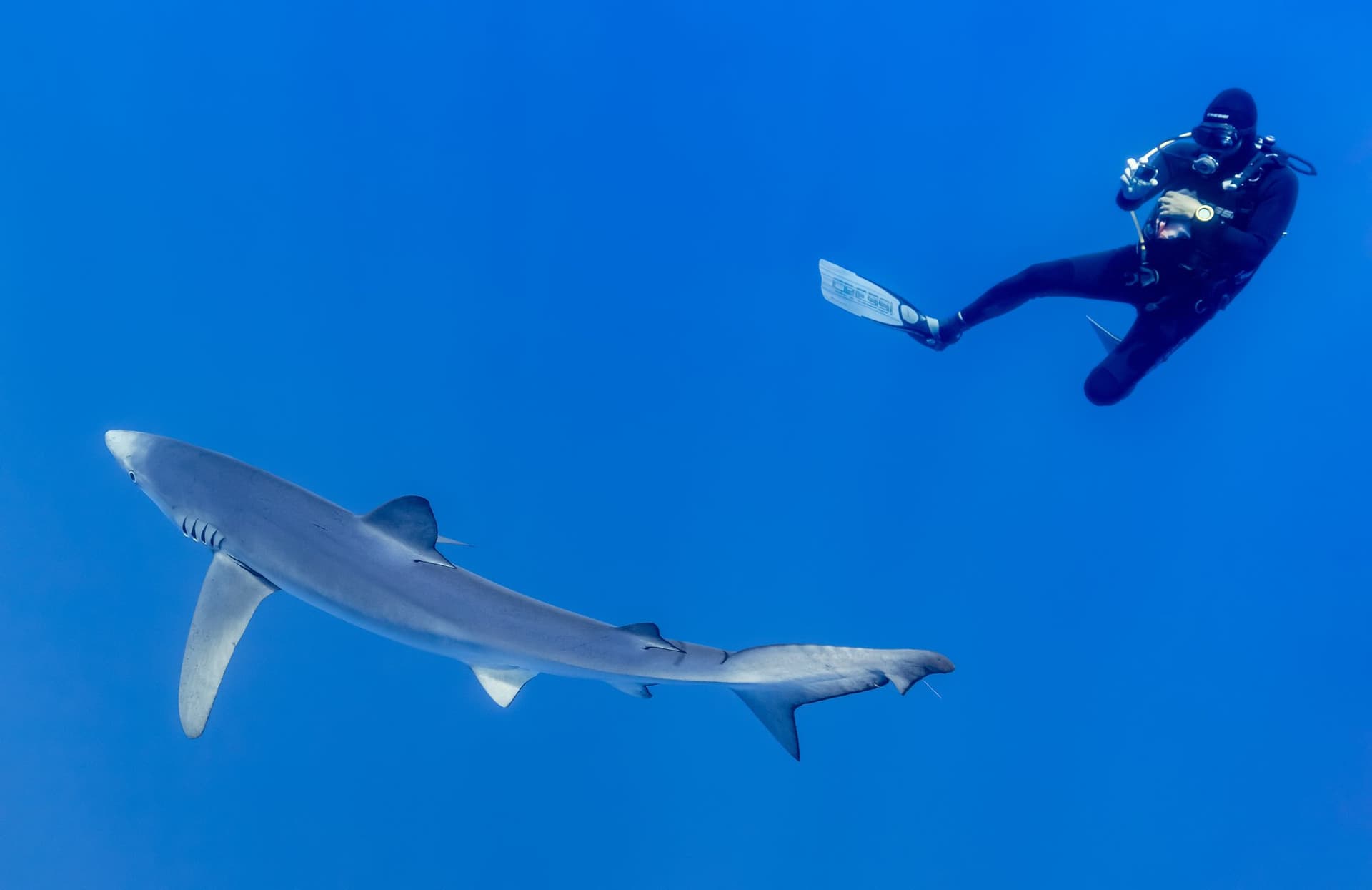
The signature dive is Princess Alice Bank, an offshore seamount whose pinnacle rises to about 35 metres out of open water, with no reef or wall anywhere on the dive. Divers hang on a mooring line in blue water for mobula-ray aggregations, mostly sicklefin devil rays, with counts topping 20 animals on a good day alongside giant amberjack, barracuda schools and yellow-fin tuna. Blue sharks are the area's second headline, a separate open-water trip with chumming, run mostly out of Horta on Faial, though a couple of Pico-based operators also offer it, July through September. Both trips swing with the weather: a calm day can bring the best shark dive of a trip, a rough one murky water and a quiet pinnacle.
Closer to shore, Ilheus da Madalena is an islet cluster two minutes by boat from the Pico dive shops, shallow and easy. On Faial, Boca da Caldeirinha sits in a sheltered bay at the foot of the Monte da Guia volcano crater near Horta, reported with moray eels, ornate wrasse and parrotfish over rocky reef. Dolphins, including bottlenose and common dolphins, and occasional sperm whales turn up on the boat run out to the banks. Whale sharks are seen here too, but rarely, and less often than around Santa Maria, so treat that as a bonus, not an expectation.
Fly into Horta (HOR) on Faial or Pico Airport (PIX) on Pico, then cross between them by the 20 to 30 minute car ferry if your operator works from the other island. Most operators expect Advanced Open Water and around 50 logged dives before the Princess Alice Bank trip, a multi-hour blue-water crossing ending in an open-water hang at depth. Condor Bank, the shorter shark dive at about an hour out of Faial, varies by operator: one requires the same Advanced Open Water plus 50-dive bar, age 18 and a check dive, while another runs a no-certification snorkel and shark-watch option instead. Offshore-bank season runs July to October, peaking July to September, with a few operators starting as early as June, and books out three to six months ahead in high season; local coastal dives run through the same months in calmer water. Pico has dive shops based at the Madalena marina, among them CW Azores; Faial's diving centres on Norberto Diver, the name that comes up across independent community accounts for shark and seamount trips. Build in a rest day before flying out: diving is not recommended within 24 hours of departure.
Volcanic terrain shaped by the Azores hotspot above the Mid-Atlantic Ridge: lava arches, tunnels, pinnacles and steep walls, with the seabed near Pico dropping past 1,000 metres close to shore.
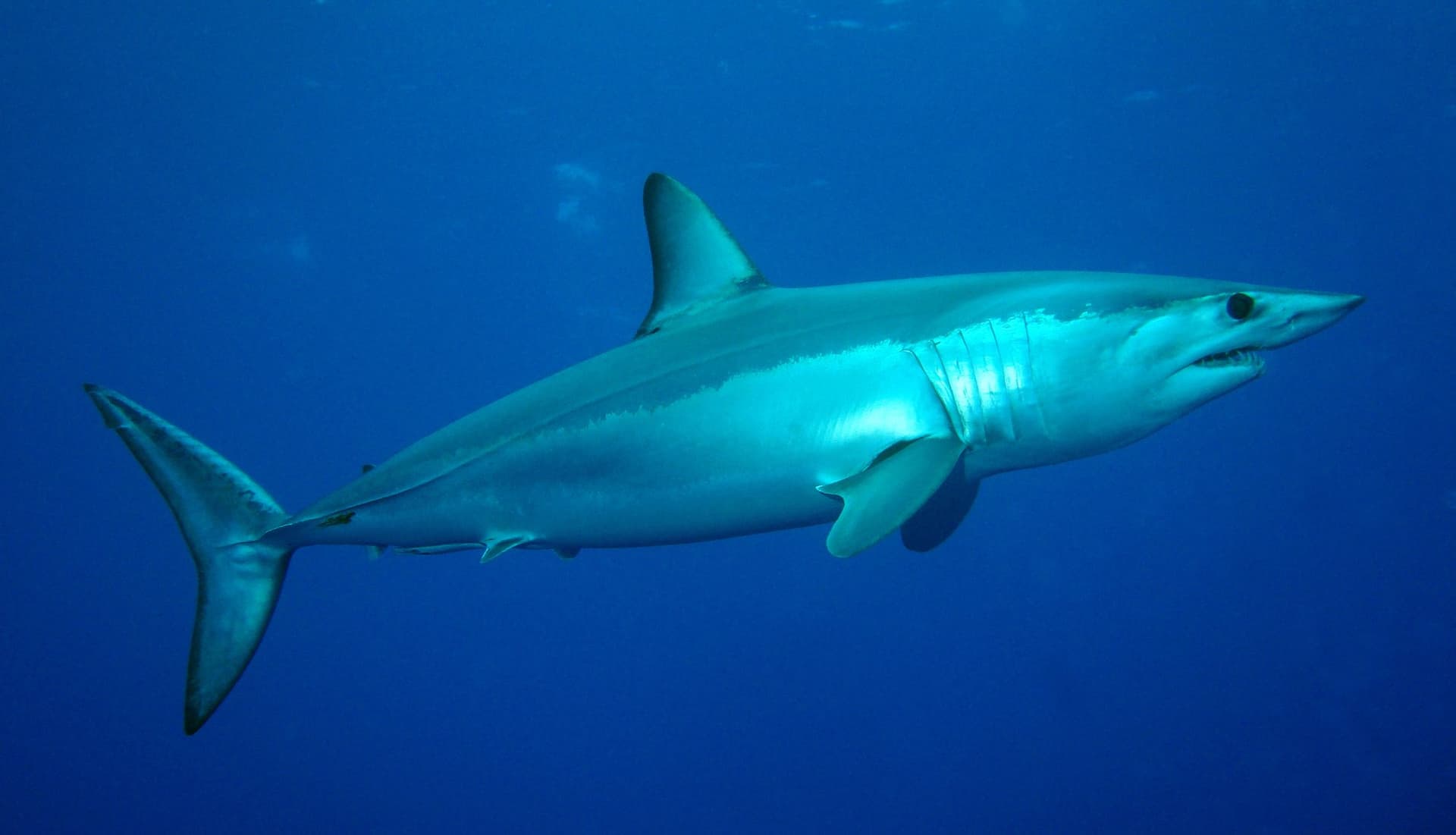
The area's quickest blue and mako shark trip, no seamount descent
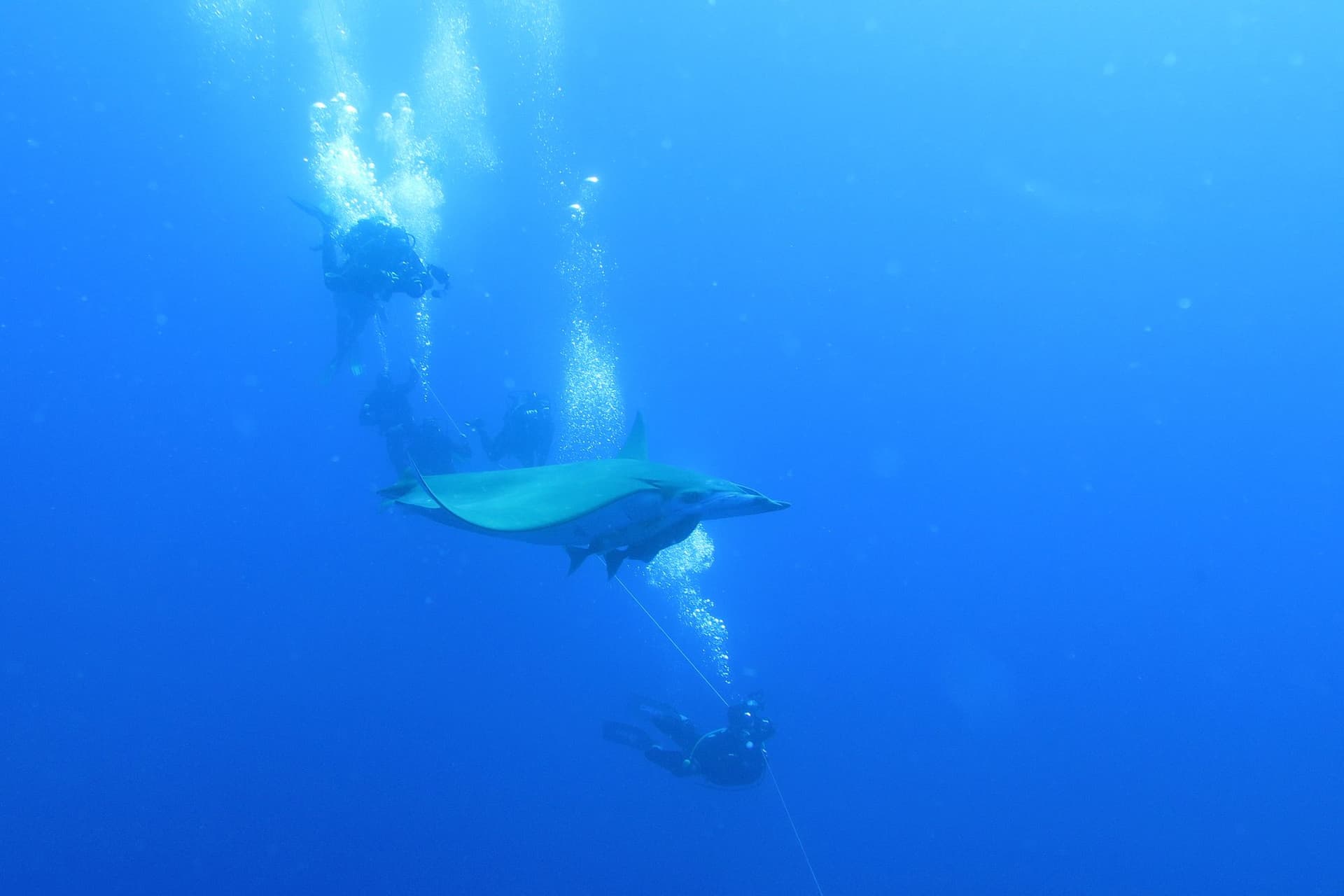
Faial-Pico's offshore mobula ray expedition, a full day out in blue water
Faial's crater-edge wall, dense life at the border of a forbidden reserve
Faial's sheltered, all-comers counterpoint to the area's offshore banks
Pico's closest boat dive: a drowned crater you swim right through
A 2003-scuttled barge near Horta, thick with seabream and triggerfish
Book online or contact a centre that dives this area.
SSI dive centre and whale-watching operator at Madalena marina, Pico, running shark, Princess Alice Bank and coastal diving from four boats.

PADI and SSI dive resort and whale-watching eco-operator in Horta, Faial, running reef, blue-shark and Princess Alice Bank trips.

Small, owner-run Mares/SSI dive centre in Lajes do Pico, running Princess Alice Bank, Condor Bank and Shark Diving expeditions.

SSI-affiliated shark and manta ray specialist at Marina da Horta, Faial, running marine-biologist-led Condor Bank and Princess Alice Bank trips.

PADI Dive Center at Marina da Horta, Faial, part of the 6-location Haliotis chain, running blue-shark, Princess Alice Bank and five named coastal dives.

Small, owner-run SSI dive centre at Marina da Horta, Faial, led by marine biologist Alba; coastal, blue shark and Princess Alice Bank diving.

Get in touch to add or claim your dive center listing on DiveCodex.
Offshore-bank trips are weather-gated enough that centres book them three to six months ahead in high season. Local coastal dives run through the same window at milder, more forgiving conditions.
What can go wrong here, and what divers do about it. Conditions change - take the briefing from the operator on the day.
Marine reserve
Park authority and permit formsPark rules (2026 text)Banco Condor boat rulesChecked: Oct 2026
National rules also apply: Rules and permits in Portugal
Divers who have done both call the diving itself much the same either way. Horta on Faial has more restaurants and nightlife, while Madalena on Pico is quieter and sits closer to the dive shops. The car ferry between them takes 20 to 30 minutes.
The seamount's peak sits at roughly 35 metres, with no reef or wall at all, just open blue water on every side. Divers clip onto a mooring line at the top and hang there; there is no route to swim.
Published distances vary: the official Azores tourism site gives 45 to 50 miles from Horta or Madalena, one operator citing Lajes do Pico specifically logs 60 nautical miles, about 150 minutes, another Pico operator's own site says 70 km, and one diver's trip report logged 48 miles. Expect a two to three hour crossing each way, longer from Lajes do Pico specifically.
Most sources tie the trip to Faial alone; one wider source lists departures from Faial, Pico, Flores and Corvo as well. Confirm with your operator before booking, since a longer crossing changes the day.
No confirmed permit or fee applies to diving around Faial and Pico in general. Princess Alice Bank specifically has been an officially designated Marine Natural Reserve (PMA15) since December 2024, though no diver-specific permit or fee applies there either. Monte da Guia is sometimes described as a protected feature, and one Pico-based dive centre markets Ilheus da Madalena as a protected area, but no official source confirms what either designation means for divers.
Princess Alice Bank does: most operators expect Advanced Open Water and around 50 logged dives before that multi-hour blue-water crossing. Condor Bank, the area's shorter shark dive at about an hour offshore, varies by operator: one requires the same certification plus a minimum age of 18 and a check dive, while another offers a no-certification snorkel and shark-watch package instead.
The season runs July to October and peaks July through September, with a few operators starting as early as June and water at 20 to 24C. Outside that window offshore trips are limited or do not run.
Both are reported around Faial and Pico, but rarely, and less often than around Santa Maria to the east. Treat either as a possible bonus on a Princess Alice trip, not a reason to book one.
No: the standard guidance keeps divers out of the water for 24 hours before a flight, so island-hopping by plane straight after a trip needs a rest day built in.
Results swing with the weather. One trip report describes the best shark dive of a week on a calm day; another describes murky water and a quiet pinnacle on a rough one. A single-day booking bets everything on one weather window, so a few days in the schedule spreads that risk.
Also known as: Faial e Pico, Faial-Pico Channel
Log your dives - notes, photos, conditions and the marine life you saw - and share them as one public diver profile. What you share helps the next diver, too.
Log every detail
Depth, duration, conditions, gear, buddy, notes — all in one place. Import from Suunto and other dive computers.
Track marine life
Record species sightings on each dive. Build a personal catalogue of everything you've seen underwater.
Your public dive profile
Share your dive history, stats, and experiences with a profile page you control. Show the world where you've been.