
Arenal Diving Ibiza
PADI 5 Star Dive Resort in San Antonio, operating since 2004 with a four-boat fleet covering Ibiza's west-coast caves, gorgonian walls, and the Don Pedro wreck.
PADI7 services3 languages
Also known as: Don Pedro, Pecio Don Pedro
142m Ro-Ro cargo ship sunk in 2007 off Ibiza, the largest diveable wreck in the Mediterranean accessible to recreational divers, on her port side at 25-47m.
Last updated July 2026
Five to ten minutes by RIB from Ibiza port or Marina Botafoch, twenty-five from Formentera. From the surface there is only a marker buoy. The descent down the mooring line is the first signature moment: blue-dark and nothing else, until at around 25 metres a hull resolves out of the void. The ship is 142 metres of Ro-Ro cargo ship lying on her port side, so what divers swim across is the starboard hull and former superstructure tipped sideways.
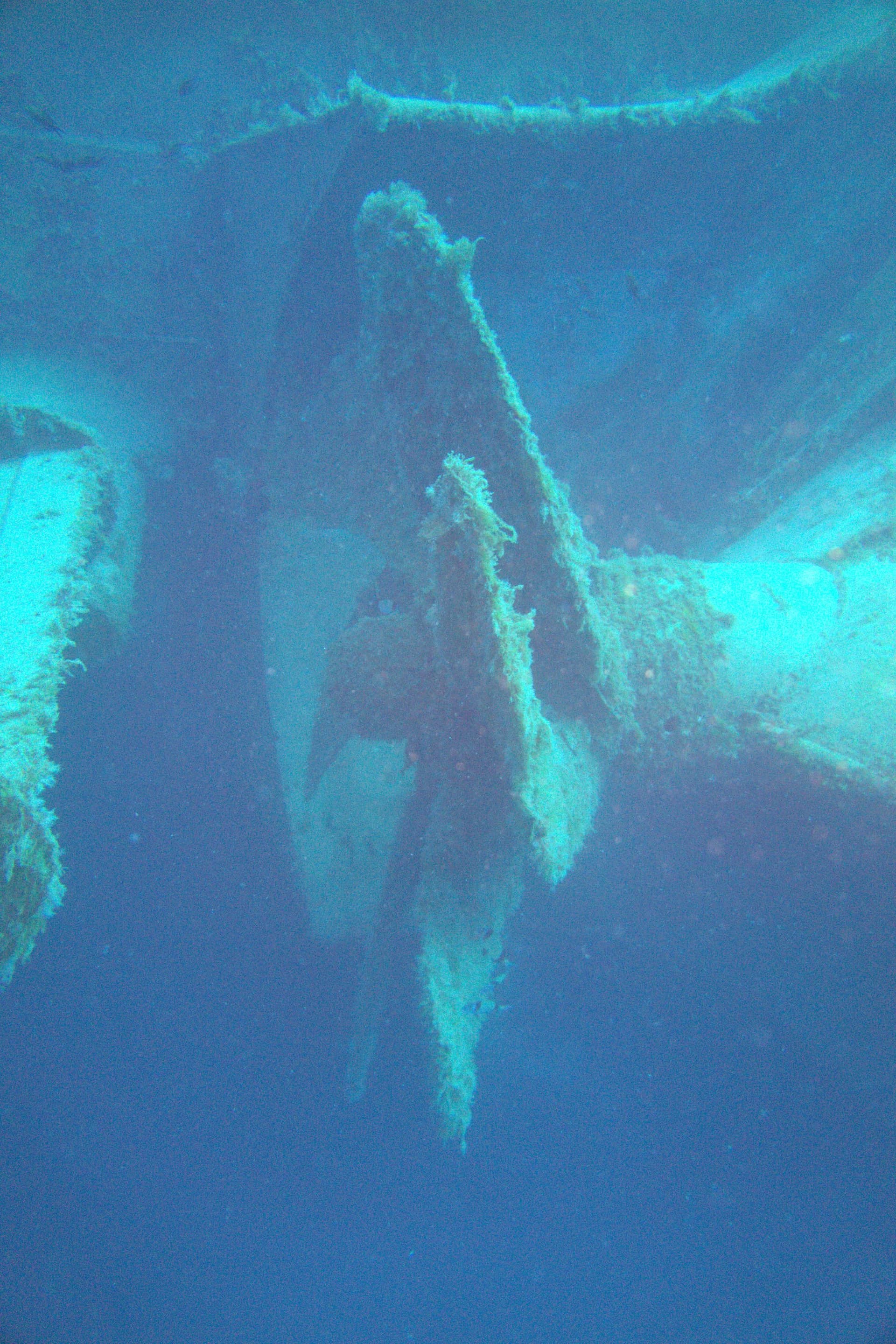
Three routes are standard, chosen by the operator at the briefing. The cargo-hold transit is the most-described in community accounts — entry through the cargo zone into a large internal tube, swimming along the upper part to keep decompression manageable, with trucks and vans piled against what is now the floor. The stern circuit is the local favourite — drop down by the stern castle, work back to the six-bladed propeller at 35 metres, then return through the recesses. The propeller is a defined turnaround, oversized enough that experienced divers have called it modern art crossed with mechanical perfection. The bridge-to-bow route is longer and gets mixed reviews, though the bridge does hold the often-cited detail of a telephone hanging off the hook as if someone had left in haste.
Light fades as you move along the hull. By 35-40 metres the colour has gone fully blue, and inside the cargo tube it can become very dark even with good outside visibility. The thermocline below 30 metres drops the temperature sharply. Bottom time is 20-30 minutes on air, longer on Nitrox. The closing moment many divers remember is a school of barracuda passing on the way back to the ascent line, drifting between the wreck and Dado Pequeño 200 metres away.
Three things stack up here that rarely appear together on a Mediterranean wreck: scale, accessibility, and the recency of the story. The Don Pedro is comparable in size only to the MT Haben in Genoa among Mediterranean recreational targets, and yet she sits five minutes by RIB from Marina Botafoch.
The wreck also rewards return visits. Five distinct routes have been documented, and few divers see the whole hull in one immersion, which is why most centres sell it as a 2-3 dive progression. Local divers who have been on the wreck since 2007 consistently describe the colonisation as improving year on year — sponges and algae carpeting the hull, scorpionfish settled as permanent residents on the deck and stern ramp. Twelve years on from the diving ban being lifted, the bridge telephone, the trucks in the cargo holds, and the intact six-bladed propeller still carry enough fresh detail to read as narrative while you swim them.
The Don Pedro was a Spanish-flagged Ro-Ro cargo ship — a roll-on/roll-off vessel built to carry trucks, cars and semi-trailers rather than passengers — completed at Astilleros de Santander in 1984. She measured 141.55 metres overall with a gross tonnage of 10,957 and carried IMO number 8030295.1 At the time of her loss she was registered in Las Palmas de Gran Canaria and operated by the Balearic freight line Iscomar on the Ibiza-Valencia run.1
She sailed from Ibiza at about 02:30 on 11 July 2007, pilot aboard, bound for Valencia.1 After clearing the harbour mole her track fell away to the east toward the Los Dados islets, and a late course correction came too late to clear the rocks; at 02:52 she struck the shallows around the Dado Pequeño islet, opening a hull breach that flooded progressively.1 A port tug took her in tow, but the list worsened, the captain ordered abandon ship, and she rolled onto her port side and sank at about 04:04, roughly 1.4 miles southeast of the Botafoch breakwater.2 All 20 aboard — 18 crew and 2 passengers — were recovered safe by the rescue craft Salvamar Markab.1
Spain's maritime accident commission (CIAIM) found the ship had been on an incorrect course, displaced east of the correct outbound track by an unexplained turn to port on leaving Ibiza, and that the error was not corrected in time; it identified no mechanical failure and good weather, pointing instead to inadequate voyage planning and captain fatigue as contributing factors.1 The ship's officers were later prosecuted, and at the 2017 trial the captain and second officer gave contradictory accounts of the navigation in the minutes before the grounding.3
She went down with about 150 tonnes of heavy fuel oil aboard; part of it escaped and formed a slick that reached the Talamanca, ses Figueretes and Platja d'en Bossa beaches.4 Over the following years a State-run salvage extracted about 93% of the hydrocarbons and cleared hazardous residues from inside the hull, which now rests on its port side at about 45 metres.4 The wreck was later declared clean and opened to recreational diving, with local operators dating routine dives from the early 2010s.
Plan multiple dives if the wreck is the reason you are on Ibiza. One dive covers a single route at most, which is why operators run it as a 2-3 dive progression. Nitrox is mandatory with Scuba Ibiza and recommended elsewhere; gas planning matters here in a way it does not at the easier sites in the Es Freus reserve.
Bring a primary torch and a backup — the interior cargo tube is dark enough that a single torch failure inside the hull is serious. A DSMB is on the standard PADI equipment list for ascents through active-port waters. A 5mm wetsuit with hood and booties is the summer minimum, thicker semi-dry below the thermocline in shoulder season. Pair the wreck with Dado Pequeño 200 metres away as the standard second dive. May-June and September-October are the windows local centres point visiting divers toward.
What makes this dive site stand out.
Built 1984, sunk July 2007, the largest diveable Mediterranean wreck accessible to recreational divers
Stern-to-propeller, cargo-hold transit, bridge-to-bow, orientation circuit, and sand dive at the base
Defined turnaround point on the stern circuit, photogenic and intact
98 transport platforms plus vehicles still piled against what is now the cargo-hold floor
Short RIB run from Marina Botafoch and Ibiza port; 25 minutes from Formentera
38.8733°N, 1.4721°E
Shoulder seasons offer warm water, peak visibility, and fewer dive groups. July-August water is warmest but the site is heavily booked.
Two-dive day pricing reported around €74 historically; full-rental rates higher. Verify directly with the operator.
AOWD minimum for external swim-arounds at 25-35m. Wreck Diver specialty required for any internal penetration. Deepest sand floor at 47m approaches or exceeds recreational limits.
Summary
Depth, scale, and overhead environment for penetration. Narcosis risk at 40m+ has been reported. Briefings define depth limits per zone.
Safety considerations
What can go wrong here, and what divers do about it. Conditions change - take the briefing from the operator on the day.
Book a guided dive at this site.
PADI 5 Star Dive Resort in San Antonio, operating since 2004 with a four-boat fleet covering Ibiza's west-coast caves, gorgonian walls, and the Don Pedro wreck.
SSI dive centre on Cala Vadella beach, southwest Ibiza, run by Pablo Suarez with shore access and boat trips to Es Vedra and the Don Pedro wreck.

PADI 5 Star center on Cala Pada beach, Santa Eulalia, Ibiza, with direct beachfront boat boarding and a multilingual team covering German, Dutch, English, and Spanish.

First PADI Eco Center in the Balearics and the only PADI 5 Star CDC on the islands, operating year-round from Marina Botafoch with two permanent Course Directors.
Get in touch to add or claim your dive center listing on DiveCodex.
Compulsory diving insurance applies (around €6/day if not already covered).
Among wrecks accessible to recreational divers, yes — at 142 metres long and just under 19 metres wide, it is widely cited as the largest diveable Mediterranean shipwreck. The MT Haben in Genoa, at around 300 metres, is larger but is not a standard recreational target. The accurate framing is largest diveable wreck accessible to recreational divers.
Advanced Open Water is the minimum for external swim-arounds at 25-35 metres, where most of the site's features sit. Wreck Diver specialty is required for any interior penetration. The deepest area at 47 metres approaches recreational limits. Scuba Ibiza requires Nitrox certification to dive the wreck; other operators strongly recommend it.
No. The wreck is 142 metres long and most features are at 35 metres or deeper, which limits bottom time to 20-30 minutes on air or longer on Nitrox. Most centres run it as a 2-3 dive progression, choosing one of the documented routes per dive — typically stern-to-propeller, cargo-hold transit, or bridge-to-bow.
May-June and September-October offer the best balance: warm water, peak visibility, and fewer crowds. July-August has the warmest water but heavy booking and weather variability. The wreck is theoretically diveable year-round, though winter operations depend on weather windows. Surface water can be as cool as 15°C in early spring.
Limited penetration is permitted via one rectangular entry point at 26 metres. Additional internal routes through the cargo hold with exits via side windows are reported by experienced divers. Hatches were welded shut and bridge windows barred during the cleanup. Wreck Diver specialty is required, a torch is essential, and operators run penetration as a guided dive only.
Dado Pequeño — the rocky islet the ship struck — sits 200 metres away and is the standard second dive of the day. It is multi-level from 4 to 30 metres with high large-fauna density, which complements the Don Pedro's depth and scale. La Plataforma, a shallower wreck between Ibiza and Formentera, is the other Ibiza wreck most often paired with the Don Pedro across a multi-day trip.
Don Pedro is the most visited single advanced dive on Ibiza, with operators across the island running trips. In season the site can see dozens of visits per week. Practically, multiple boats can be on the buoy in peak summer; shoulder seasons are noticeably quieter.
Log your dives - notes, photos, conditions and the marine life you saw - and share them as one public diver profile. What you share helps the next diver, too.
Log every detail
Depth, duration, conditions, gear, buddy, notes — all in one place. Import from Suunto and other dive computers.
Track marine life
Record species sightings on each dive. Build a personal catalogue of everything you've seen underwater.
Your public dive profile
Share your dive history, stats, and experiences with a profile page you control. Show the world where you've been.