

Tritón Diving Llafranc
Family-owned dive center in Llafranc since 1979, with 4.9/5 on 717 Google reviews, covering 11 sites across two Costa Brava dive areas.
SSI5 services5 languages
Also known as: Boreas, Boreas wreck, El Boreas, Pecio Boreas, Pellworm
Most-visited wreck on the Costa Brava: a 40 m former German Navy tugboat scuttled off Palamós in 1989, with five penetrable rooms from 18 to 32 m.
Last updated May 2026
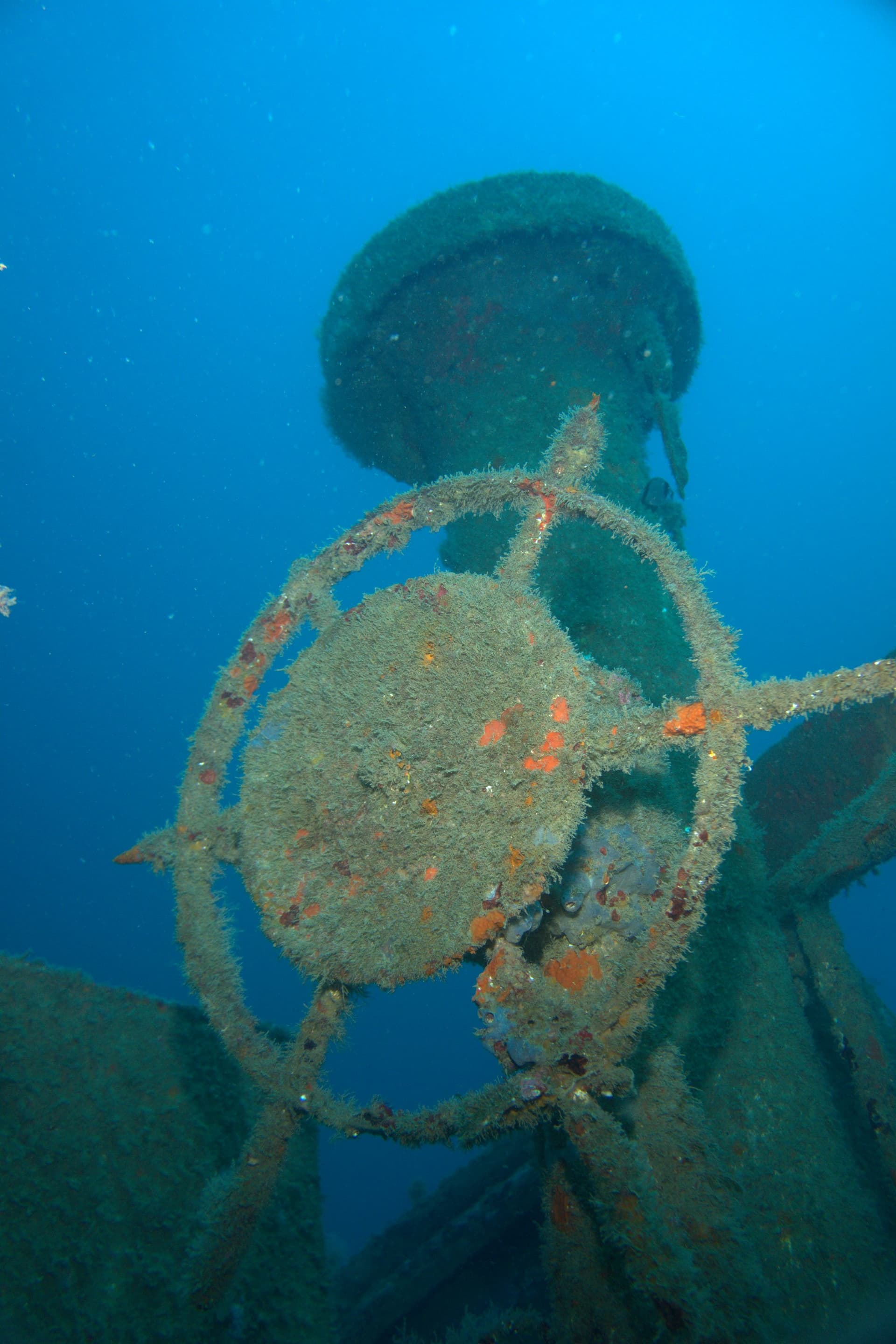
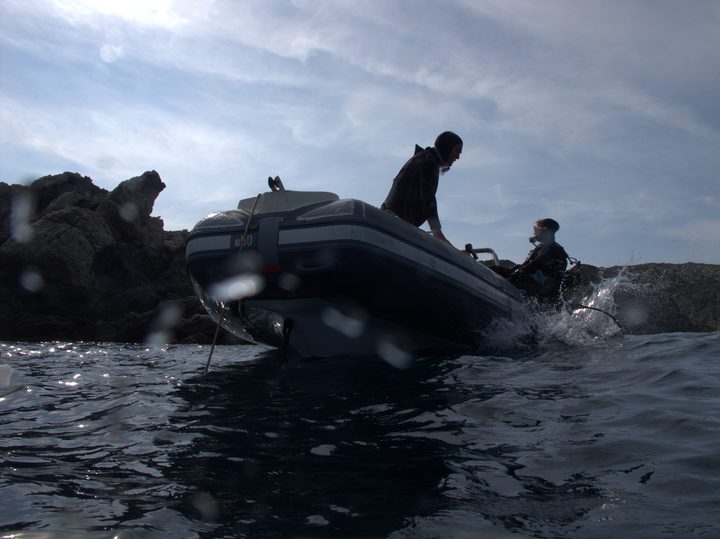
The boat ride from Port Marina runs roughly five minutes. You drop down a line into open blue, and within a dozen metres the silhouette of a tugboat resolves below: deck at 22 m, wheelhouse already visible above, propeller waiting at 32 m. Most centres run the same loop in the same order. Bow first, then aft along the deck to the propeller for the depth check, then back up to the hold (the air pocket is pointed out, not entered as a swim-through), the engine room with its resident congers, the kitchen, the captain's cabin with the bathtub still bolted in, and finally up to the bridge before the line. Forty metres of hull, slightly heeled to port, encrusted in sponges and bryozoans, with red gorgonians on shaded surfaces. The interior is what people come back for, and the briefing leans on small groups and good buoyancy because the engine room silts out fast on a sandy bottom. Boreas reads as a circuit, not a wall.
Three things separate Boreas from the rest of the Palamós wall and pinnacle dives. The penetrable interior, with five rooms cleared of hazards before scuttling, is the local rite of passage that many in Catalan diving forums describe from their first deep dive after Advanced. The compact depth band keeps the entire vessel in one no-deco-friendly window for a recreational AOW diver running a single dive. And the backstory carries weight that other Costa Brava sites simply do not have: a 1930s German Navy tugboat, post-war Atlantic crossings, a hashish seizure off Begur, and a deliberate scuttle in 1989. Few sites in this stretch of coast ask a diver to navigate inside a structure on a planned route, and even fewer hand them a complete history to think about while they do it.
The vessel began as Pellworm, a deep-sea tugboat launched in the 1930s for the German Navy and assigned to submarine school work. It survived the war, passed through American hands, returned to German service, and eventually entered civilian work under a Panamanian flag, picking up the name Boreas around 1980. In 1989 Spanish customs intercepted the ship off the coast of Begur with a hold full of hashish (community accounts cite roughly 500 kg) and seized it. After the hull was decontaminated and loose hazards removed, the vessel was deliberately scuttled off Palamós on 23 January 1989 to create an artificial reef. It has held that role for more than three decades, colonised by sponges, bryozoans, and gorgonians, with congers settled into the engine room.
Boreas earns its advanced rating from the prop, not the deck. The 32 m bend is where the no-deco window tightens, and the engine room is where buoyancy mistakes turn into a silt-out. A computer is essential, and nitrox is worth taking when a centre offers it. Bring a torch and a backup for the interior, plus a line cutter or knife for the loose pipes and cables on a 35-year-old hull. Carry an SMB; the wreck sits in a busy navigation corridor and surfacing in open water is not an option here. On summer weekends, agree on the ascent line with your buddy and centre before you splash, because several boats often share the wreck and ascending on someone else's line is the most-mentioned downside in local trip reports. Five Palamós centres rotate boats over the wreck week in, week out: Palamós Dive Center, Gidive, H2O Diving Center, Anemone Diving, and Fosca Divers.
What makes this dive site stand out.
Engine room, kitchen, captain's cabin with bathtub, hold with air pocket, and bridge.
Wheelhouse around 18 m, deck at 22 m, propeller at 32 m, all in one no-deco window.
The engine room is the canonical habitat, with congers in cracks throughout the hull.
Ex-Pellworm German Navy tugboat seized for hashish in 1989, then deliberately scuttled.
Reached in roughly 5 minutes from Port Marina Palamós.
Summer for warmest water, autumn for clearest visibility. Diveable year-round.
Boat dive with bottle. Verify current rates with each centre.
Advanced Open Water for the full route to the propeller and any interior penetration. Some centres run shallower deck-only dives for Open Water divers above 18 m, no penetration.
Summary
Propeller at 32 m gives a tight no-deco window; penetration adds overhead and silt-out risk; sandy bottom inside the engine room amplifies buoyancy errors.
Safety considerations
What can go wrong here, and what divers do about it. Conditions change - take the briefing from the operator on the day.
Book a guided dive at this site.
Family-owned dive center in Llafranc since 1979, with 4.9/5 on 717 Google reviews, covering 11 sites across two Costa Brava dive areas.
PADI, SSI, and CMAS center at Port Marina Palamós with year-round boat dives, small groups, and full MARES equipment. SSI Instructor Training Center.

Small SSI center on the Cala Gogo beachfront near Sant Antoni de Calonge, capping discover dives at two and courses at four, with the boat from Palamos.
Small-group dive center in Tossa de Mar with a year-round boat, max 4 divers per guide, PADI TecRec and CCR training, and on-site accommodation.

PADI 5-Star IDC Center at Port Marina Palamós with technical, recreational, and freediving programs and daily boat trips to Ullastres and the Boreas wreck.

SSI center at Port Marina Palamós, open every day of the year, with the 30-pax MANSABA boat covering Boreas, Ullastres, and Illes Formigues.
Dive center at Port Marina Palamós, 20+ years running, with a full published price list and DPV rental under owner Jordi.
Get in touch to add or claim your dive center listing on DiveCodex.
Upcoming trips to this dive site published by local centres.
Availability is read from each centre's public calendar and refreshed daily. Last checked October 16. Confirm with the centre before travelling.
Dive centres in Catalonia must require insurance from every diver on their dives, and must be able to offer a policy to anyone who has none.
Advanced Open Water for the full route to the propeller at 32 m and any interior penetration. Some centres run shallower deck-only dives above 18 m for Open Water divers, but the deeper rooms and the prop are off-limits at that level. Wreck Diver and Deep Diver specialties are recommended for full interior work.
Yes, five rooms are penetrable: engine room, kitchen, captain's cabin with the bathtub still in place, hold with a reported air pocket, and the bridge. Hazardous materials were cleared before scuttling. Centres run guided interior loops; solo penetration is reserved for divers with a wreck specialty and appropriate gear.
Originally Pellworm, a 1930s German Navy deep-sea tugboat used in the submarine school. After WWII it passed through American hands, returned to German service, and ended up in civilian use under a Panamanian flag as Boreas. Spanish customs seized it off Begur in 1989 for drug smuggling, decontaminated the hull, and scuttled it off Palamós on 23 January 1989.
Multiple boats often work the wreck at the same time on summer Saturdays. Local divers describe it as feeling like rush hour, with a real risk of ascending on the wrong boat's line if you lose track. Agree on the ascent line with your buddy and centre before you splash. Out of season the dive feels much quieter.
June through October for warmest water, with autumn often delivering the clearest visibility. Below the wheelhouse the water stays in the mid-teens even in August because of the thermocline, so plan thermal protection for 15-19 °C at depth, not surface temperature. The site is diveable year-round.
Some Palamós centres run it as a nocturna in summer. Wreck-specific night-active species are not well-documented here, so treat the night profile as a different look at the same hull rather than a known fauna catalogue, and follow the centre's briefing.
Log your dives - notes, photos, conditions and the marine life you saw - and share them as one public diver profile. What you share helps the next diver, too.
Log every detail
Depth, duration, conditions, gear, buddy, notes — all in one place. Import from Suunto and other dive computers.
Track marine life
Record species sightings on each dive. Build a personal catalogue of everything you've seen underwater.
Your public dive profile
Share your dive history, stats, and experiences with a profile page you control. Show the world where you've been.