

Tritón Diving Llafranc
Family-owned dive center in Llafranc since 1979, with 4.9/5 on 717 Google reviews, covering 11 sites across two Costa Brava dive areas.
SSI5 services5 languages
Also known as: Formigues Islands, Islas Formigues, Islas Hormigas, Les Illes Formigues
Offshore archipelago of 16 islets between Palamós and Calella with gorgonian-lined canyons, dense nudibranchs, and dual routes from 3 to 32 m.
Last updated September 2026
The boat moors east of the islets at a fixed buoy, and the line drops to a sandy-rocky cape at around 14 m. From here the dive forks. Keep the wall on your right and the northeast route opens through a series of canyons that drop toward 25 m, their flanks thickening with red gorgonians as the depth builds. Lobsters back into cracks. Moray eels and conger eels watch from gaps in the coralligenous rock. Nudibranchs work the walls in numbers most Costa Brava sites cannot match, and the route can extend to a deeper ridge where an 11 m tunnel between rock walls leads toward the deepest reported point near 42 m.
Turn the other way and the southwest route is wider and brighter. White gorgonians line walls down to about 20 m. Strong light contrasts cut through the canyon mouths, octopus settle in the shallows, and the rock gives way to posidonia meadows over sand on the seaward edge. The dive ends back at the buoy, typically around 50 minutes door to door.
Three things separate Formigues from its Palamós neighbours and they fit on one boat trip. The first is the dual-route system: the same anchorage feeds an Open Water route through wide canyons and an Advanced route through narrower gorgonian channels, so mixed-certification groups dive together without splitting boats. The second is macro density. Visiting divers report multiple nudibranch species per dive at this site specifically, not as a generic Costa Brava claim, with the 12 cm Doris on one Dutch diver's count standing out. The third is the surface scenery itself. Sixteen reddish and grey islets carry a small navigation lighthouse on the largest, and the seabed below has held two layers of history for centuries: the 28 August 1285 Battle of Les Formigues, when Admiral Roger de Lauria's Aragonese fleet defeated French and Genoese ships, and the 1921 collier Paz de Espalza, which sank near the islands. Local centre framing calls Formigues a mythical enclave of the Costa Brava; community accounts are more measured, framing it as a simple dive whose appeal is the beauty of the gorgonian walls. Both readings hold.
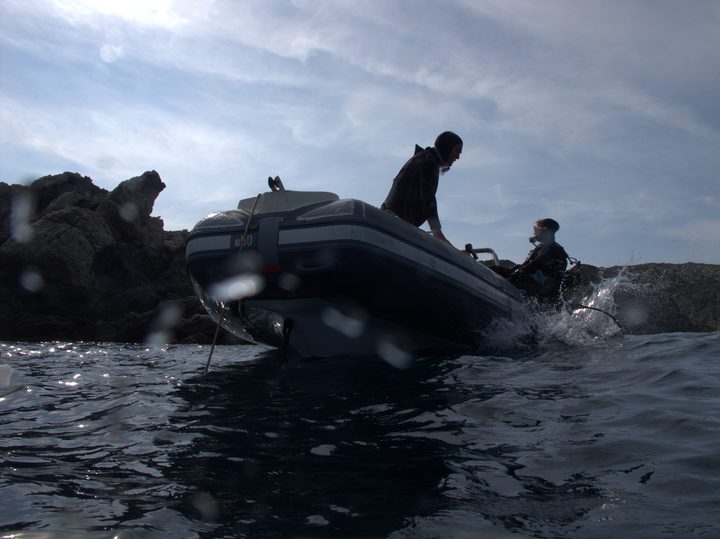
The islands sit exposed to easterly weather. Tramuntana, Gregal, and Levant winds at force 3-4 chop the surface and can cancel the crossing from port, so check the forecast before leaving. Centres from both Palamós and Calella de Palafrugell run boats here, which widens booking options compared with single-port sites. A torch is worth bringing for the canyons where scorpionfish flatten against the rock and nudibranchs hide in shadow. The site can get busy in high season with multiple boats moored above the canyons; early departures avoid the crowd.
What makes this dive site stand out.
Paramuricea clavata thickens between 20 and 32 m on the northeast canyon walls.
Multiple nudibranch species per dive, with one diver report citing a 12 cm Doris.
Wide southwest canyons for Open Water; narrower northeast canyons for Advanced.
Reddish and grey islets with a working lighthouse on the largest, Cap de Planes.
Surface scenery includes the 1285 Aragonese naval battle site and the 1921 Paz de Espalza wreck.
16-islet archipelago with canyons, gorgonians, posidonia meadows
41.8625°N, 3.1867°E
Warmest water and best visibility. Diveable year-round, weather permitting.
Verify current rates with the dive centre.
Open Water divers stay on the southwest route through wider, shallower canyons. The northeast canyon system and any deep extension beyond 30 m are Advanced territory.
Summary
Easy on the southwest route through wide canyons to about 20 m, moderate on the northeast canyons to 32 m. Variable surface conditions add challenge on exposed easterly days.
Safety considerations
What can go wrong here, and what divers do about it. Conditions change - take the briefing from the operator on the day.
Book a guided dive at this site.
Family-owned dive center in Llafranc since 1979, with 4.9/5 on 717 Google reviews, covering 11 sites across two Costa Brava dive areas.
PADI, SSI, and CMAS center at Port Marina Palamós with year-round boat dives, small groups, and full MARES equipment. SSI Instructor Training Center.

Small SSI center on the Cala Gogo beachfront near Sant Antoni de Calonge, capping discover dives at two and courses at four, with the boat from Palamos.

PADI 5-Star IDC Center at Port Marina Palamós with technical, recreational, and freediving programs and daily boat trips to Ullastres and the Boreas wreck.

SSI center at Port Marina Palamós, open every day of the year, with the 30-pax MANSABA boat covering Boreas, Ullastres, and Illes Formigues.
Dive center at Port Marina Palamós, 20+ years running, with a full published price list and DPV rental under owner Jordi.
PADI 5 Star Dive Center in Calella de Palafrugell, Costa Brava, operating since 1969 with beach-launch boat access to Ullastres and the Boreas wreck.
Get in touch to add or claim your dive center listing on DiveCodex.
Upcoming trips to this dive site published by local centres.
Availability is read from each centre's public calendar and refreshed daily. Last checked October 16. Confirm with the centre before travelling.
Dive centres in Catalonia must require insurance from every diver on their dives, and must be able to offer a policy to anyone who has none.
Two main options from the mooring buoy. The southwest route follows wider canyons with white gorgonians to about 20 m and suits Open Water divers. The northeast route descends through narrower canyons lined with red gorgonians to 25-32 m, with lobsters and nudibranchs in every crevice. Advanced divers can extend further to a ridge with an 11 m tunnel.
The canyon walls and crevices concentrate small life at accessible depths. Nudibranchs are the headline subject, with multiple species per dive and one visiting diver reporting a 12 cm Doris. Tube worms, flatworms, and scorpionfish add to the macro portfolio. The gorgonian walls also work for wide-angle if you switch lenses between dives.
No. A reserve proposal of more than 3,000 hectares was floated in October 2009 and met with public opposition, including a roughly 1,000-strong demonstration in Palamós that November. The Spanish government shelved the plan in August 2011 for lack of funds. The Amics de les Illes Formigues association continues to advocate for protection.
On 28 August 1285, Admiral Roger de Lauria's Aragonese fleet fought and defeated French and Genoese ships near these islets during the Aragonese Crusade. The collier Paz de Espalza, which sank in 1921, also lies in the surrounding seabed, though it is not commonly described as a discrete dive.
Depths start at the surface, with the most common diving between 12 and 25 m. The northeast canyons reach 32 m with dense red-gorgonian growth. A deeper extension via a tunnel route is reported beyond 38 m, though most centres cite 30-38 m as the practical floor.
Yes. The southwest route through wider canyons stays above 20 m with good ambient light and suits Open Water divers. Centres from both Palamós and Calella de Palafrugell run trips here for all levels. The deeper northeast canyons and the tunnel route require Advanced certification.
June through October for warmest water and best visibility. Summer visibility averages 15-20 m and can spike higher after calm spells. The site is exposed to easterly winds, so calm days offer the best surface conditions and shortest crossings. Local centres operate year-round.
Log your dives - notes, photos, conditions and the marine life you saw - and share them as one public diver profile. What you share helps the next diver, too.
Log every detail
Depth, duration, conditions, gear, buddy, notes — all in one place. Import from Suunto and other dive computers.
Track marine life
Record species sightings on each dive. Build a personal catalogue of everything you've seen underwater.
Your public dive profile
Share your dive history, stats, and experiences with a profile page you control. Show the world where you've been.