
Aldora Divers
Downtown Cozumel operator running six-diver boats on high-pressure steel tanks, with gear set up before divers board and cleaned after.
PADI7 services4 languages
A 22 km line of wall and drift diving down the leeward coast of a Mexican Caribbean island, inside a national park that rests its reefs in rotation.
Last updated October 2026
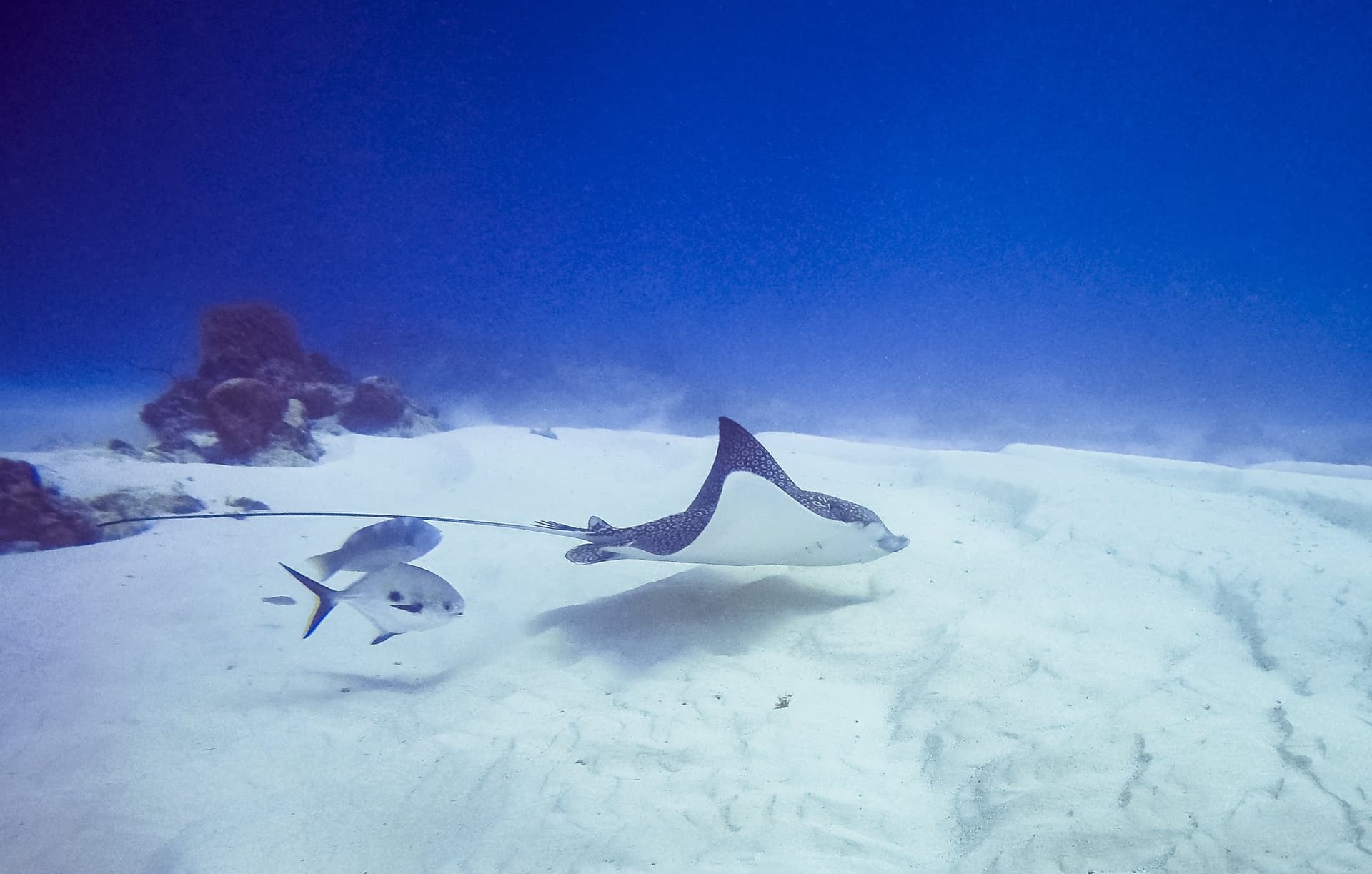
Twenty-two kilometres of reef runs down the island's leeward coast, and the water moves along all of it, south to north, at about a knot and a half. You get dropped up-current and carried. You do not swim a route here, you ride one. A diver who has never drifted before starts on the inner reefs at Paraíso, Chankanaab or Yucab, where the flow is mild and the coral heads sit between 10 and 20 metres.
The other half of the geography is the channel. The island is separated from the mainland by deep water and the reef line runs along its rim, so a dive that begins on a coral shelf at 12 metres finishes looking over a drop into blue. Palancar is one reef of about five kilometres sold as four named sections, Jardines, Cuevas, Herradura and Ladrillos, which is why a week of two-tank mornings can cover it without repeating a dive. Santa Rosa Wall is the classic drift and can run fast enough to clear the reef in fifty minutes. At the southern tip, Punta Sur holds the Devil's Throat, an inclined tunnel that exits on the wall between 35 and 43 metres; divers who know the island well rate the reef around it above the tunnel, and several operators decline to run it at all. The C-53, a former minesweeper, sits upright on sand off Chankanaab with holes cut through her for divers.
Cozumel is a reef and wall destination, not a big-animal one. The splendid toadfish is the animal to want, wedged under a coral ledge at 10 to 15 metres with only its striped face showing, and it is found almost nowhere else and reliably only here1. Nurse sharks asleep under ledges are the shark you meet. Reef condition is argued over by divers who have been coming for years. Some park reefs have lost up to 90% of the coral species susceptible to stony coral tissue loss disease2, the brain corals worst of all, and the rotating closures that answered it have run since 20193.
Fly into Cozumel International or take the ferry from Playa del Carmen.
The park does not cover the whole west coast. Its boundary starts at the north tip of Paraíso reef and runs south around the island's tip4, so the northern sites operators sell as advanced trips, Villa Blanca, San Juan, Barracuda and Cantarell, lie outside it, where fishing is permitted and no wristband applies.
Inside it, an authorised guide is mandatory by law on every dive, and that guide has to run a buoyancy check before any reef dive and can stop a diver who cannot hold it5. The park accredits the guide and not the diver: it sets no certification level for divers at all, so the Advanced Open Water card operators ask for at Punta Sur or the Devil's Throat is their rule and the park sets none.
Park entry is a federal duty under Article 198 of the Ley Federal de Derechos: 225 pesos per person per day for 20266, collected through your dive shop as a wristband good for one day7. Mexican nationals and foreign residents pay half on proof8.
Three of the park's fourteen reef complexes are resting at any time, in blocks of about two months, under a programme that began in 2019 against bleaching and coral disease3. No government page publishes the year's calendar, so ask which reefs are open before you build a trip around Palancar or Colombia.
The far south carries two more rules worth knowing before you book: six divers per guide instead of eight, and no night diving at all at Punta Sur or Colombia5. Sport diving in the park is capped at 45 metres.
Mornings run two tanks, deep first and shallow second, with sites chosen by agreement on the boat and not by your booking. November to May gives the settled weather and the clearest water, December to March the strongest current and the best visibility together, and the same winter months bring El Norte, the north wind that closes the port and cancels diving for days. San Miguel has two hospital-based recompression chambers, one of them running since 1987.
A flat limestone island at the northern end of the Mesoamerican Barrier Reef, separated from the mainland by a deep channel. The dived terrain is spur-and-groove coral shelf on the inshore side and a wall on the channel edge, cut by swim-throughs, tunnels and coral buttresses, most dramatically at the southwest end.
The diving here splits into 3 zones:
A decorated WWII minesweeper, upright on sand at 24 m
A Palancar dive where the wall is optional
A reef tunnel that exits onto an open wall near 40 m
Swim-throughs in the reef crest beside a vertical wall
Shallow Cozumel drift with splendid toadfish under the coral heads
The deep, boulder half of Chankanaab reef, beside its own shallow half
The wall half of Colombia reef: pinnacle caves and swim-throughs past 27 m
A mild coral-head drift over white sand, out on the platform
A calmer Cozumel drift for splendid toadfish and dense macro life
A deep wall edge with an arch cut through it, at Cozumel's southern tip
The far end of Palancar, dived for its towers and its brick field
Wide, sunlit swim-throughs on a Cozumel wall
The Palancar drop where the deep half and the shallow finish are one dive
A shallow ridge-and-sand drift on the reef where the national park begins
Fish-packed reef breaks and nurse sharks on a Cozumel drift
Cozumel's second-dive reef of overhangs and small caves, not a wall
One reef sold as two dives: an easy shelf and a 36-40m advanced wall extension
One reef, two products: an easy shelf and a wall that keeps going past 30m
Cozumel's easiest-depth reef with some of its fastest current
Book online or contact a centre that dives this area.
Downtown Cozumel operator running six-diver boats on high-pressure steel tanks, with gear set up before divers board and cleaned after.
Cozumel dive centre inside a north-shore beach club, running boats south to the park reefs, with coral and fish identification taught on ordinary dives.

Boat diving from San Miguel de Cozumel with a stated ceiling of two divers per guide, at an SSI Diamond centre that also teaches coral identification.
Beachfront hotel-and-dive-shop resort on Cozumel's south road, boat trips to Palancar and Santa Rosa reefs plus house-reef night dives from its own dock.

Beachfront dive centre at Hotel Playa Azul in Cozumel's north hotel zone, running a six-diver boat that also sells the northern reefs most operators skip.
Cozumel centre on the Casa del Mar dive dock in the southern hotel strip, where divers pick the sites, with a house reef off the end of its own pier.

SSI-affiliated small-boat operator near Cozumel's Ferry Pier since 1995, reviewers crediting named instructors for patient, safety-first guiding.
Get in touch to add or claim your dive center listing on DiveCodex.
December to March brings the strongest current and the clearest water together, and also El Norte. March to June and November give the mildest, most predictable current.
What can go wrong here, and what divers do about it. Conditions change - take the briefing from the operator on the day.
National park
Management programme and rules (1998)Federal fees law, park entryPark decree (1996)Checked: Oct 2026
National rules also apply: Rules and permits in Mexico
Three of the park's fourteen reef complexes are resting at any given moment, in blocks of roughly two months, and which three depends on when you come. The rotation runs in a repeating order, so Chankanaab tends to rest in midwinter, Cedral and La Francesa in late winter, Dalila and two Palancar sections in spring, Paraíso in early summer, Palancar Cuevas and Ladrillos with Colombia in late summer, and San Francisco and Santa Rosa in autumn. No government page publishes the year's calendar; the park announces each cycle as it starts and dive shops and the local press pass it on, so ask your operator which reefs are open for your dates before you build a week around one of them.
Divers pay 225 pesos per person per day for 2026, a figure that comes from 225.56 and is charged rounded to the nearest five, though some visitors pay less. Entry is a federal duty under Article 198 of the Ley Federal de Derechos, not a price the park sets, and the law gives Mexican nationals and foreign residents in Mexico a 50% reduction on proof of nationality or residence, with 75% off for students and teachers and full exemption for under-12s, people with a disability, INAPAM cardholders, pensioners and retirees. Divers and snorkellers pay the same rate. It is collected through your dive shop as a wristband good for one day, and shops usually quote it in dollars at around 10 to 13 a day, which is their own conversion of the peso figure. The rate moves: it was 108.66 pesos in 2024. If you spend more than about seventeen days a year inside Mexican protected areas, the annual Pasaporte de la Conservacion at 3760 pesos covers all of them except Revillagigedo.
Yes, with the caveat that you should not start at the wrong end of the island. The current here almost always pushes you along the reef instead of against it, which makes drift diving easier to learn than its reputation suggests, and the inner reefs at Paraíso, Chankanaab, Yucab and Tormentos run mild at 10 to 20 m. Palancar Gardens and the shallow section at Colombia are also within reach on a calm day. What is not is the far south: Punta Sur, Colombia's deep wall and Maracaibo carry midwater current strong and unpredictable enough that a boat can miss the site entirely, on top of profiles past 30 m. Operators route new divers to the inner reefs by default.
Water sits at 25 to 27 C in winter, 27 to 28 C in spring and autumn and 28 to 30 C from June to October, with deeper reef sites a degree or two cooler than the surface. A 3 mm full suit works all year, though repetitive diving in January and February is more comfortable with a 5 mm or a hooded vest, and January mornings have measured as low as 24 C. Visibility is the reason people come back: 30 m is a very good day, 20 to 25 m is normal, and the dry season from November to May holds the best of it. The 45 to 60 m figures that circulate in marketing are not what to plan on. Operators name rain and freshwater runoff as what cuts visibility on a poor day.
On the second, shallow dive of the morning, not on a special trip. The species lives at 8 to 25 m and usually 10 to 15, wedged into a den under a coral head at the sand-and-rubble edge of the reef, and the giveaway is the sloping patch of sand outside the hole. By day you see the face and not much else: a flat head with yellow fins and blue and white stripes. Guides on the inner reefs know individual dens and will point them out. It is listed by the IUCN as Endangered, an assessment made in 2012 and flagged by the IUCN itself as needing updating, and it is found almost nowhere else and reliably only here. The park's rules prohibit disturbing or removing marine organisms in any way and single out animals in their refuges, which is exactly what a toadfish in its den is5. Some guides still coax them out with a lure or a mirror. Flash is not addressed either way.
Not on the deepest one, and this catches people out because the intuition runs the other way. EAN32, the standard mix on the island, has a maximum operating depth of about 34 m (112 ft) at a PO2 of 1.4, which is shallower than the Devil's Throat exit at 35 to 43 m. Diving it on 32% would put you past the oxygen limit at exactly the moment you are hovering below the exit waiting for the rest of the group, and experienced local divers deliberately save their one air fill of the trip for that dive. Nitrox earns its keep on the repetitive shallow dives, where it buys no-decompression time on the second and third tanks of the day. Gas volume is the real constraint at the deep end, which is why larger steel cylinders are a standing local request.
El Norte is the winter north wind, and it can. When it blows the port closes and no boat leaves, sometimes for days, and it turns up most often between December and March. That is the same window sold as peak season for visibility, and both things are true at once: the clearest water and the strongest current arrive with the weather most likely to stop you diving. Divers who come here regularly in winter build spare days into the trip, and some prefer the shoulder months of March to June and November for that reason. Hurricane season is a separate risk, running 1 June to 30 November and peaking in September.
Ask the shop you are booking with, and treat their answer as the current one. Two authorities sit over that dive, not one. The park's management programme allows night diving on the reefs it names for it, and prohibits it outright in the restricted-use zone that covers Punta Sur and Colombia5. Taking a boat out of San Miguel after dark is the port authority's permission to give rather than the park's, which is why the answer can change without anything in the park's rules changing. Night dives on the inner reefs are sold on the island, so ask your operator what is running before you plan an evening around one.
No, and it is not what it was either. Stony coral tissue loss disease reached these reefs around 2018 and some park reefs lost up to 90% of the coral species susceptible to it, with brain corals the visible casualty: the affected ones are now rock with algae over them. Divers who have come here for fifteen years disagree openly about the trend since, some describing the best conditions they have seen after the closures and the pandemic quiet, others saying they stopped coming. What is documented is a reef under pressure with a management response running against it, which is what the rotating closures are, and a reef line long enough that condition varies a lot between sites.
Mostly nurse sharks. They sleep under ledges and on the sand and are a routine sighting on the inner reefs, but Cozumel is not a shark destination and divers who come here regularly say so plainly. The bull shark aggregation that people associate with this coast is at Playa del Carmen, on the mainland across the channel, and Cozumel operators sell it as a ferry day trip off the island, not as a dive here. The same applies to whale sharks, which gather far offshore of Isla Mujeres in summer as a snorkelling trip where diving is not permitted. What you get here instead is eagle rays at the north end in winter, turtles all year and the toadfish.
Yes, two of them, both hospital-based and both in San Miguel. One belongs to the Costamed hospital and the other to Cozumel International Hospital, which has run a chamber since 1987. Higher counts you may see quoted for the island fold in hyperbaric oxygen therapy units at clinics, which treat other conditions and are not the same facility. Carry dive insurance with hyperbaric cover regardless, confirm with your operator which hospital they use, and remember that the far-south sites are a long boat ride from town.
Log your dives - notes, photos, conditions and the marine life you saw - and share them as one public diver profile. What you share helps the next diver, too.
Log every detail
Depth, duration, conditions, gear, buddy, notes — all in one place. Import from Suunto and other dive computers.
Track marine life
Record species sightings on each dive. Build a personal catalogue of everything you've seen underwater.
Your public dive profile
Share your dive history, stats, and experiences with a profile page you control. Show the world where you've been.