
DIVECODEX FOR CENTERS
Add your dive center
Get in touch to add or claim your dive center listing on DiveCodex.
Contact us
FreeReach divers
Two contrasting offshore islands at Egypt's far south: Rocky for current-swept shark walls, Zabargad for turtle bays and a Russian wreck. Liveaboard only.
Last updated October 2026
Everything at Rocky Island starts with the current. It usually runs south to north, hits the islet hardest on its western and eastern sides and shifts with the island's exposure, so guides pick the entry on the day and the dives are drifts along walls that fall away past 600 metres. The islet is tiny, described as anything from 200 to just over 500 metres long, and sits at the far southern end of Egypt's Red Sea, 60 to 70 kilometres offshore near the Sudanese border. The area's big animals belong here: oceanic whitetips and grey reef sharks patrol the walls, hammerheads appear in the warmer months, usually deep, and tiger sharks have turned up on some autumn trips. Sightings vary by trip: some divers have had sharks on every dive and others on only a few.
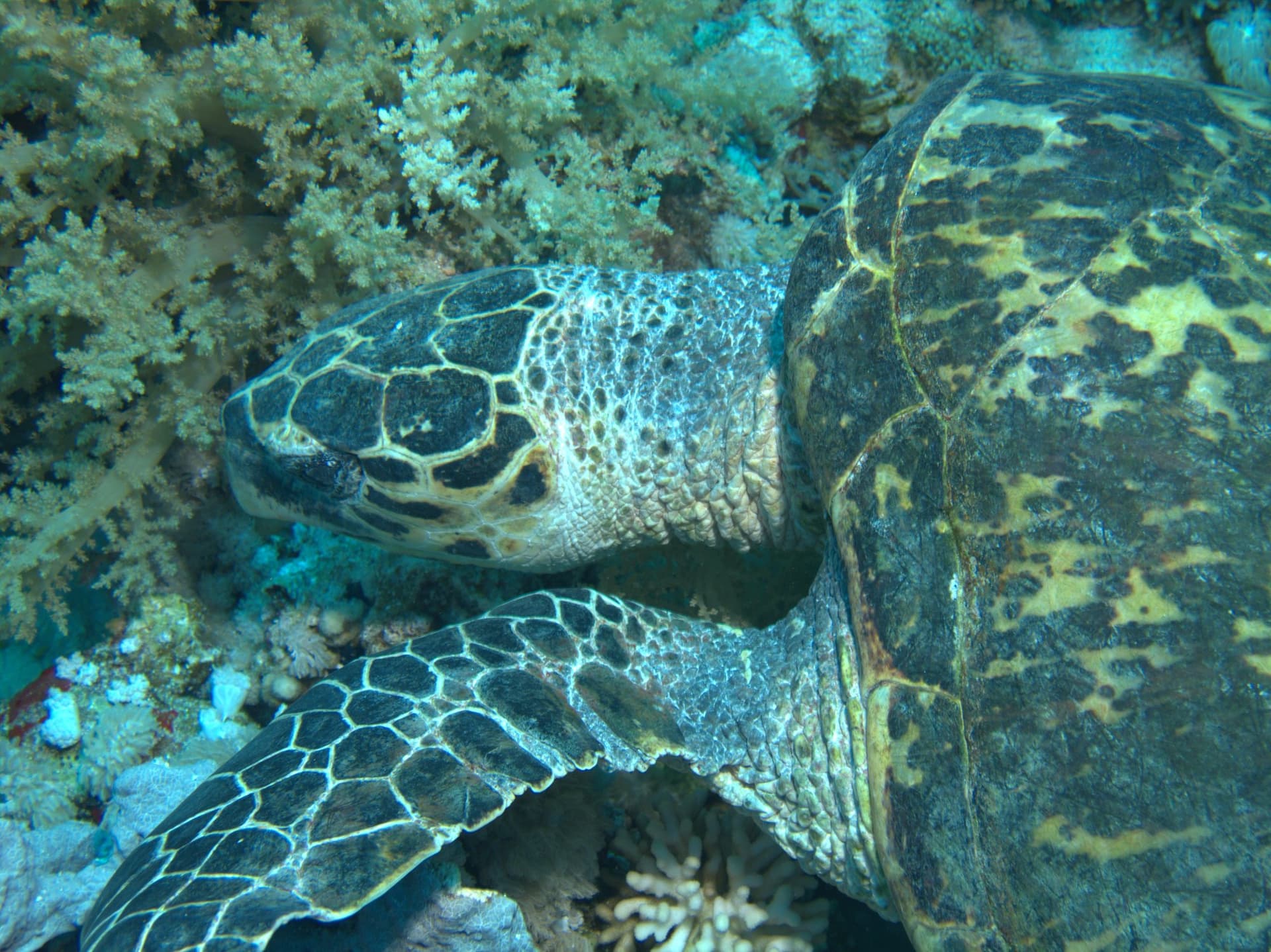
Zabargad lies 3 to 5 kilometres to the northwest, and its bays give the week a sheltered counterpart. It is a much larger, mountainous island, an uplifted block of Earth's upper mantle ringed by a turquoise lagoon, and it was a gem island long before divers arrived: peridot was mined here from Ptolemaic times. Turtle Bay holds cuttlefish, octopus, blue-spotted rays and crocodilefish, green turtles nest on the beaches in August, and coral gardens, canyons and walls fill the rest.
In the western bay a Russian MOMA-class (Project 861M) survey ship, reportedly fitted for signals intelligence, sits upright in 24 metres with its mast breaking the surface at low tide. Divers call it the Russian Wreck or the Khanka, a name nobody has proven, and wreck-trained divers can enter the pilothouse and engine room. One liveaboard week can mix hard drift dives at Rocky with easy reef and wreck days at Zabargad within the same 24 hours.
Egypt declared both islands marine reserves with strict regulations in 1983, and they belong to the offshore group known as Marine Park 2. The southern reefs have been under heat stress: divers returning in December 2024 described them as in very poor condition, with water above 30 C blamed, so expect coral that is patchier than older write-ups suggest.
Deeper still, the SS Maidan, a steamer lost on the islet's reef, sits 80 metres down and more, to 120 on its south side, a dive for technical divers.
Fly into Marsa Alam (RMF), the nearest airport, and board at Port Ghalib or Marsa Alam. Hurghada works as an alternative arrival, with a drive of about three hours south to Port Ghalib. Both islands are uninhabited and there is no day boat, so every dive runs from a liveaboard on a week-long far-south itinerary, often combined with St John's Reef and Fury Shoal. Book the boat and the route together, and confirm the route actually includes this pair. Boats usually spend the night at Zabargad or St John's, since captains prefer those moorings to Rocky.
Operators expect Advanced Open Water and real drift experience, on top of the park's own logged-dive minimum. Zabargad's sheltered bays suit a moderate diver, while Rocky's exposed walls are advanced. March to May and September to November balance calm crossings, warm water and good visibility, and the exposed islands can be undiveable in strong weather.
Rocky is a small fossil-coral islet ringed by a narrow plateau and walls that drop past 600 m; Zabargad is an uplifted block of Earth's upper mantle ringed by a turquoise lagoon.
The diving here splits into 2 zones:
Book online or contact a centre that dives this area.
Safari boats based elsewhere that run itineraries to these dive sites.
41m, 26-guest wooden liveaboard running Master Liveaboards' full Egyptian Red Sea catalogue from Hurghada and Port Ghalib, from northern wrecks and Tiran through the offshore Brothers, Daedalus and Elphinstone to the far-south Rocky, Zabargad and St John's reefs.

Compact 18-guest, 9-cabin wooden liveaboard focused on Deep South and St John's routes from Port Ghalib, reaching remote Rocky Island and Zabargad.

26-guest sister of Superior with Junior and Executive suites, ranging across Emperor's Egypt catalogue from northern wrecks and offshore Brothers, Daedalus and Elphinstone to the Deep South.

Red Sea Explorers' largest liveaboard: 37.5m, 28 guests across 14 cabins, running the same GUE-leaning offshore and deep-south Egypt route catalogue.

36m, 22-guest steel liveaboard with a dedicated camera room and gas-blending deck, running the Brothers, Daedalus, Deep South and Fury Shoal weeks.

40m, 25-guest steel liveaboard, built 2023 for the Deep South: Daedalus, Rocky Island, Zabargad and St John's, plus Fury Shoal, from Port Ghalib.

Red Sea Explorers' tech flagship: a 37m, 22-guest steel liveaboard with a full trimix/CCR fill station and scooters for offshore and deep-south Egypt safaris.

131ft (40m), 26-guest steel Aggressor liveaboard for the remote Deep South Red Sea, running two alternating Saturday-to-Saturday itineraries from Port Hamata: Rocky & Zabargad Islands, and Elba Reef, reaching Egypt's southernmost reefs and St John's.
Strong winter winds, roughly November to April, can reroute or cancel the exposed offshore legs. Autumn into early winter suits oceanic whitetips and tiger sharks, and May and June bring hammerheads nearer the surface.
What can go wrong here, and what divers do about it. Conditions change - take the briefing from the operator on the day.
National park
Park leaflet (Arabic)Visit fees (Arabic)Protectorates list (English)Checked: Oct 2026
National rules also apply: Rules and permits in Egypt
It is a Soviet-era MOMA-class (Project 861M) survey ship, identified by a communications-vessel hull designation and usually described as a Cold War signals-intelligence vessel. Khanka is the popular name, believed but never proven: the ship listed under that name in shipping records does not match this type, and no record of this ship's loss survives. It lies upright in 24 m in Zabargad's western bay with its mast breaking the surface at low tide, and the pilothouse and engine room can be entered by wreck-trained divers.
Possibly, though never reliably. Tiger sharks have been reported at Rocky in autumn and early winter, and some trips have had one on several dives. Other divers who spent two full liveaboard weeks there saw sharks on only a few dives. Oceanic whitetips are the steadier bet, present through the year and most often seen from October to March.
No. The British cargo steamer SS Maidan struck Rocky's reef on 10 June 1923 while steering for the neighbouring island and sank. She sits 80 m down and more, to 120 m, well beyond recreational limits, and was found again in 2003. She is a technical-diving target only.
Divers disagree. Some rate this corner among the best diving in the Red Sea, while others found the reef-and-wall routine wearing by the third day, and divers who put it beside Daedalus often rate it quieter for sharks. The wreck and the turtle bays supply the variety, and the sharks are a bonus on the days they show. Combining the pair with St John's Reef or Daedalus on the same trip changes the rhythm.
In antiquity the island was known as Topazios, and the gem mined here was peridot, a green olivine once called the topaz of the ancients. Mining is reported from the Ptolemaic era, around 300 BC, into the twentieth century. The rock itself is unusual: an upthrust block of Earth's upper mantle, ringed by a turquoise lagoon.
Also known as: Rocky Island, Zabargad, Zabarjad
Log your dives - notes, photos, conditions and the marine life you saw - and share them as one public diver profile. What you share helps the next diver, too.
Log every detail
Depth, duration, conditions, gear, buddy, notes — all in one place. Import from Suunto and other dive computers.
Track marine life
Record species sightings on each dive. Build a personal catalogue of everything you've seen underwater.
Your public dive profile
Share your dive history, stats, and experiences with a profile page you control. Show the world where you've been.