
Anthia Diving Center
SSI Instructor Training Center at Sesimbra harbour, running boat dives to Batelão and the River Gurara wreck since 2004, with technical diving to Trimix.
SSI8 services2 languages
A protected marine park off Sesimbra, with boat trips to the River Gurara wreck and macro-rich reefs, plus a shore dive at Portinho da Arrábida.
Last updated September 2026
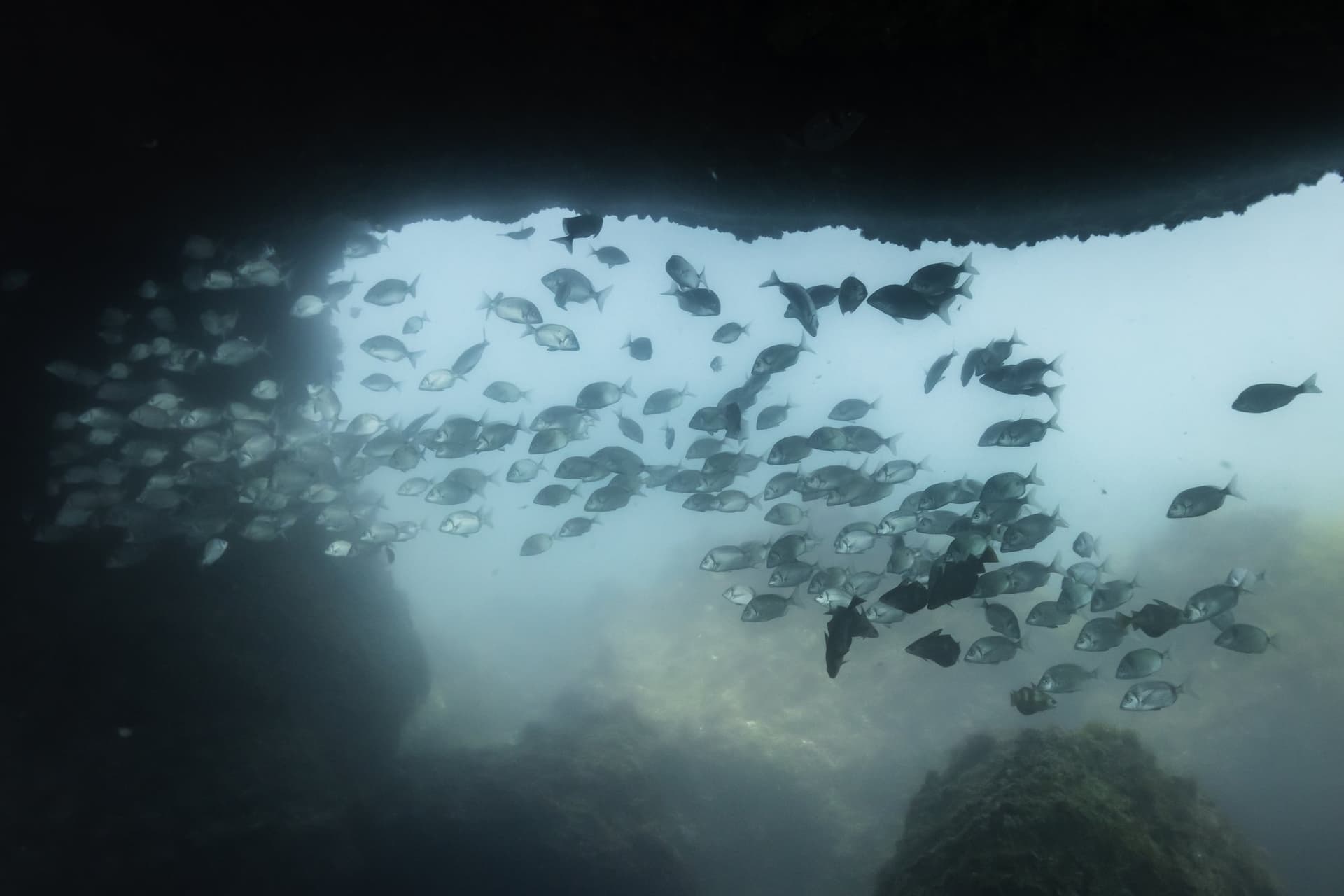
Sesimbra's dive ground sits entirely inside the Professor Luiz Saldanha Marine Park, the seaward extension of a nature park protected on land since 1976 and given its own marine designation in 1998.1 Two very different ways to dive it sit side by side. Every named site out of Sesimbra's own harbour runs by boat or zodiac, typically a run of 10 to 30 minutes, to reef, wall and one flagship wreck. Portinho da Arrábida, 15 to 20 kilometres away and administratively part of Setúbal's own municipality, not Sesimbra's, is the separate shore and snorkel hub, a shallow stairway entry running 3 to 8 metres.
The wreck is River Gurara, a 175-metre Nigerian cargo ship that went down off Cabo Espichel in February 1989 and now lies broken across roughly 20 to 33 metres, advanced divers only. Closer to the harbour, Jardim das Gorgónias is an easy orientation dive whose gorgonian cover presumably, though unconfirmed, gives the site its name, and Pedra do Meio works as a nursery reef, where octopus, cuttlefish and squid lay their eggs at the shallow end. A large grouper works the wreck rubble; a greater pipefish and a short-snouted seahorse turn up on the reef, and gorgonian gardens carry the white sea fan documented along the wider Arrábida coast. Beyond the named sites, further points toward Cabo Espichel range from shallow beginner rocks to a technical wreck past 50 metres, for divers who want to go looking.
Open Water certification, or its equivalent, covers Sesimbra's general boat-dive menu, and a Try Dive product exists for anyone without a card; the River Gurara wreck's deeper, split profile calls for Advanced Open Water at the stern and a deep-diving specialty beyond it for the bow. No separate marine park entrance fee or permit applies to diving here; the dive centre's price is the only cost. One 2026 rate card puts a single boat dive at about EUR40 and a double at EUR70, with River Gurara priced higher as a longer, dedicated trip; treat that as that one centre's own rate, since prices elsewhere may differ.
Sesimbra sits roughly 36 to 44 kilometres from Lisbon's Humberto Delgado Airport: a public bus covers it in about an hour, and a taxi or ride-hailing car direct to a dive shop runs roughly 30 to 35 euros; no rental car is needed.
Several independent centres run day boats from the harbour, and at least one sells River Gurara as a separate, longer trip; Portinho da Arrábida's diving runs through a single dedicated operator, where spearfishing is prohibited under the site's nature-reserve status. Start with Jardim das Gorgónias or Pedra do Meio and work up to the River Gurara wreck once you hold the right certification for it.
The rocky Arrabida-Espichel range: rock and cliff bottoms, walls and caves along most of the coast, giving way to mixed sand and rock near the harbour mouth.
Easy-orientation reef dive around a gorgonian-covered rock
Sesimbra's easy reef dive, a nursery for octopus, cuttlefish and squid
An advanced wreck dive near Lisbon, split across two boat dives to 20-33 m
Sesimbra's swim-through split rock, marked on the marine park's own dive map
A boat-only Sesimbra pinnacle known for nudibranchs and octopus in its crevices
Sheltered Sesimbra bay dive with a resident seahorse colony at the anchor line
The easy, short-boat-ride wreck dive at Sesimbra's harbour mouth
A 34-47 m technical-leaning wall and cave dive off Sesimbra
A rock-and-sand reef off Sesimbra for camouflaged and sand-dwelling species
A short boat hop to a mule-shaped wall near Ribeira do Cavalo
Sesimbra's fish-filled swim-through arch, shallow and easy at 14 m
A kelp-garden canyon at Sesimbra, unusual on an otherwise bare-rock coast
Book online or contact a centre that dives this area.
SSI Instructor Training Center at Sesimbra harbour, running boat dives to Batelão and the River Gurara wreck since 2004, with technical diving to Trimix.

SSI Instructor Training Center at Sesimbra's Porto de Abrigo, running daily boat dives and a premium River Gurara wreck product.

Dual SSI Diamond ITC and PADI dive centre at Sesimbra's Porto de Abrigo, running boat dives and courses to instructor level since 1992.
PADI dive centre at Sesimbra's Porto de Abrigo, part of the six-branch Haliotis network, running boat trips and a dedicated River Gurara wreck trip.

SSI Diamond Center at Porto de Abrigo, Sesimbra, running Marine Park boat dives, technical diving and a separate dolphin-watching tour.

SSI dive centre with PADI training at Sesimbra's Porto de Abrigo, guiding boat dives since 2003 plus Red Sea and Maldives group trips.

Get in touch to add or claim your dive center listing on DiveCodex.
Conditions turn on wind and current direction more than the calendar: a northerly Atlantic current keeps the water calm and clear, a southerly one turns it turbid, sometimes down to about 2m.
What can go wrong here, and what divers do about it. Conditions change - take the briefing from the operator on the day.
National rules also apply: Rules and permits in Portugal
They are two different dives inside the same marine park. Sesimbra town's named sites, including the River Gurara wreck and Jardim das Gorgónias, are boat or zodiac trips out of the harbour; nothing there is shore-accessible. Portinho da Arrábida, a beach in Setúbal municipality roughly 15 to 20 kilometres away, is the separate shore and snorkel hub, a shallow stairway entry running 3 to 8 metres.
No separate marine park entrance fee or permit applies, unlike some other Portuguese reserves that charge a land-access pass. The dive centre's own price, whatever it charges for the boat and gear, is the only cost.
Sources give slightly different figures for the bow, but the wreck sits broken across roughly 20 to 33 metres: the stern shallower, around 20 to 23 metres, sits within Advanced Open Water's depth range; the bow, deeper still toward 33 metres, calls for a deep-diving specialty beyond AOW. Every account treats the wreck overall as an advanced-divers-only dive, well past what an Open Water course certifies for.
Accounts vary more than usual here. Local dive centres describe a range of roughly 14 to 20 degrees across the year, while at least one Portuguese diver reports a much colder winter, down toward 8 degrees. Dress for the colder figure to be safe: a semi-dry suit in summer and a drysuit in winter, whichever account you trust.
Figures disagree by roughly double. Dive centres and grounded research put the macro-species count at 1,100 to 1,400; the park authority's own page states over 2,000. Neither figure is reconciled here, but both describe a park with an unusually rich list for this stretch of Atlantic coast.
No, despite the similar-sounding names. Batelão is a shallow barge that sank during construction of Sesimbra's harbour breakwater and split in two; Barco das Telhas is a distinct, much deeper cargo wreck near Cabo Espichel, carrying a tile cargo at 55 to 65 metres and dived only by technical divers.
Not at Portinho da Arrábida: underwater hunting is prohibited there because the seabed holds nature-reserve status. That rule is confirmed for Portinho specifically; treat the wider park as at least as restrictive until you have confirmed otherwise with an operator.
Counterintuitively, winter. January and February bring the clearest water of the year, even though May to October is the warmer, busier season most visitors choose. Diving runs close to year-round either way, on this sheltered, south-facing bay.
It is roughly 36 to 44 kilometres. A public bus covers the route in about an hour for a few euros, and many divers instead take a taxi or ride-hailing car direct to their dive shop, at roughly 30 to 35 euros. No rental car is needed either way.
Yes. During roughly the same high season the coast is busiest, a seasonal vehicle-access programme on the Arrábida coast road restricts car access at several points, including at least one boat-launch ramp, from around 4 June to 15 September. Check current access and any shuttle arrangement with your operator before driving to Portinho da Arrábida in that window.
Divers who have done both routinely rate Berlengas ahead on pure visibility and marine-life density, but give Sesimbra the edge on shelter and year-round reliability, since its south-facing coast is protected from the exposed north and west swell that can shut Berlengas down. Against Lisbon-Cascais, the pattern runs more one-sided: divers consistently rate Sesimbra's marine life and water clarity higher, even though Cascais sits closer to the capital.
Also known as: Portinho da Arrábida, Sesimbra, Sesimbra e Arrábida, Setubal
Log your dives - notes, photos, conditions and the marine life you saw - and share them as one public diver profile. What you share helps the next diver, too.
Log every detail
Depth, duration, conditions, gear, buddy, notes — all in one place. Import from Suunto and other dive computers.
Track marine life
Record species sightings on each dive. Build a personal catalogue of everything you've seen underwater.
Your public dive profile
Share your dive history, stats, and experiences with a profile page you control. Show the world where you've been.