Kimon M
Largest and deepest of four Abu Nuhas wrecks, a 120m German cargo vessel on its starboard side at 5-32m, sunk in 1978 carrying lentils to India.
Last updated May 2026
The dive
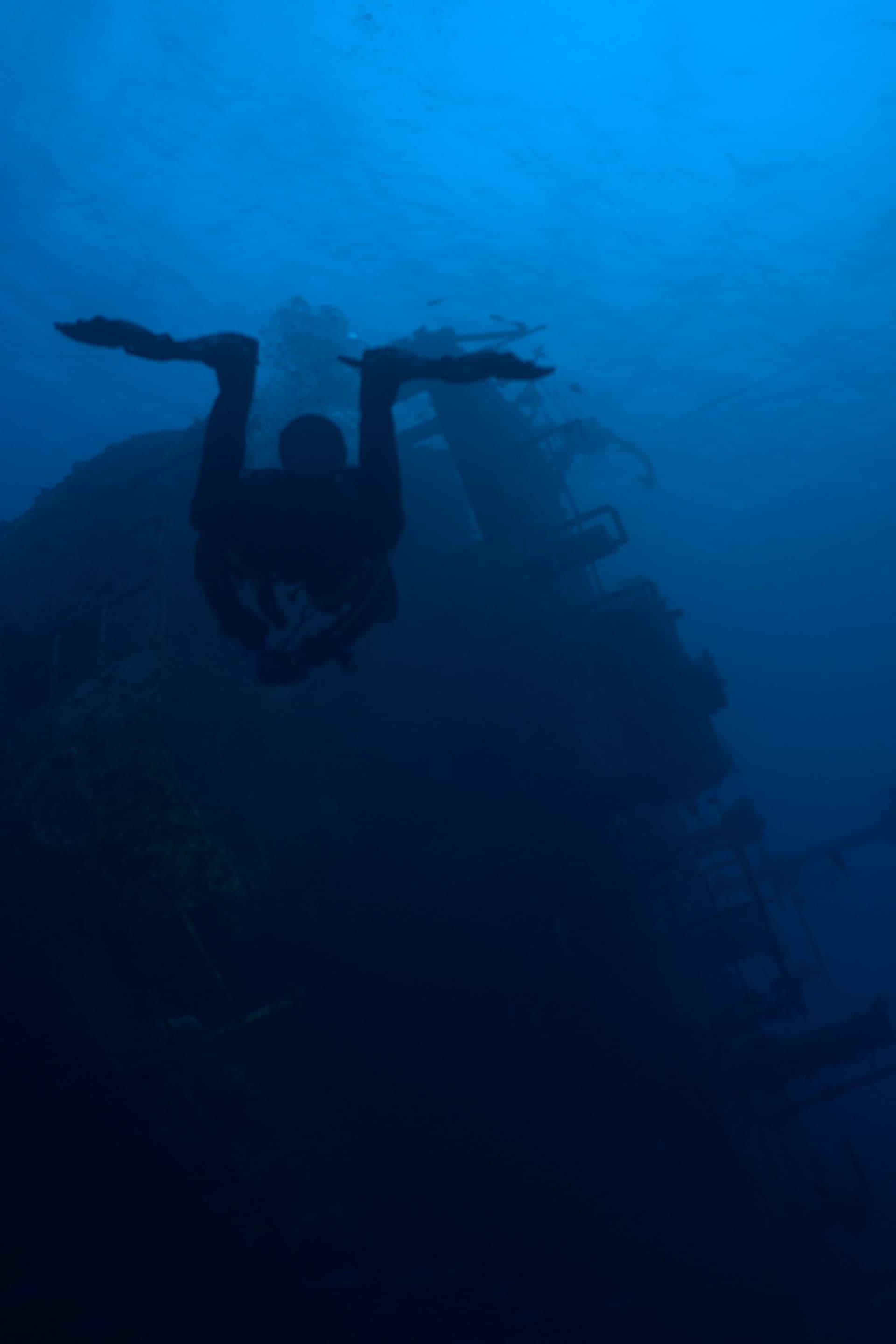
Stern first. At 32m the propeller and rudder wait on the sand, the largest hardware on any Abu Nuhas wreck. The scale is immediate. Swim forward along the port side and enter the engineering compartment through a hole cut in the hull. Inside, the original piping runs along the walls. Gauges and valve wheels are still readable after nearly five decades. Exit and continue forward past the rear decks to the central bridge area, where the captain's bathtub sits among the collapsed superstructure. The midship section is a different proposition: steel has buckled, plates hang loose, and the wreck's structural age shows clearly. Beyond this, the forward section gives way entirely. The bow is a debris field scattered across the reef, fragments of hull plating and structural members spread over the coral down to 5-6m. Soft corals line the remaining cable runs. Batfish cruise the exterior in loose formation.
What makes it special
The Kimon M occupies a specific role at Abu Nuhas. It is not the prettiest wreck, not the easiest, and not the most famous. It is the biggest. At 120 metres, the hull dwarfs the Giannis D (100m), Chrisoula K (98m), and Carnatic (90m). The depth range, from debris on the reef at 5m to the stern at 32m, covers more vertical ground than any of its neighbours. This is also the quietest wreck on the reef. Most liveaboard groups gravitate to Giannis D first. The Kimon M often has one team exploring it at a time. The engineering compartment swim-through rewards that relative solitude: original machinery, dim natural light filtering through the hull, and the particular silence of a wreck interior without other divers' bubbles overhead. Built in Hamburg in 1952, the vessel sailed under six different names before its final cargo of lentils brought it here. That long, restless history ended abruptly on 12 December 1978, at full speed, against a reef that does not forgive navigation errors.
Know before you go
This wreck sits at the northeast corner of Abu Nuhas, the most exposed position on the reef. Currents here can be stronger than at the other three wrecks, and rough surface conditions sometimes cancel the dive entirely. A descent line simplifies arrival when current is running. Plan your gas carefully. On air at 32m the no-decompression limit is roughly 16 minutes. Nitrox makes a real difference. Most groups dive the Kimon M first in the morning, then move to shallower wrecks as nitrogen loading accumulates. The engineering compartment is a straightforward swim-through. Beyond it, the structural condition deteriorates. Loose steel panels in the collapsed midship section make further penetration inadvisable without wreck specialty training. Carry a torch for the interior. An SMB is essential for ascent.
Why Dive Kimon M
What makes this dive site stand out.
- 1Massive stern propeller
Rudder and propeller intact at 28-32m, among the most imposing at Abu Nuhas
- 2Largest Abu Nuhas wreck
120m length, significantly bigger than the other three recreational wrecks
- 3Engineering compartment
Swim-through with original piping, gauges, and valves still in place
- 4Captain's bathtub
Found in the central bridge deck, one of the wreck's quirky interior details
- 5Least dived of four
Fewer groups on any given day compared to Giannis D or Chrisoula K
Depth & Profile
Location
27.5800°N, 33.9319°E
Conditions
Difficulty & Certification
Deepest of the four Abu Nuhas wrecks. Possible strong currents at the exposed northeast corner. Wreck is structurally unstable in sections.
Frequently Asked Questions
Why is the Kimon M called the Lentil Wreck?▾
Why is the Kimon M usually the first dive of the day?▾
Is the Kimon M suitable for Open Water divers?▾
Can you go inside the Kimon M?▾
How does the Kimon M compare to the other Abu Nuhas wrecks?▾
What happened to the ship before it became a wreck?▾
Photos
Log your dives
Track every dive with depth, duration, conditions, and marine life sightings. Join a club and share your underwater experiences.
Try DiveLog — it's free