YellowSub Tarifa
Tarifa / Dive Center
(140)
PADIes en it
Canyon-like reef of large perforated rocks off Isla de las Palomas, Tarifa: swim-throughs, octopuses, morays and gorgonians between 5 and 22 m.
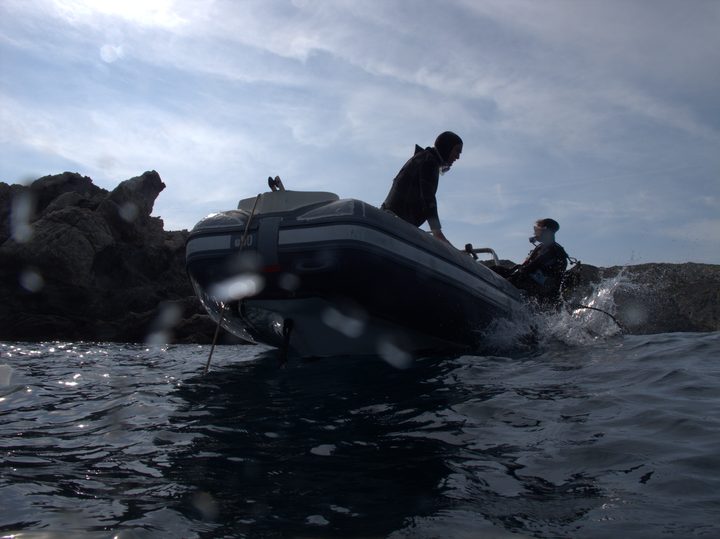
The rock starts at about 5 m and steps down to 22 m through groups of large boulders. Corridors run between the groups, which gives the site its canyon feel, and many of the boulders are pierced by natural holes wide enough for a diver to pass through. Big octopuses, morays and scorpionfish sit in the crevices, and gorgonians grow on the rock faces. The boat covers the ten minutes or so from Tarifa harbour to the east face of Isla de las Palomas.
Large rocks perforated by holes stand together like the walls of a submerged fortress, which is where the site takes its name. On a usual two-dive morning from Tarifa this is the shallower rock dive that follows the San Andres wreck, and it sits on the levante side of the island. Groupers, sea breams and lobsters share the crevices with the octopuses and morays.
The site lies inside the Parque Natural del Estrecho, so the park's rules govern the dive: every scuba dive has a support boat, and divers keep off the walls and the bottom and leave the animals alone. Because touching the rock is forbidden, trim neutrally before you enter a hole. Currents around the island can run hard, and guides pick the side by wind and current.
Visibility of 12 to 15 m was noted here in August 2010; the Tarifa coast as a whole is quoted at 15 to 30 m. Water around Tarifa sits near 18 C, cold enough that a full wetsuit, hood and gloves are advised even in summer.
Large rocks with natural holes wide enough to swim through.
Passages between the rock groups give the site its canyon feel.
The ground steps down slowly from a shallow top.
Big octopuses, morays and scorpionfish sit among the rocks.
36.0044°N, 5.6058°W
Book a guided dive at this site.
Open Water covers the shallow rock from 5 m. The deepest part reaches 22 m, beyond the 18 m Open Water limit, where Advanced Open Water applies. The centre that dives it grades the site from beginners to advanced divers.
Summary
Easy to moderate: the shallow top suits less experienced divers, and the current around the island can raise the difficulty on a given day.
Safety considerations
What can go wrong here, and what divers do about it. Conditions change - take the briefing from the operator on the day.
The Parque Natural del Estrecho requires authorisation for diving at a named list of dive points around the island, and La Fortaleza is not on that list. The plan does not say the site is exempt either, so a permit cannot be ruled out and 'no permit needed' is not a safe assumption. Dives here are run from a boat by a local centre, and the park rules apply on the dive itself: a support boat, no touching, no feeding.
It lies on the east (levante) side of the island. Tarifa guides choose the side by wind: with an east wind they dive the west side, with a west wind the east side, so La Fortaleza fits west-wind days. The guide decides on the day.
Log your dives - notes, photos, conditions and the marine life you saw - and share them as one public diver profile. What you share helps the next diver, too.
Log every detail
Depth, duration, conditions, gear, buddy, notes — all in one place. Import from Suunto and other dive computers.
Track marine life
Record species sightings on each dive. Build a personal catalogue of everything you've seen underwater.
Your public dive profile
Share your dive history, stats, and experiences with a profile page you control. Show the world where you've been.