

Big Blue Diving
SSI Career Center in Sairee Beach, Koh Tao, running the full course ladder to Instructor and a technical diving department since 1991.
SSI7 services6 languages
Gulf of Thailand island reached only by ferry, a high-volume certification hub prized for cheap training and reliable whale sharks more than site spectacle.
Last updated September 2026
Koh Tao runs on volume, not spectacle. It is widely described as one of the busiest dive-certification hubs anywhere, and every account of it agrees on the trade divers are making: cheap, reliable Open Water and Advanced courses, a bundled five-day package reported around $500, for reef diving that is good rather than exceptional. Divers chasing big-animal, liveaboard diving on Thailand's other coast are routed by their own community to the Similan Islands and Richelieu Rock instead, and nobody who has dived both claims Koh Tao competes on site quality; the island's own long-serving instructors do not dispute it either.
Four sites carry the certified-diver programme. Chumphon Pinnacle, a granite seamount that never breaks the surface, is the island's best-known trip, drawing divers for dense schools of barracuda and trevally and, more rarely, for bull sharks that have shared the water with grey reef sharks since 2007. Southwest Pinnacle runs the same offshore rotation with a multi-peak circuit and some of the island's best-documented whale shark odds, best March to May and again October to November. HTMS Sattakut, a WWII landing craft deliberately sunk in 2011, gives Koh Tao its wreck dive, guns still mounted and local schools teaching wreck-diving courses on the hull. White Rock, close to shore on the sheltered west side, is dived by day for its twin-pinnacle layout and after dark for what most operators call the island's best night dive. Sail Rock, an isolated pinnacle in open water toward Koh Phangan, is sold as a day trip from all three islands and rated by many divers as the best single dive in the Gulf of Thailand; which island it belongs to is a live dispute among the operators running it, not a settled fact.
Whale sharks are the headline animal, reported close to shore and recently rather than as an old reputation. The reef itself is argued over more than the wildlife: divers who have dived Koh Tao for years describe both crowded, gear-worn trips and small-group dives on well-maintained kit, and the split tracks the operator chosen far more than the island as a whole. There is no marine-reserve creation story here, because Koh Tao never had one; a 2016 government mooring-buoy programme protects the reef instead of a permit system, and the two longest-running schools each run their own reef-conservation programme on top of it. The same informal structure shows up in the labour market: a freelance, largely foreign instructor workforce documented since 2010 and enforced against as recently as August 2026, when six foreign dive instructors were arrested for working without authorisation: five Spanish nationals at Pura Vida Koh Tao Diving on 18 August, plus one British national in a separate inspection.1 Separately, a fatal dive-boat fire on the Davy Jones Locker in March 2025, on the way to Southwest Pinnacle, killed a 26-year-old British passenger; press accounts disagree on the cause and on how many were aboard, but it was a mechanical failure on a single vessel, not a pattern tied to the diving itself.23
Koh Tao has no airport and is reached only by ferry: about two hours from Koh Samui, 1.5 to 2 hours from Chumphon, or 3 to 4 hours from Surat Thani, with Bangkok travellers typically flying to one of those and ferrying on. Three hub towns split the diving differently: Mae Haad is the ferry port, Sairee Beach carries the largest concentration of dive shops, and Chalok Baan Kao is the quieter base for several long-established schools. Every operator sells the standard PADI or SSI ladder from Open Water to instructor, and beginner-friendly bays sit alongside the advanced pinnacles and the wreck, so a typical week moves between levels rather than staying at one throughout.
No national-park instrument covers Koh Tao. What applies instead is a 2017 Ministerial Regulation placing the island in the Southern Island Group Tourism Development Zone with Koh Phangan and Koh Samui, a 2018 DMCR order protecting marine and coastal resources across the same three islands, and a 2016 DMCR mooring-buoy programme so dive boats can moor around Koh Tao and Koh Nang Yuan instead of anchoring on the reef.456 There is no formal park entrance fee.7 Best season is genuinely disputed, with different accounts naming March-May and September-October, December-April, or May-September, and whale shark odds running broadly March through October depending on the site. A 24-hour recompression chamber operates on the island.
Granite pinnacles, some breaking the surface, rise from a floor of boulder swim-throughs and sandy bays typical of the Gulf of Thailand's continental-shelf islands, with a handful of wrecks sunk deliberately among the natural rock.
The diving here splits into 3 zones:
Koh Tao's roped-off coral training bay, walkable from the beach
Koh Tao's default Discover Scuba and first Open Water training bay
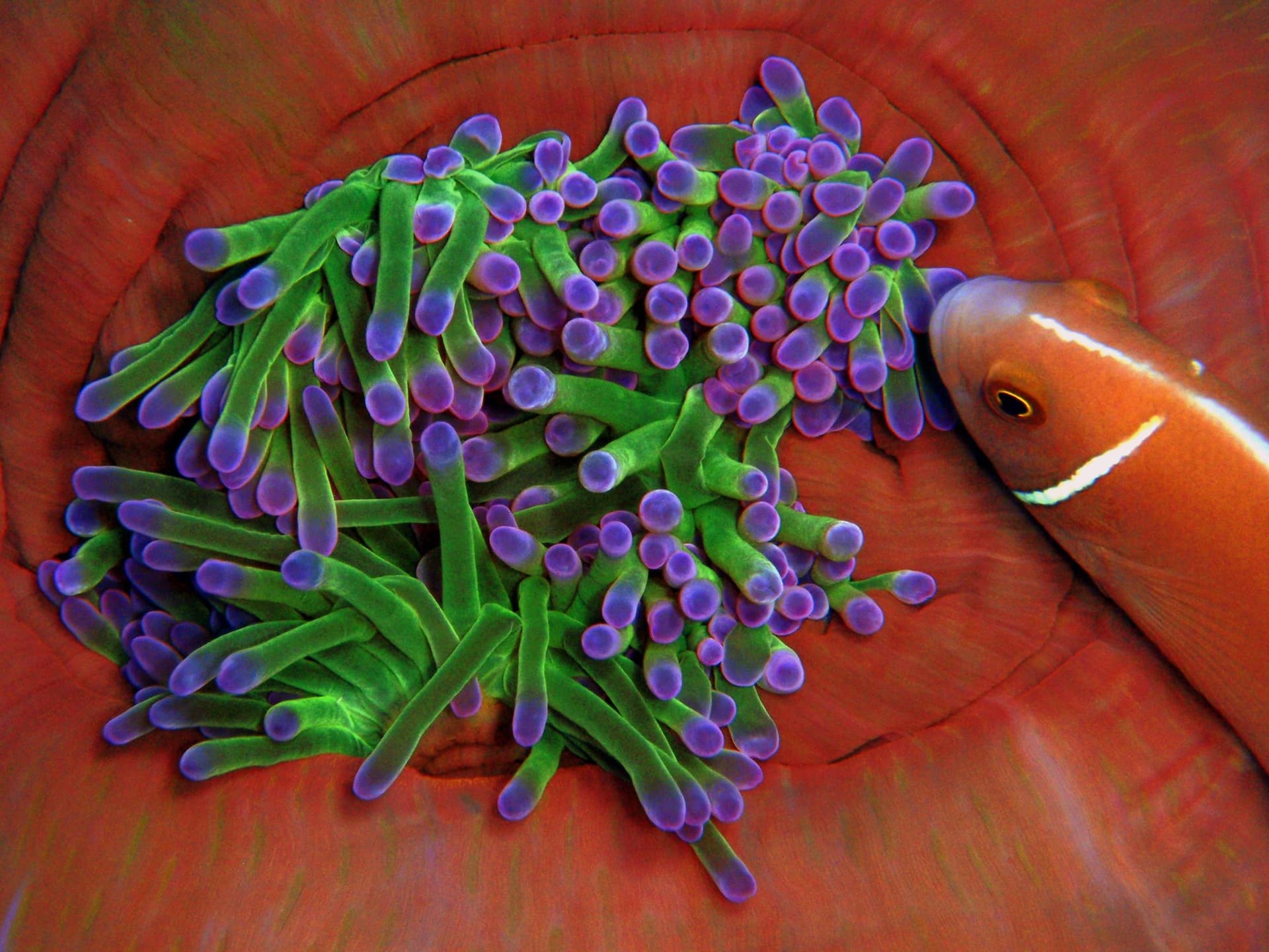
Where most of Koh Tao's first Open Water dives happen, clownfish family included
A named triggerfish nesting ground and real, recurring current, atypical for Koh Tao
Open-water pinnacle with a swim-through chimney and frequent whale sharks
A boulder-and-coral islet named for its fin shape, sharks themselves debated
Book online or contact a centre that dives this area.
SSI Career Center in Sairee Beach, Koh Tao, running the full course ladder to Instructor and a technical diving department since 1991.

RAID-only beachfront resort in Chalok Bay, south Koh Tao; boat dives capped at four divers per guide, rated 4.7/5 from 467 reviews.

Family-run Chalok Baan Kao dive school on Koh Tao since 1995, capped at 24 divers a day and known for its New Heaven Reef Conservation Program (est. 2007).
French-speaking SSI dive school at Mae Haad, Koh Tao, founded 2016, capping every guided dive at 4 divers per guide.

PADI 5-Star Dive Center at the Amari Koh Samui Resort, running its own boats to Sail Rock and Chumphon Pinnacle since 1999.

Get in touch to add or claim your dive center listing on DiveCodex.
What can go wrong here, and what divers do about it. Conditions change - take the briefing from the operator on the day.
National rules also apply: Rules and permits in Thailand
Neither exclusively, and the operators who run it disagree. It sits in open water between the two islands and is sold as a day trip from Koh Tao, Koh Phangan and Koh Samui alike, with Koh Phangan-based schools running it daily and treating it as their home site, while Koh Tao operators sell it as a signature add-on trip. Which island it properly belongs to is unresolved.
It depends who you ask, and the disagreement runs deeper than a shoulder-season quibble. Some accounts name March to May and September to October as peak; a long-time local instead names December through April; the wider Gulf of Thailand rule of thumb points to May through September. Water holds a near-constant 26 to 30 degrees C year-round, so the variable that actually moves is visibility, clearer in the two windows either side of the monsoon and reduced after heavy rain from October to December.
No. Unlike Thailand's national parks, which charge a per-visitor entrance fee, Koh Tao sits outside that system entirely and has no formal park fee.7 A 2017 tourism-development-zone designation covers Koh Tao alongside Koh Phangan and Koh Samui, and a 2018 order from Thailand's marine and coastal resources department separately protects the same three islands' waters, backed by a mooring-buoy network installed in 2016 so dive boats can moor instead of anchoring on the reef.456
Because they are usually describing different operators, not the same island. Rental gear, group size and reef condition are all reported as inconsistent, with some schools singled out by name for well-maintained kit and small groups and others for the opposite, often in the same online discussion. The split tracks which shop you book and when: a trip during Songkran, the single busiest week of the year, reads very differently from the same site the following month.
A freelance, cash-in-hand instructor model has been reported as the island's norm since at least 2010, and a 2026 estimate from a shop owner put foreign nationals at roughly 95 percent of working dive professionals. Enforcement caught up with that pattern in August 2026, when six foreign dive instructors were arrested for working on visas that do not authorise employment: five Spanish nationals at Pura Vida Koh Tao Diving on 18 August, plus one British national in a separate inspection. It reads as enforcement of a long-standing, widely known arrangement rather than a problem specific to one shop.
Sightings are reported as frequent and current rather than an old reputation, with the strongest odds running broadly from March to October depending on the site, best documented around Southwest Pinnacle. Nothing is scheduled, and a trip built entirely around one sighting is still a gamble, but divers keep reporting multiple encounters in the same month across recent years.
Only for part of it. Twins, Mango Bay, Aow Leuk and the Japanese Gardens are shallow, sheltered sites built for training and an Open Water diver's first dives. The offshore pinnacles at Chumphon and Southwest, and the wreck at HTMS Sattakut, all call for Advanced Open Water or better, so a typical week mixes both bands rather than staying at one level throughout.
Yes. In March 2025 the Davy Jones Locker caught fire on the way to Southwest Pinnacle; a 26-year-old British passenger died, and the captain and a crew member were later charged with negligence.2 Contemporary press accounts disagree on the cause, a crew member's compressed-air tank-filling equipment malfunctioning by one account or an engine-room fire by another, and on how many people were aboard, giving 22 and 28 respectively.23 It was a mechanical failure on a single vessel, not a pattern tied to any dive site.
They are two different products more than two versions of one. Koh Tao is shore-based, ferry-only and built around cheap, reliable certification with no liveaboard option; the Andaman side, reached from Phuket or Khao Lak, means a liveaboard commitment for a shot at Richelieu Rock or the Similan Islands, at higher cost, for reef condition and pelagic odds that divers who have made both trips rate well ahead of Koh Tao's own diving. People choose Koh Tao for the course and the price, not to out-dive the other coast.
Also known as: Ko Tao, Turtle Island
Log your dives - notes, photos, conditions and the marine life you saw - and share them as one public diver profile. What you share helps the next diver, too.
Log every detail
Depth, duration, conditions, gear, buddy, notes — all in one place. Import from Suunto and other dive computers.
Track marine life
Record species sightings on each dive. Build a personal catalogue of everything you've seen underwater.
Your public dive profile
Share your dive history, stats, and experiences with a profile page you control. Show the world where you've been.