

ATLANTIK Scuba Diving Tenerife
PADI Gold Palm 5 Star IDC Resort in Puerto de la Cruz, founded 1994 by the Christoph family and run today by sons Thomas and Dirk.
PADI / SSI8 services3 languages
Also known as: Atlantis (La Rapadura), Canarian Giant's Causeway
A National Geographic-featured basalt-column wall off north Tenerife: Spain's biggest known columnar disjunction, dived boat-only at 20-45m by expert divers.
Last updated July 2026
Prismatic basalt blocks stack the wall in tight, hexagonal ranks, the product of a lava flow that met the sea and cracked apart as it cooled. Divers drop along the face until the columns resolve into shape around 25 metres, some four-sided, some seven, most six, ending at different levels like organ pipes cut to different lengths. The wall keeps going. What's diveable bottoms out near 45 metres, but the rock continues down past that toward 120 metres, well outside any recreational profile. At 40 to 45 metres, large yellow fan corals grow along the sand where the wall finally levels out. Erosion has already toppled some of the columns into rubble at the base, a reminder that the formation is still slowly coming apart. Current is the variable that shapes the dive: some days it barely moves, other days it builds enough to decide how far along the wall the group goes, and guides read it before committing to a route.
Most of Tenerife's north coast hides its geology behind sand and scrub growth. La Rapadura doesn't. The columns sit close to bare rock, stacked with enough regularity that comparisons to a cathedral organ, or to Ireland's Giant's Causeway, come up again and again in how people describe it. It's also, by the numbers, the biggest known columnar disjunction anywhere in Spain: nowhere else in the country has this much basalt cracked into this many clean-edged blocks in one place. Every other dive in the Puerto de la Cruz cluster nearby is built around a cave, a chimney or a chamber cut into the rock. La Rapadura has none of that. It's an open wall, column after column running down into the dark, nothing to swim through.
The image that put this wall on the map was shot by underwater photographer Francis Perez, who is also credited with discovering parts of the site. His photograph ran on the cover of National Geographic in 2012, and more than a decade later divers still turn up here with cameras aimed at the same columns. Wide-angle is the obvious call: the scale of the formation reads best when several columns and their staggered heights fit in one frame, ideally with a diver alongside for scale. The cleanest light tends to fall on the upper sections of the wall, where the hexagonal edges catch it directly. Save some attention for the sand at 40-45 metres too. The yellow fan corals there make a different kind of shot, colour against dark rock rather than pure geometry.
Recent deep-diving experience counts for more here than a freshly stamped Advanced card. The depth range runs 20 to 45 metres, and current can shift from calm to demanding with little warning, so a Deep specialty is worth having before you book this one. Multiple operators around Puerto de la Cruz, including Atlantik, LoCura Diving, Scubanana and LJ Diving, run trips out to La Rapadura, typically a 25-minute boat ride, some three nautical miles offshore. May through October tends to bring the calmest conditions, and October is often singled out as the best month for warm, settled water. A 5mm wetsuit covers summer comfortably; consider a drysuit or thicker exposure protection outside that window.
What makes this dive site stand out.
Prismatic hexagonal columns form Spain's biggest known columnar disjunction
Photographer Francis Perez's 2012 image of the wall ran on the magazine's cover
Diveable 20-45m, with current that can turn strong without much warning
Large yellow fan corals grow along the sand at 40-45m
About 25 minutes by boat from Puerto de la Cruz, roughly three nautical miles out
28.4413°N, 16.4952°W
October is often singled out as the best month for calm, warm conditions
Contact a local operator for current pricing
Advanced Open Water is the stated minimum; a Deep Diver specialty is recommended given the 20-45m range
Summary
Consistently described as an arduous, demanding dive reserved for expert divers, not a first Advanced-level outing
Safety considerations
What can go wrong here, and what divers do about it. Conditions change - take the briefing from the operator on the day.
Book a guided dive at this site.
PADI Gold Palm 5 Star IDC Resort in Puerto de la Cruz, founded 1994 by the Christoph family and run today by sons Thomas and Dirk.
Small, owner-operated boat-diving centre at Marina Del Sur, Las Galletas, run by Ludo and Julie around individual, never group, try dives.

SSI 5-Star dive centre and equipment store in Radazul, east Tenerife, with a full recreational-to-technical course ladder including Decompression Diving, an on-site classroom and pool, and guided trips reaching sites across the island.
PADI 5-Star dive centre in Radazul harbour, east Tenerife, running daily double and single-tank boat dives plus a structured island-wide 'Top 10 Tenerife' trip for advanced divers, TEC diving, and PADI Freediver.
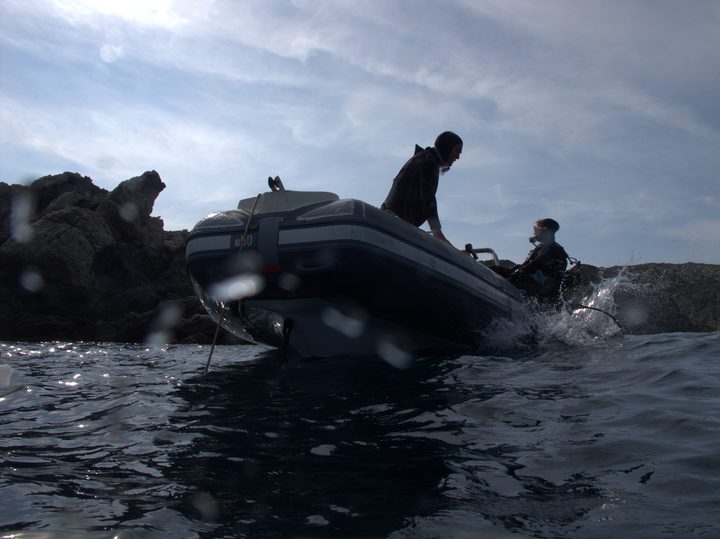
Get in touch to add or claim your dive center listing on DiveCodex.
No. Despite one outlier description of a sheltered, easy dive, the consistent picture from operators and researchers alike is an arduous, expert-level wall. The 20-45m depth range and unpredictable current rule out anything less than solid Advanced experience with a Deep specialty behind it.
Underwater photographer Francis Perez, credited with discovering parts of the site, shot the image that ran on National Geographic's cover in 2012. It remains the strongest independent fame marker of any dive site on Tenerife's north coast.
The diveable wall runs from about 20m to 45m, with the largest fan corals concentrated at the deeper end, 40-45m. The rock itself keeps going well past that, down toward 120m, but that is outside any recreational profile.
May through October generally brings the calmest conditions, and October is often called out specifically for warm water and settled current. The site is diveable year-round, but current is the variable that decides whether a given day works.
By boat only, roughly 25 minutes or three nautical miles out from Puerto de la Cruz. Several operators around the harbour, including Atlantik, LoCura Diving, Scubanana and LJ Diving, run trips to the site.
The columnar rock formation is the main event, but large yellow fan corals grow along the sand at 40-45m, and groupers, parrotfish and octopus work the wall and its base.
No. The site falls outside the island's two Natura 2000 marine zones, and no permit, fee, or quota applies to divers here.
Log your dives - notes, photos, conditions and the marine life you saw - and share them as one public diver profile. What you share helps the next diver, too.
Log every detail
Depth, duration, conditions, gear, buddy, notes — all in one place. Import from Suunto and other dive computers.
Track marine life
Record species sightings on each dive. Build a personal catalogue of everything you've seen underwater.
Your public dive profile
Share your dive history, stats, and experiences with a profile page you control. Show the world where you've been.