
Tritón Diving Llafranc
Family-owned dive center in Llafranc since 1979, with 4.9/5 on 717 Google reviews, covering 11 sites across two Costa Brava dive areas.
SSI5 services5 languages
Also known as: Els Ullastres I, Riff III, Ullastre 1, Ullastre de tierra, Ullastre I
Shallowest of the three Ullastres pinnacles off Llafranc, a wide-topped seamount from 10 to 32m where crevice-rich base rocks shelter scorpionfish, morays, and congers.
Last updated May 2026
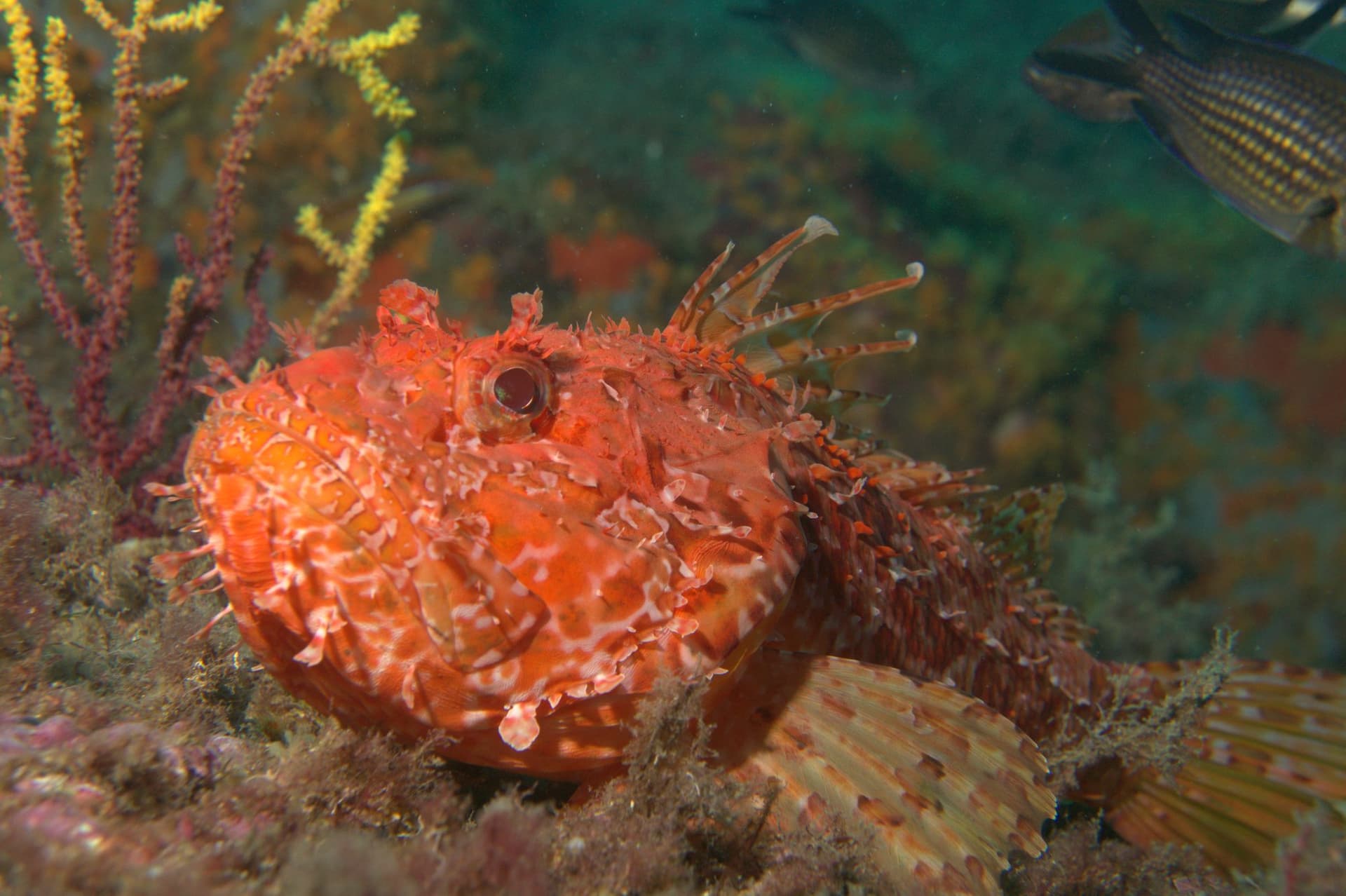
Ten metres down the mooring line, the summit opens into a wide flat platform — wider than the steep starts at Ullastres II or III, and that difference shapes the whole dive. From the top at 10-11m, divers push outward to the broad base platform around 12m, where large scattered rocks form a maze of holes and crevices. This is where the dive happens. Most groups potter slowly across the platform, torch into every crack: a scorpionfish wedged inside, a moray's head working at the entrance, an octopus pulling shell debris over its lair. The seamount then slopes down to walls at 28-32m on the seaward sides, and air and certification permitting, divers swing along the base at depth before turning back shallower for the off-gassing leg. The north face carries the most gorgonian coverage. Ascent is back up the buoy line, often with a safety stop in the water column above the seamount where damselfish and small wrasse cloud the line.
Ullastres II has its towers. III has its wall. This pinnacle has hiding places. Within the Palamós offshore set — Boreas at 18-32m, Furió Fitó into a 13-56m massif, Ullastres III plunging to 54m — Ullastres I is the slot a centre books when a guest still wants the full pinnacle experience but does not want to go deep. The buoy line drops into open water, life is concentrated by the seamount effect, and the diver has the security of a 12m base platform and the option to stay above 20m the whole dive. The character is the opposite of deep-wall drama: hands-and-eyes diving, torch into the cracks, scan the holes for snouts. Divers sum up the trade-off cleanly: less coral than Ullastres III, less current than the bigger brother, lots of fish.
The macro angle is the specific draw beyond the initiation framing. Rock holes shelter scorpionfish, morays, congers, octopus, nudibranchs, and small crustaceans like Scyllarus arctus and Galathea strigosa, at depths and light levels that suit close-up work. Bring a torch and a macro lens. Most of the photographable terrain sits comfortably above 20m, which keeps colour and ambient light on the diver's side. The north face offers wider compositions on red and yellow gorgonians for mixing angles inside one dive, though the colonies are smaller and less dense than at Ullastres III. Ullastres I is also flagged locally as a night dive, which transforms the crevice-resident encounters entirely.
Bring a torch. The crevice residents that define this pinnacle are invisible without one, and scorpionfish blend completely into rock under ambient light. Plan to move slowly rather than cover ground. Watch for boat traffic during ascent and deploy an SMB. From Palamós the boat is about 20 minutes; from Llafranc it is shorter. Centres in Palamós, Llafranc, Calella de Palafrugell, and Tamariu run trips to the Ullastres, with single boat dives around 40-41 EUR including tank.
What makes this dive site stand out.
The shallowest and most wind-protected of the Ullastres trio, routed by guides for newer divers
Broad rim around 12m where scattered rocks form holes hiding scorpionfish, morays, and congers
Tight light and close subjects in the rock holes suit macro work
Broad mooring-line top permits a slow descent and a long shallow off-gassing leg
41.8795°N, 3.1979°E
Warmest water and best visibility. Diveable year-round when weather allows.
Verify current rates with dive center
Two centres explicitly bill Ullastres I as an initiation dive. The shallow summit and gentle base platform suit newly certified divers.
Summary
Sheltered from wind, gentle profile, simple navigation from the mooring line. Appropriate for newly certified divers.
Safety considerations
What can go wrong here, and what divers do about it. Conditions change - take the briefing from the operator on the day.
Book a guided dive at this site.
Family-owned dive center in Llafranc since 1979, with 4.9/5 on 717 Google reviews, covering 11 sites across two Costa Brava dive areas.
PADI, SSI, and CMAS center at Port Marina Palamós with year-round boat dives, small groups, and full MARES equipment. SSI Instructor Training Center.

Small SSI center on the Cala Gogo beachfront near Sant Antoni de Calonge, capping discover dives at two and courses at four, with the boat from Palamos.

Small-group dive center in Tossa de Mar with a year-round boat, max 4 divers per guide, PADI TecRec and CCR training, and on-site accommodation.

PADI 5-Star IDC Center at Port Marina Palamós with technical, recreational, and freediving programs and daily boat trips to Ullastres and the Boreas wreck.

SSI center at Port Marina Palamós, open every day of the year, with the 30-pax MANSABA boat covering Boreas, Ullastres, and Illes Formigues.
SSI and PADI center inside Port Marina Palamós, twenty-plus years operating, with a published price list and a 4.8/237 Google rating under owner Jordi.
Get in touch to add or claim your dive center listing on DiveCodex.
Upcoming trips to this dive site published by local centres.
Availability is read from each centre's public calendar and refreshed daily. Last checked September 21. Confirm with the centre before travelling.
No permits, no fees.
It is the shallowest of the three Ullastres pinnacles (10-32m), the closest to the coast, and the most sheltered from wind. Two local dive centres bill it as an initiation dive. The flat summit at 10-11m and the simple descent down the mooring line make orientation straightforward.
The broad base platform around 12m is full of scattered rocks honeycombed with holes. Scorpionfish wedge inside ledges, moray eels work at the cracks, congers coil deeper. Octopus shelter in the gaps. Bring a torch — in ambient light most of these residents are invisible.
Ullastres I is the shallowest and most sheltered, suited to newer divers and macro work. Ullastres II has 25m gorgonian towers and a lobster fissure to 42m. Ullastres III is the near-vertical north wall to 55m with the densest gorgonian cover. The trio reads as a natural progression from gentle pinnacle to advanced deep wall.
Local divers single it out specifically for macro photography. The base rocks concentrate small subjects at close range — scorpionfish, nudibranchs, small lobsters, moray heads in cracks. The north face also carries red and yellow gorgonians for wider compositions, smaller and sparser than at Ullastres III.
By boat only. Less than two nautical miles off Llafranc. From Palamós it is roughly a 20-minute ride northeast. Centres in Palamós, Llafranc, Calella de Palafrugell, and Tamariu run trips to the Ullastres.
June through October for the warmest water and best visibility, with surface temperatures of 22-26 degrees and bottom temperatures of 14-19 degrees. The site is diveable year-round when weather allows. Winter trips are quieter and colder, with bottom temperatures around 13-15 degrees and occasional John Dory sightings.
Log your dives - notes, photos, conditions and the marine life you saw - and share them as one public diver profile. What you share helps the next diver, too.
Log every detail
Depth, duration, conditions, gear, buddy, notes — all in one place. Import from Suunto and other dive computers.
Track marine life
Record species sightings on each dive. Build a personal catalogue of everything you've seen underwater.
Your public dive profile
Share your dive history, stats, and experiences with a profile page you control. Show the world where you've been.