

Buddies Dive Cove
Family-run PADI 5 Star Career Development Centre in Bugibba, Malta, guiding daily shore and boat dives to Cirkewwa, Um El Faroud and the Ghar Lapsi coast.
PADI8 services1 language
Wreck-led Mediterranean shore diving off Malta: scuttled tankers and tugs, WWII war wrecks, and limestone caves in 20-30m visibility.
Last updated July 2026
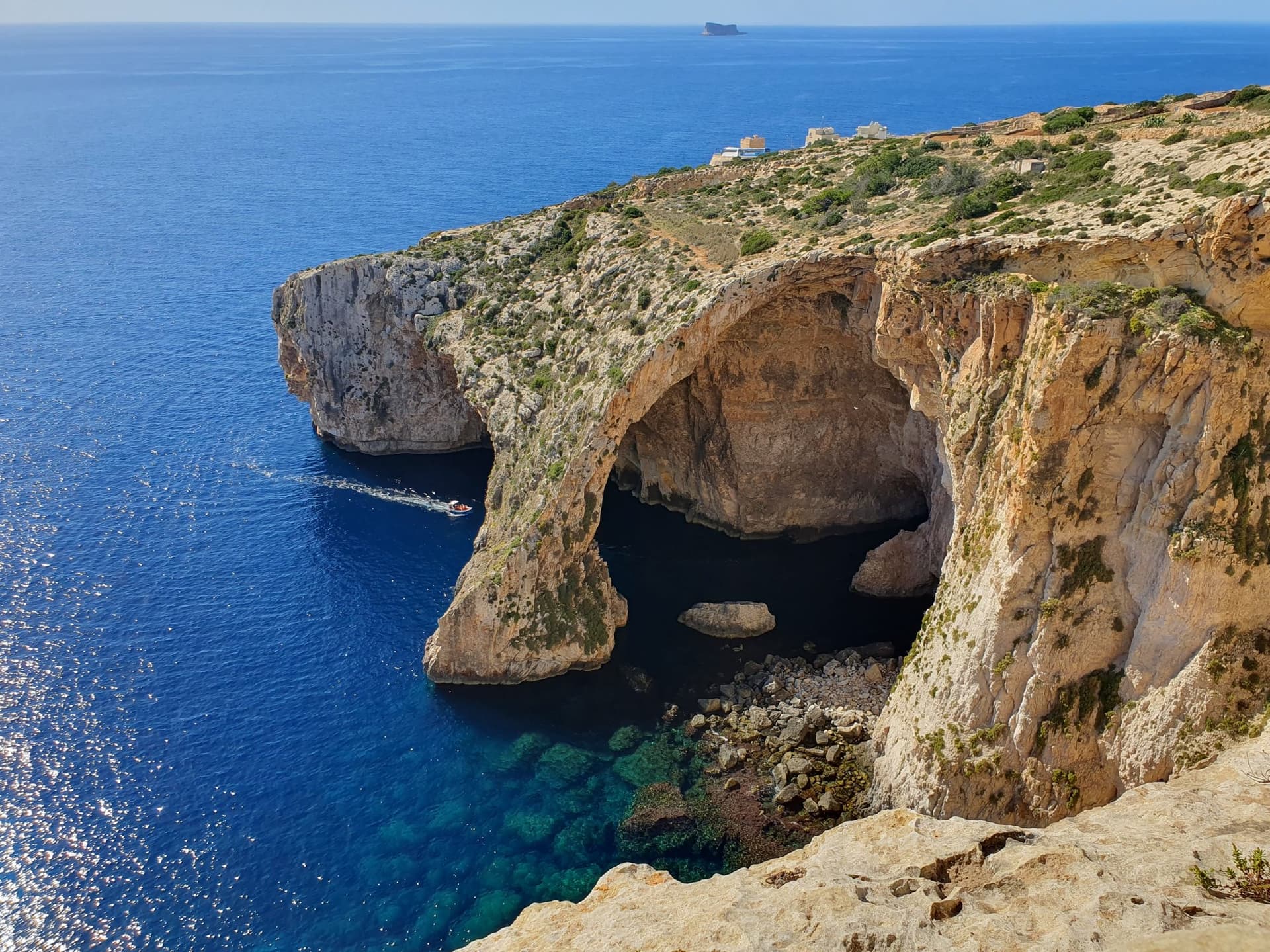
Malta's marquee wrecks are shore dives. That one fact shapes the island's diving more than anything else. Um El Faroud, a 115-metre tanker scuttled off Wied iz-Zurrieq, is the biggest of them and the wreck most divers name first; you walk in from a slipway, no boat needed. At Cirkewwa on the northwest tip, the patrol boat P29 and the tug Rozi lie a couple of hundred metres off the same entry, dived as one circuit past a natural limestone arch and a sheltered training bay. HMS Maori is rarer still: a genuine 1942 war loss shallow enough at 14 metres for a first wreck dive, set in a harbour below Valletta.
The coast is hard limestone, not coral. It gives arches, caves and gently shelving reefs instead of tropical colour, and the fish run to a Mediterranean cast of grouper, moray, octopus, seabream and cuttlefish, with barracuda circling the larger wrecks. Beyond the wrecks, Ghar Lapsi hides a sunlit cavern, and Qawra Point pairs a shallow reef with a deeper offshore wall. History divers have the Bristol Blenheim bomber, intact on sand off the southeast coast. Malta is the wreck-and-shore anchor of a three-island archipelago; neighbouring Gozo and Comino are dived on their own trips.
Let the dive shop pick your site. Wind and swell decide which coast is workable, and when one side is churned up the other is usually calm, so the morning plan follows the forecast. Most diving is self-drive shore entry from a handful of access points; a few sites, like the Blenheim bomber and the Imperial Eagle, are boat-only. There is no dive permit, quota or reserve fee anywhere on the island. One rule does bite: you may dive independently only with a 30-metre certification such as Advanced Open Water, and below that a licensed instructor must accompany you. Water is warmest and seas calmest from May to October, September the pick of the year, though the island dives year-round in the right suit. Beginners start on the shallow harbour wrecks and cavern reefs; the deeper hulls and the aircraft wreck want Advanced experience.
Coralline and Globigerina limestone coast producing underwater arches, caves, caverns, gullies and gently shelving reefs, with Posidonia oceanica meadows over sand. No hard coral reef.
Deep-certified divers after one of Malta's few intact WWII aircraft wrecks
One shore entry spanning beginner training, a natural arch and two wrecks
The gentlest way to try a real WWII wreck dive in Malta
A full-size tanker wreck in two sections, reached on a shore swim
Named West Reef caves and an East Reef wall on the Um El Faroud entry
A sheltered NW Malta bay pairing a named anchor with a guided cavern swim
A shore cove pairing a light-filled cavern with an underwater nativity scene
A documented ferry wreck dived alongside Malta's underwater Christ statue
The gun-fitted half of Cirkewwa's two-wreck dive
One shore entry spanning a training bay, a cavern, a tunnel and a wall
The fish-rich half of Cirkewwa's two-wreck dive
The Sliema seafront's shallow default for training, try dives and night diving
The newest of Malta's shallow shore-dive wrecks, upright off Exiles
Newer divers wanting a shallow shore wreck with genuine WWI-to-WWII history
Book online or contact a centre that dives this area.
Family-run PADI 5 Star Career Development Centre in Bugibba, Malta, guiding daily shore and boat dives to Cirkewwa, Um El Faroud and the Ghar Lapsi coast.
Owner-run PADI 5 Star centre at Cresta Quay, St Julian's, Malta, covering Cirkewwa, the Blue Grotto and the island's wreck circuit with free area pickup.

PADI 5-star training academy in Qawra, Malta, running shore-dive courses from first breath to rescue diver with a small, hands-on instructor team.

PADI 5 Star Instructor Development Centre in St Paul's Bay, Malta, covering recreational-to-technical training and the Malta wreck circuit plus Gozo.
SSI dive school at Ghar Lapsi on Malta's quieter southwest coast, opened 2024, with shore diving from the shop and boat trips to the Um El Faroud wreck.

By its own account, Malta's largest dive centre, family-run in Sliema since 1978, now an SSI Diamond Dive Centre with technical and CCR diving.

PADI 5 Star centre at the Westin Dragonara Resort, St Julian's, Malta, with a full recreational course ladder and technical sister brand Techwise on site.
Get in touch to add or claim your dive center listing on DiveCodex.
National rules also apply: Rules and permits in Malta
Um El Faroud, the 115-metre tanker off Wied iz-Zurrieq, tops most lists as the island's biggest and most complete wreck. The Cirkewwa circuit is the other headline dive, pairing the P29 and Rozi wrecks with a limestone arch from one shore entry. For a shallow, gentle option, HMS Maori is a real WWII destroyer bow at 14 metres. Gozo and Comino, Malta's island neighbours, have their own signature dives and are usually done as separate trips.
Most of the famous wrecks are shore dives. Um El Faroud is a surface swim from the Wied iz-Zurrieq slipway, and the P29 and Rozi sit a couple of hundred metres off the Cirkewwa entry. A handful of sites are boat-only, including the Bristol Blenheim bomber and the Imperial Eagle ferry, but shore access is the norm here rather than the exception.
It depends on your certification. Maltese rules let you dive independently only if you are qualified to 30 metres, meaning Advanced Open Water, CMAS two-star or an equivalent. Divers below that level must be accompanied by a licensed instructor. Even certified visitors often dive with a local centre anyway, since wind and swell make same-day local knowledge valuable.
No. Much of Malta's coast lies inside the Natura 2000 network, but those are habitat-conservation designations, not no-take reserves, and they carry no diving permit, quota or fee. The 'Cirkewwa Marine Park' you see in dive marketing is a managed dive-tourism zone, not a legally closed reserve. You pay for a centre's services, nothing more.
May to October brings the warmest water, longest days and fullest centre schedules, and September is the single most-recommended month for its warm sea and thinning crowds. Malta dives year-round, though: winter water sits around 14 to 17 degrees and asks for a 7mm semi-dry or drysuit, and the deeper wrecks stay cool below the summer thermocline whatever the surface reads.
Summer surface temperatures run 22 to 28 degrees, dropping to the mid-to-high teens on the deeper wrecks below the thermocline; a 5mm wetsuit or thin semi-dry suits most summer diving. Winter surface water falls to 14 to 17 degrees, when a 7mm semi-dry or a drysuit is the sensible choice, especially for the deep Valletta wrecks.
Yes, though the depth range is wide. Shallow harbour wrecks like HMS Maori and X127, the training bays at Cirkewwa and Wied iz-Zurrieq, and the sunlit caverns at Ghar Lapsi and Qawra Point all sit within Open Water limits. The signature scuttled wrecks reach 34 metres or more and want Advanced Open Water, so a mixed group can share a coastline without sharing a dive.
Because wind direction, not water temperature, governs diving here. One coast shelters while the opposite is churned up, and the calm side changes day to day, so centres route divers to whichever access point is workable that morning. It is why a rigid site-by-site itinerary planned before you arrive rarely survives contact with the forecast.
Log your dives - notes, photos, conditions and the marine life you saw - and share them as one public diver profile. What you share helps the next diver, too.
Log every detail
Depth, duration, conditions, gear, buddy, notes — all in one place. Import from Suunto and other dive computers.
Track marine life
Record species sightings on each dive. Build a personal catalogue of everything you've seen underwater.
Your public dive profile
Share your dive history, stats, and experiences with a profile page you control. Show the world where you've been.