

Red Sea Diving Safari
Eco-diving resort south of Marsa Alam with 3 villages, unlimited house reef diving, 60+ sites, and access to Elphinstone Reef.
Resort dive centrePADI9 services5 languages
Far-south Egyptian Red Sea reef complex near the Sudanese border, reached only by liveaboard: coral tunnels, sunlit caverns and shark pinnacles.
Last updated October 2026
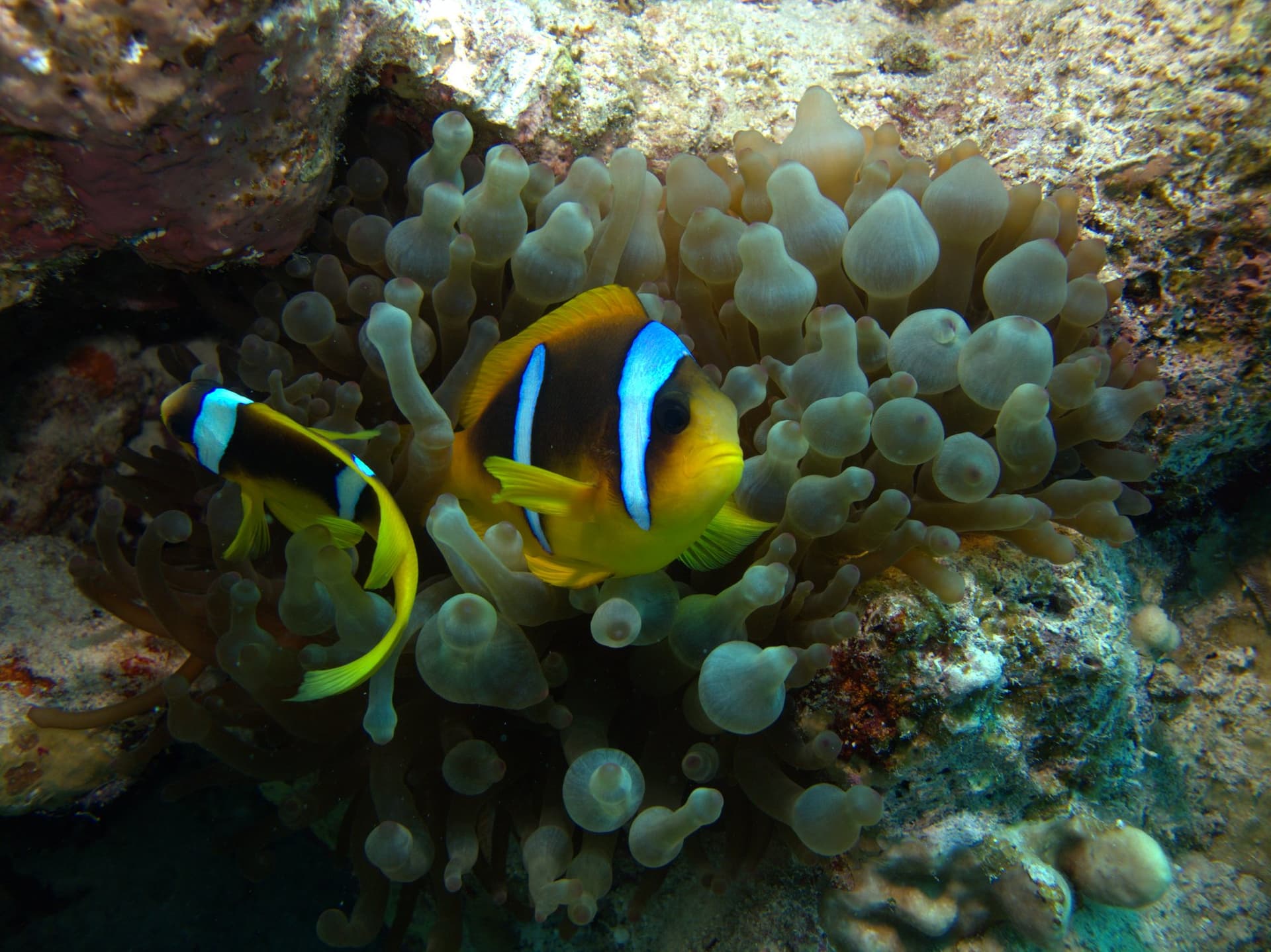
At St John's Caves, shafts of sunlight fall through cracks in the reef onto a maze of coral tunnels only a few metres down. It is the signature dive [st-john-caves] of a complex that spreads across a wide stretch of sea near the Sudanese border: coral towers, tunnels, swim-throughs and a pair of deeper pinnacles standing off to one side. A gota is a reef that breaks or nears the surface and a habili a pinnacle whose top stays below it. Gota Kebir [gota-kebir] is the large reef, known for its tunnels and a south plateau, and Small St John [small-st-john] is a steep wall whose overhangs fill with glassfish. Umm Aruk [umm-aruk] is the gentle one, a shallow forest of coral towers on sloping walls over a sandy bottom, with anemones, garden eels and the odd eagle ray. Visibility runs 20 to 30 m and reaches 40 m on the best days.
Habili Ali [habili-ali] and Habili Gaffar [habili-gaffar] sit further out and are where the sharks are looked for, with a grey reef shark cleaning station at Habili Ali and silvertips patrolling Habili Gaffar. Sharks here are possible, not promised, so plan for coral first.
Divers who know the southern route and the Brothers describe St John's as the one with less current. The exposed pinnacles, Dangerous Reef and the northern tip of Gota Kebir can still run hard, and Umm Aruk's current is unpredictable.
Coral condition differs from reef to reef. Some reefs in the far south now carry dead, algae-covered patches, and others hold healthy gardens, so the walls and swim-throughs are the safer reason to come.
Every dive here starts from a liveaboard, because there is no town, shore base or day-boat option. The usual trip is a seven-night round trip from Port Ghalib or Marsa Alam, often pairing St John's with the Fury Shoals reefs and the dolphins at Sha'ab Sataya. Fly into Marsa Alam, under 15 minutes from Port Ghalib, or into Hurghada and allow about 3.5 hours of road south. The crossing is an overnight sail of around 200 km from Port Ghalib, and itineraries differ in how far south they actually go, so confirm the boat reaches the St John's reefs.
Advanced Open Water is the usual minimum, and operators recommend it for the pinnacles and walls. The caverns are daylight dives, and recreational training does not cover going past their entrance, so stay in the light with the guide.
The nearest hyperbaric chamber is at Marsa Alam, about 200 km away. Any decompression problem means a long evacuation, which is a reason to keep profiles conservative.
Expect three to four dives a day plus night dives, with a marine-park fee included in the trip price. May-June and October-November are the windows operators favour.
A scatter of small coral reefs, coral islands and submerged pinnacles near the Sudanese border: walls, coral towers, tunnels, caverns and swim-throughs over sandy bottoms.
The diving here splits into 3 zones:
A big, varied reef: drift walls, plateaus and southeast tunnels
Divers wanting a scenic Red Sea wall dive with glassfish overhangs and a cavern
Light-filled coral swim-throughs and tunnels, made for wide-angle photography
Divers who like threading coral architecture and a good night dive on a Deep South safari
Book online or contact a centre that dives this area.
Eco-diving resort south of Marsa Alam with 3 villages, unlimited house reef diving, 60+ sites, and access to Elphinstone Reef.
Get in touch to add or claim your dive center listing on DiveCodex.
Safari boats based elsewhere that run itineraries to these dive sites.

41m, 26-guest wooden liveaboard running Master Liveaboards' full Egyptian Red Sea catalogue from Hurghada and Port Ghalib, from northern wrecks and Tiran through the offshore Brothers, Daedalus and Elphinstone to the far-south Rocky, Zabargad and St John's reefs.

Compact 18-guest, 9-cabin wooden liveaboard focused on Deep South and St John's routes from Port Ghalib, reaching remote Rocky Island and Zabargad.

26-guest sister of Superior with Junior and Executive suites, ranging across Emperor's Egypt catalogue from northern wrecks and offshore Brothers, Daedalus and Elphinstone to the Deep South.

Red Sea Explorers' largest liveaboard: 37.5m, 28 guests across 14 cabins, running the same GUE-leaning offshore and deep-south Egypt route catalogue.

36m, 22-guest steel liveaboard with a dedicated camera room and gas-blending deck, running the Brothers, Daedalus, Deep South and Fury Shoal weeks.

40m, 25-guest steel liveaboard, built 2023 for the Deep South: Daedalus, Rocky Island, Zabargad and St John's, plus Fury Shoal, from Port Ghalib.

Red Sea Explorers' tech flagship: a 37m, 22-guest steel liveaboard with a full trimix/CCR fill station and scooters for offshore and deep-south Egypt safaris.

138ft (42m), 26-guest Aggressor liveaboard out of Port Ghalib running two Saturday-to-Saturday southern itineraries: Brothers-Daedalus-Elphinstone, and St John's-Daedalus, across offshore plateaus and the Marsa Alam and St John's reefs.
Boats run April to November, with May-June and October-November the windows operators name for pelagic activity and calmer crossings. The far-south reefs can pick up wind and chop that reshapes an itinerary.
What can go wrong here, and what divers do about it. Conditions change - take the briefing from the operator on the day.
National rules also apply: Rules and permits in Egypt
Possibly, but they are not the reason to book. Operator itineraries put grey reef and silvertip sharks on the offshore habili pinnacles and one wall, with hammerheads in season. Experienced Red Sea divers say St John's is not a shark destination and that sharks belong to the Brothers, Daedalus and Elphinstone. Treat a shark as a bonus on the pinnacles and expect the coral and caverns to carry most dives.
Divers who have done both describe the southern route as more coral, shallower dives, swim-throughs and less current, and the BDE route as drift dives with better odds of sharks. If coral, caverns and easier water matter more than big animals, St John's fits; if sharks lead the list, BDE does. Some divers book one route one year and the other the next.
In a straight line the reefs lie roughly 130 to 150 km south of Marsa Alam, while the overnight sailing route from Port Ghalib is about 200 km. Boats usually sail overnight and often stop at the Fury Shoals reefs on the way.
Advanced is the usual minimum and the sensible level for the habili pinnacles and outer walls, where depth and current add up. The shallow coral gardens and daylight caverns suit careful divers with good buoyancy, and some operators run training during the trip so Open Water divers can build up on the gentler reefs first.
Boats run from April to November. Operators name May-June and October-November as the peak for pelagic activity, and those months also tend to bring calmer crossings. Winter water is cooler at 22 to 25 C, against 26 to 30 C for most of the season.
It varies reef by reef. Recent accounts from the far southern Red Sea describe stretches of dead, algae-covered coral beside healthy stretches, while still rating the swim-throughs and walls highly. Plan the trip around the structure and treat living cover as a variable.
It is a cavern: a shallow maze of cracks, arches and short tunnels in the light zone, with shafts of sunlight reaching the floor. Because it is an overhead environment, recreational training does not cover going past the entrance. Stay with the guide inside the natural light and do not push on beyond it.
Often on the way through rather than at the reefs. Southern itineraries commonly stop at Sha'ab Sataya, a spinner dolphin reef in the Fury Shoals, where snorkelling with the pods is a highlight. The St John's reefs themselves are about coral, caverns and the pinnacle sharks.
Also known as: Gota St John, Saint John's Reefs, St John's
Log your dives - notes, photos, conditions and the marine life you saw - and share them as one public diver profile. What you share helps the next diver, too.
Log every detail
Depth, duration, conditions, gear, buddy, notes — all in one place. Import from Suunto and other dive computers.
Track marine life
Record species sightings on each dive. Build a personal catalogue of everything you've seen underwater.
Your public dive profile
Share your dive history, stats, and experiences with a profile page you control. Show the world where you've been.