

Azores Sub
SSI Diamond Center at Vila Franca do Campo marina, running boat dives to Sao Miguel's south coast and the offshore Formigas & Dollabarat reserve.
SSI / PADI / CMAS7 services2 languages
The Azores' largest island, with volcanic day-boat diving off Ponta Delgada and Vila Franca do Campo, built around the WWII Dori wreck.
Last updated September 2026
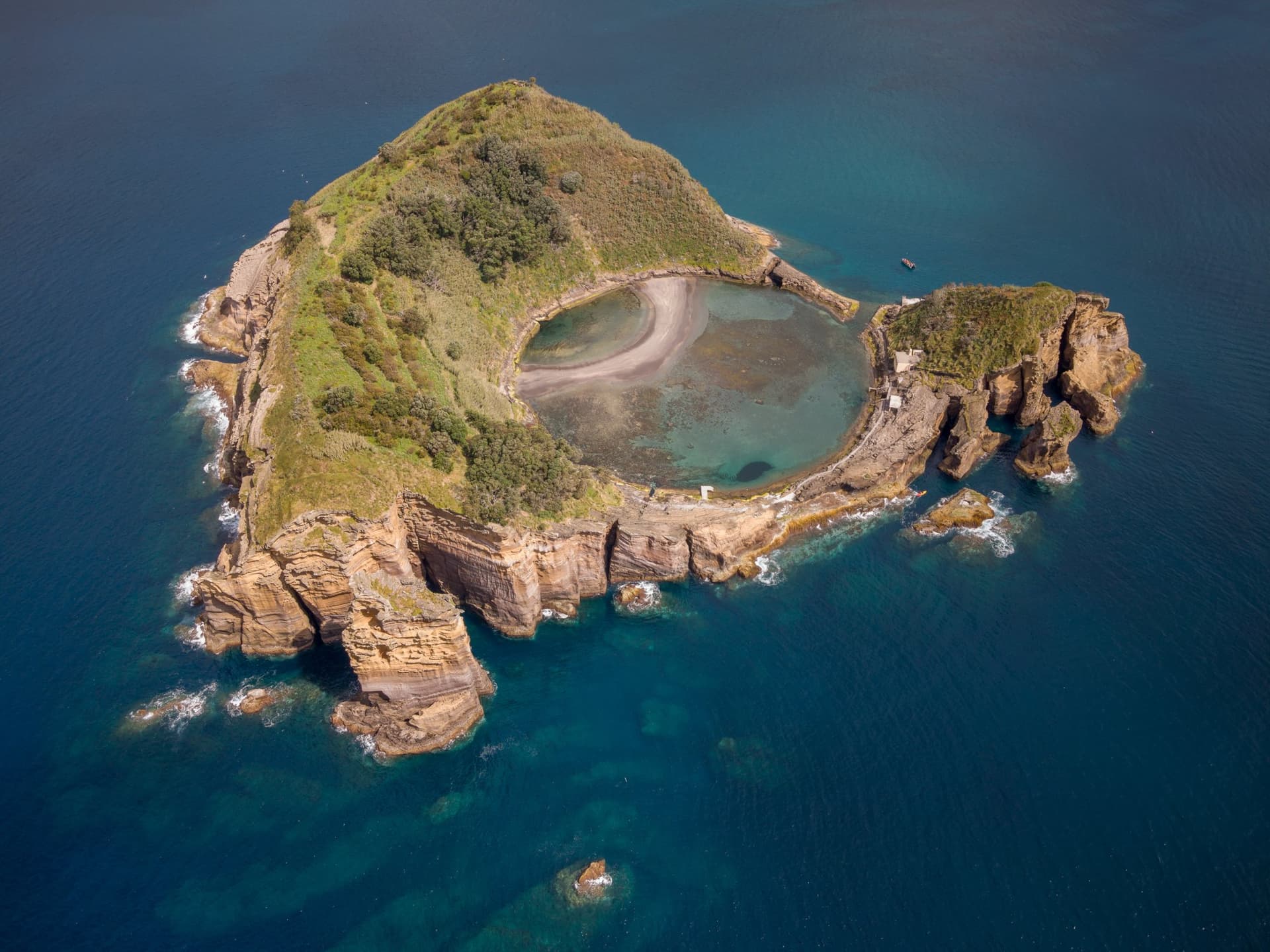
Sao Miguel is the largest island in the Azores and the archipelago's main air gateway, and every dive here starts from a boat: there is no shore diving anywhere on the coast. Two harbours run the whole island, Ponta Delgada, the capital, and Vila Franca do Campo, its older predecessor, with most coastal sites five to twenty minutes out from one or the other. The underwater terrain is volcanic, tuff-cone islets and lava-delta coastline worked into sea caves, small arches and pot-shaped vertical caves, mostly at easy, sheltered depths.
The Dori, a WWII-era steel-cargo ship close to Ponta Delgada, is the one dive that comes up in nearly every account of the island's diving, though her exact depth and the story of how she came to rest here each rest on a single, unconfirmed account (see FAQ). Near Vila Franca do Campo, the Caloura protected area holds Arcos da Caloura's small arches and a low cave, and, next to it, Panela da Ponta da Galera, a vertical pot-shaped cave dropping toward 18 metres. Divers also describe the Ilheu de Vila Franca do Campo itself as walled to about 22 metres, naming it alongside the Dori as one of the two dives worth building a trip around.
Community opinion on the marine life splits down the middle: some divers call it a mixed bag, cold water and a thin fish count against decent topography, while others rate the same operators and sites well within category, pointing to nudibranchs, morays, rays and octopus. Both camps agree on the trade the island makes: calmer, easier inshore diving than Santa Maria or Faial and Pico, at the cost of the mobula-ray and blue-shark aggregations that make those islands' name. Black moray, an Azorean-endemic-leaning species, shares the Caloura caves with Mediterranean moray, dusky grouper and common octopus; loggerhead turtles and bottlenose dolphins pass through, and barracuda and white trevally school over the open reef.
Fly into Joao Paulo II Airport (PDL) at Ponta Delgada, with year-round direct flights from Lisbon and Porto plus seasonal European and North American routes; a rental car helps combine diving with the island's crater lakes and hot springs on days off. Azoresdiving and Best Spot Azores run from Ponta Delgada marina, Azores Sub and Espirito Azul from Vila Franca do Campo, and every dive goes out by RIB or boat. No diving-specific permit or fee applies; the one access control is a visitor cap at Ilheu de Vila Franca do Campo, in force each June to September under Ordinance 66/2018.1 June to October is the best season, with April, May and November as a quieter, less-scheduled shoulder. Pack 5mm exposure protection for summer and 7mm with a hood and gloves for winter, and lean toward the colder end: more than one trip report found the water colder than the stated range. Lagoa das Furnas, the volcanic crater lake inland, is not a dive site.
Volcanic tuff cones and lava-delta coastline, cut into sea caves, small arches and pot-shaped vertical caves; the relief stays shallow and sheltered compared with the sheer walls and seamounts of the central Azores.
The diving here splits into 3 zones:
A shallow, deliberately placed anchor-field artificial reef off Ponta Delgada
A shallow volcanic arch drift near Ponta Delgada, current-driven to about 20 m
One arch site, two routes: shallow photography or a deep black coral passage
South coast reef with a black coral wall at an unusually shallow 14 metres
A 3m reef top named by operators from both of Sao Miguel's south-coast marinas
One islet dived as sheltered east and current-swept west, 12-20 m
West-coast pinnacle for pelagics: barracuda schools and a 60m technical drop-off
A vanished 1811 island's seamount, dived today for manta and devil rays
Book online or contact a centre that dives this area.
SSI Diamond Center at Vila Franca do Campo marina, running boat dives to Sao Miguel's south coast and the offshore Formigas & Dollabarat reserve.

SSI/PADI dive centre at Ponta Delgada marina, Sao Miguel, running boat dives to the Dori wreck and offshore trips to Formigas and Dollabarat.

SSI Instructor Training Center at Rabo de Peixe, on Sao Miguel's north coast; family-run since 2011, away from the island's two main dive harbours.

SSI Instructor Training Center and PADI Dive Resort at Marina Pero de Teive, Ponta Delgada, Sao Miguel, running daily boat and offshore dives.
Dive centre at Marina de Vila Franca do Campo running a 28-site south-coast boat rotation, offshore manta trips, and an affiliated Azores liveaboard.
PADI 5-Star IDC Dive Resort at Marina Pero de Teive, Ponta Delgada, running daily boat dives plus whale-watching, snorkelling and hiking trips.

Get in touch to add or claim your dive center listing on DiveCodex.
More than one trip report found the water colder than the stated range even in summer, so pack toward the cold end. Boat rides can be windy, and April, May and November are a quieter shoulder with fewer, less reliable operator departures.
What can go wrong here, and what divers do about it. Conditions change - take the briefing from the operator on the day.
Heritage zone
Park decreeBanned activities in the parkChecked: Oct 2026
Natural park
Park decree (consolidated)Vila Franca islet access rulesChecked: Oct 2026
National rules also apply: Rules and permits in Portugal
No. Every dive here is boat or RIB-based, launched from Ponta Delgada or Vila Franca do Campo, with most coastal sites five to twenty minutes out and the offshore banks two and a half to three hours each way.
The one account available splits it as stern at about 9 metres and bow at about 20, with no independent confirmation. Treat 9 to 20 metres as an approximate range, not an exact figure.
By a single account: she leaked and was beached near Ponta Delgada on 16 January 1964, en route from Emden to New Orleans with a cargo of steel coils. No independent shipping-registry record has been found to confirm the date or the detail, so treat it as reported, not settled history.
No diving-specific permit or fee applies. The one access control is a visitor-number cap at Ilheu de Vila Franca do Campo each June to September under Ordinance 66/2018, and it protects the reserve during its busiest months; diving itself carries no separate rule.1
No. It is the inland Furnas crater lake, a freshwater attraction with no scuba product; the diving on Sao Miguel is entirely coastal and boat-based.
Not dependably. Divers generally rate Sao Miguel the weakest Azores island for big pelagic encounters. The mobula-ray and blue-shark aggregations that define the archipelago's reputation belong more reliably to Santa Maria and to Faial and Pico; getting to either from Sao Miguel means island-hopping, since Sao Miguel's own boats don't run there.
Two divers have described unofficial restrictions in unspecified areas, but no operator or official source corroborates it. Treat it as an unverified account, not a confirmed rule, and check current access with your operator.
Some Sao Miguel operators run the multi-hour RIB trip out there, but so do Santa Maria operators, and which island the site properly belongs to is unresolved. Confirm the crossing time and conditions with whichever operator you book.
Centres price the two very differently: a one-off discovery try-dive sits well below a full certification course, so compare quotes for each separately; a try-dive price does not carry over to a certification course.
Best Spot Azores, based in Ponta Delgada, comes up most often and most favourably across independent community accounts. Azoresdiving, Azores Sub and Espirito Azul are also active and confirmed on the official Azores dive-centre directory.
Also known as: Azores, São Miguel, The Green Island
Log your dives - notes, photos, conditions and the marine life you saw - and share them as one public diver profile. What you share helps the next diver, too.
Log every detail
Depth, duration, conditions, gear, buddy, notes — all in one place. Import from Suunto and other dive computers.
Track marine life
Record species sightings on each dive. Build a personal catalogue of everything you've seen underwater.
Your public dive profile
Share your dive history, stats, and experiences with a profile page you control. Show the world where you've been.