
Tritón Diving Llafranc
Family-owned dive center in Llafranc since 1979, with 4.9/5 on 717 Google reviews, covering 11 sites across two Costa Brava dive areas.
SSI5 services5 languages
Also known as: Canones de Tamariu, Canyons de Tamariu, Els Canons de Tamariu, Tamariu Canyons, Vijfvingerig rif
Parallel rocky ridges form gorgonian-walled canyon throats between Aiguablava and Aigua Xelida, 9-40m, with barracuda schools and grouper.
Last updated May 2026
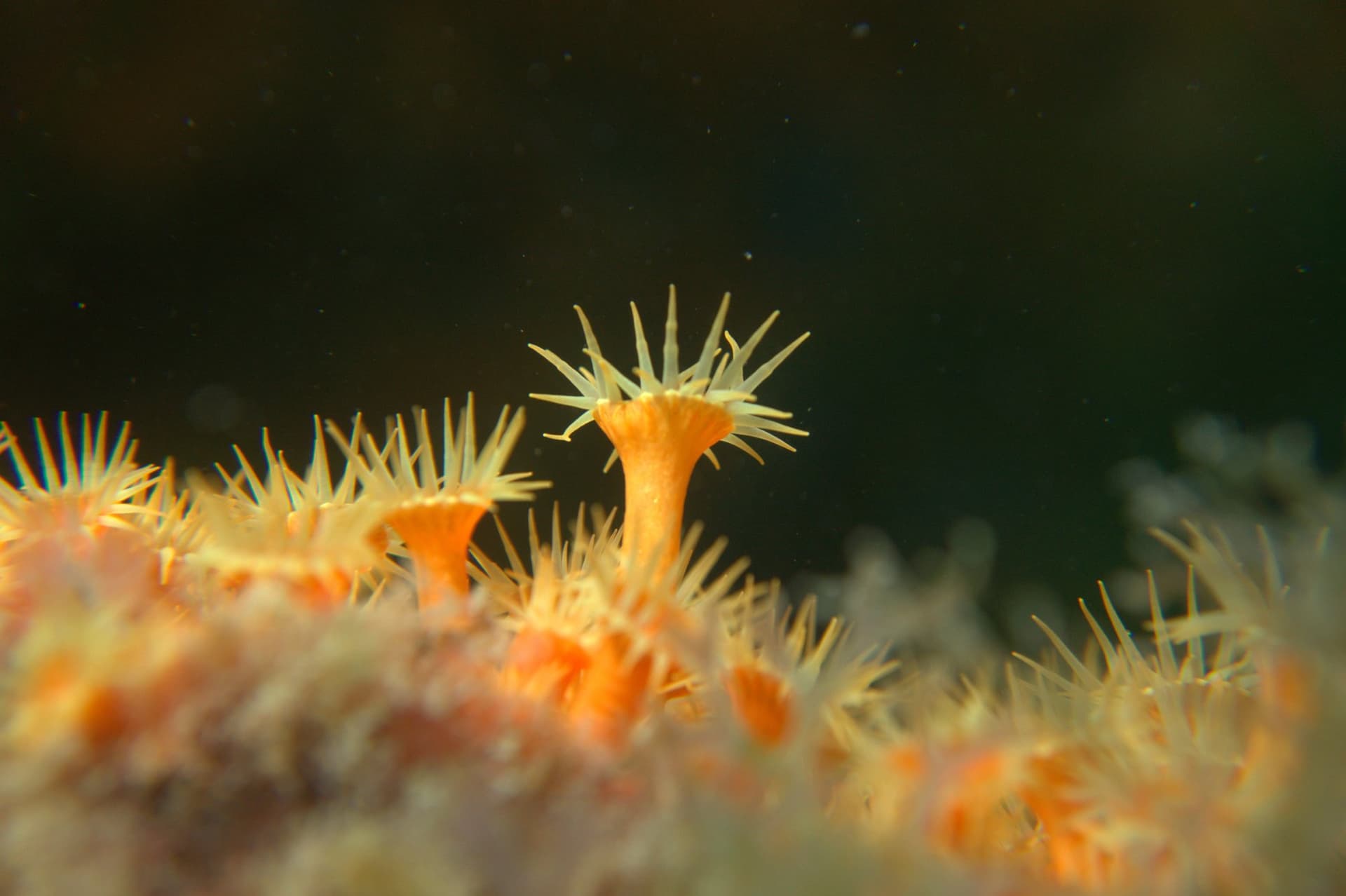
Three to five parallel rocky ridges run northeast across the sea floor, close enough together that the sand channels between them read as canyons with walls. Drop into one of those channels from the 9-12m mooring and the geometry takes over — a vertical wall on each side, sand below, gorgonians on both faces from your shoulders down. The second ridge is the most photogenic stretch, its walls thick with red Paramuricea clavata and yellow Eunicella cavolini, with the coralligenous bottom full of holes and cracks sheltering moray eels, squid, and lobsters.
The visual rhythm shifts with depth. From the reef roof to about 18m the upper canyons read as a complex reef — gorgonian-tipped boulders, damselfish columns rising off the ridges, sight lines into the channels. Between 18 and 30m the walls take over and the gorgonian carpet thickens; this is wall-species territory, with morays in the cracks, scorpionfish on the ledges, lobsters in the holes, and grouper patrolling the gaps between the ridges. Look outward into the blue regularly — barracuda schools cross the canyon openings — and return along the north side of the first ridge for a different character, more cracks, more squid, and depth that eases off in time for the safety stop.
The parallel-ridge geometry is what makes the route flexible. You can cross the crests perpendicular, run a single channel longitudinal out and down, or trace a figure-eight if bottom time allows. The ridges act as a navigation backbone in a way that exposed pinnacle dives in this area do not offer.
The architecture comes first here. Three to five rocky ridges packed close enough that the sand channels between them read as canyon throats rather than gaps between reefs — half a nautical mile offshore on the central Costa Brava, with continuous gorgonian-carpeted walls forming corridors you glide through rather than swim past. A long-running local metaphor — surfacing in Catalan diver chatter around 2006 and repeated by operators across two decades — frames the swim as flying through those throats. The corridor experience is distinct on this coast, where most signature sites are pinnacles or open walls.
Gorgonian density is the second-order draw. One experienced diver, comparing directly with Illes Medes in 2011, noted that while marine life quantity is lower at Canons, the gorgonians are overwhelming. That is the calibration the site rewards: a landscape dive, not a fish-counting dive. The wall colour deepens between 20 and 30m where the carpet is thickest, and the architecture stays legible for the full descent — descend a channel, swim out, return along the next ridge.
Bring a torch. Canyon interiors are dim and the light reveals the gorgonians' real colour even in good visibility. The 9m mooring depth allows long dives up to 60 minutes without decompression obligation, but the canyon floor drops past 40m. It is easy to follow a channel deeper than planned, so set a hard depth limit with your buddy before splashing in.
A thermocline sits below 20m even in July and August, and bottom temperatures fall to 14-19°C — considerably colder than the surface. For the full canyon profile, a 7mm wetsuit or hood is worth considering even in summer. The site is offshore enough that surface chop is part of the boat ride, and the run from Palamós takes 30-40 minutes; closer ports — Tamariu, Llafranc, Aiguablava — get you to the mooring in under 10. Multiple independent centres operate the site from each of these ports, so booking is rarely the constraint.
What makes this dive site stand out.
Red and yellow gorgonians carpet the parallel canyon walls from 12 to 35m
Large schools of Mediterranean barracuda are one of the most frequent summer sightings
Three to five parallel rocky ridges create varied swim-throughs and channels
Mooring at 9m allows OW access to the reef roof while canyons reach 40m
41.9229°N, 3.2223°E
June-August peak for warmth, visibility, and barracuda schools. March-June also good for spring species and fewer divers.
Indicative price from one Palamós operator. Other centres' rates vary; confirm with your chosen centre.
OW divers can explore the reef roof and upper canyons at 9-18m. AOW recommended for the full canyon dive to 35m and beyond.
Summary
Shallow mooring at 9m suits OW divers at the top. Full canyon exploration to 35-40m and variable currents at this offshore location raise the challenge.
Safety considerations
What can go wrong here, and what divers do about it. Conditions change - take the briefing from the operator on the day.
Book a guided dive at this site.
Family-owned dive center in Llafranc since 1979, with 4.9/5 on 717 Google reviews, covering 11 sites across two Costa Brava dive areas.
PADI, SSI, and CMAS center at Port Marina Palamós with year-round boat dives, small groups, and full MARES equipment. SSI Instructor Training Center.

SSI dive centre on Aiguablava beach in Begur, Costa Brava, running boat and shore dives to a dozen sites within ten minutes of the launch.

Small SSI center on the Cala Gogo beachfront near Sant Antoni de Calonge, capping discover dives at two and courses at four, with the boat from Palamos.
Small-group dive center in Tossa de Mar with a year-round boat, max 4 divers per guide, PADI TecRec and CCR training, and on-site accommodation.

PADI 5-Star IDC Center at Port Marina Palamós with technical, recreational, and freediving programs and daily boat trips to Ullastres and the Boreas wreck.
SSI and PADI center inside Port Marina Palamós, twenty-plus years operating, with a published price list and a 4.8/237 Google rating under owner Jordi.
Get in touch to add or claim your dive center listing on DiveCodex.
Upcoming trips to this dive site published by local centres.
Availability is read from each centre's public calendar and refreshed daily. Last checked September 21. Confirm with the centre before travelling.
Open Water is enough for the reef roof and upper canyons at 9-18m. For the full canyon experience to 35m and beyond, Advanced Open Water is recommended. Operators classify the deep route as advanced.
May through October for warm water and good visibility. June to August is peak with 22-26°C surface temperatures, 20m+ visibility on a good day, and barracuda schools. Spring (March-June) brings monkfish, John Dory, and fewer divers.
Several. The canyon system has three to five parallel ridges with many corners. Divers who know the site say repeat visits are how you get to know each finger and its cracks, especially when depth or conditions cap any single dive.
Different dives. The Ullastres are pinnacles rising from depth; Canons is parallel canyon channels lined with gorgonians. The corridor sensation at Canons is unique on the Costa Brava. The Ullastres deliver open-water wall diving. Both are signature sites in the area.
Canyon walls are heavily covered in red and yellow gorgonians, the site's defining feature. Barracuda schools, grouper, moray eels, scorpionfish, and spiny lobster are common. In spring, monkfish and John Dory appear. Older diver accounts compare the gorgonian density favourably with Illes Medes.
Nitrox is strongly recommended. The canyons reach 35-40m, and enriched air extends bottom time at those depths. Older forum reports already noted the gap between nitrox and air divers staying down on the same trip.
Tamariu, Llafranc, and Aiguablava are the closest with under-10-minute boat rides. Palamós is a 30-40 minute run. Multiple independent centres operate the site from each of these ports, so booking is usually straightforward at any of them.
Log your dives - notes, photos, conditions and the marine life you saw - and share them as one public diver profile. What you share helps the next diver, too.
Log every detail
Depth, duration, conditions, gear, buddy, notes — all in one place. Import from Suunto and other dive computers.
Track marine life
Record species sightings on each dive. Build a personal catalogue of everything you've seen underwater.
Your public dive profile
Share your dive history, stats, and experiences with a profile page you control. Show the world where you've been.