
Tritón Diving Llafranc
Family-owned dive center in Llafranc since 1979, with 4.9/5 on 717 Google reviews, covering 11 sites across two Costa Brava dive areas.
SSI5 services5 languages
Also known as: Els Ullastres II, Riff II, Ullastre 2, Ullastre del medio, Ullastre II
Middle Ullastres pinnacle off Llafranc, with 25m gorgonian towers, a south-face fissure sheltering lobsters, and an asymmetric profile for mixed groups.
Last updated May 2026
The mooring buoy puts divers on a 6-9m summit broad enough for a small group to gather before the dive splits by certification. From the rim, the south route runs gradually downslope into the 20-30m band, picking through isolated rocks that form small caves and arches: a torch into a hole for a scorpionfish, a scan of the larger crevices for moray and conger, octopus and the occasional resting ray on the gravel. Partway down the south side, a single fissure cuts into the seabed; guides flag the entrance and a beam usually picks out spiny lobster in the back. The east and north routes change the rhythm. The bottom drops more abruptly to 30-32m, and the 20-25m rock towers are best seen from below looking up, with red gorgonian filling the frame. Anthias swarm the gorgonian tops, and barracuda often hold in open water off the wall, summer-skewed from July through September. For AOW divers with adequate gas, the classic extension is the transit to Ullastres III, where the gap between the pinnacles is deeper than either summit and depth and time have to be managed for the return. The dive almost always finishes on a safety stop on the buoy line, damselfish and small wrasse clouding the line above the seamount.
Ullastres I is the shallow initiation pinnacle. Ullastres III is the deep wall. This pinnacle is the one a centre books when those two are too far at either end and a guide wants flexibility for a mixed group. Three concrete things recur in centre descriptions. The asymmetric profile is the practical one: an OW diver staying above 18m on the south slope and an AOW diver dropping the east face to the gorgonian band at 30m are on the same dive, off the same buoy. The 25m rock towers are the visual one — the densest stack of upright gorgonian-cloaked towers among the three pinnacles, all in the 20-30m band. The south-face fissure is the third, the landmark guides reach for in the briefing and the torch-find guests remember. Around the pinnacle, the picture is consistent: moray eel is the most reliable sighting and red gorgonian is the constant backdrop. The site does not have the deeper-water reverence Ullastres III gets in trip reports; it generates returning regulars who come back for the mix.
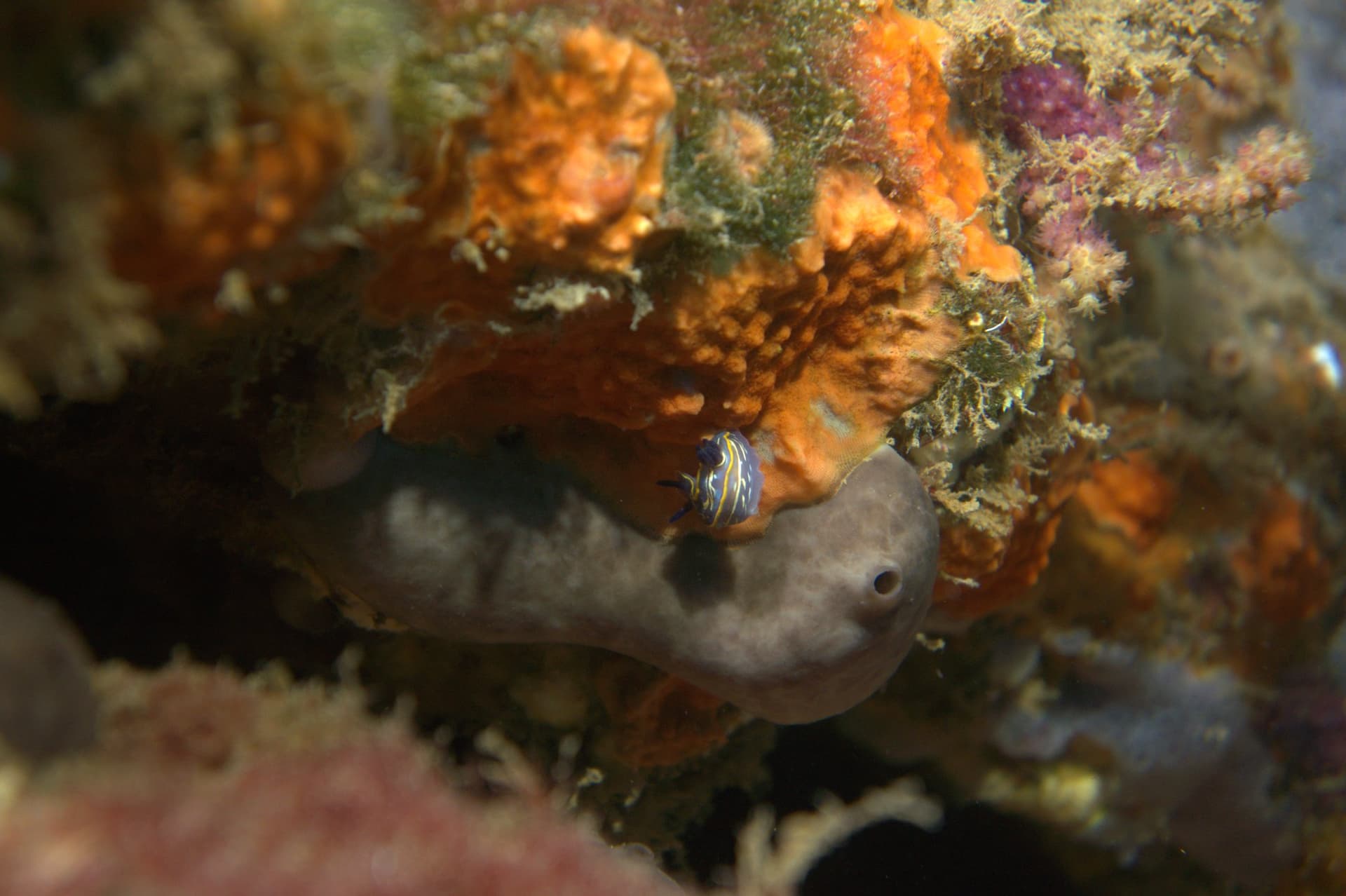
The two faces serve two different lenses on the same dive. The east and north are the wide-angle aspect: descend into the gorgonian band at 25-30m, angle up under the 25m towers, and let the red Paramuricea clavata and the anthias clouds carry the frame. In summer the barracuda schools work the open water column off the wall, with the heaviest activity from July through September. The south face is the macro aspect: torch into the crevices among the base rocks for scorpionfish and conger, watch the entrance of the fissure for spiny lobster, and scan the rock surfaces for nudibranchs. A torch is the difference between seeing the fissure residents and missing them. Red flash filters help with blue-water colour correction on the deeper east-and-north shots — standard practice at depth on this aspect.
Bring a torch for the fissure and the south-face caves and passages. Nitrox is recommended for the deeper east-and-north faces and for the transit to Ullastres III, and is available at local centres for around 8 EUR. The south slope is gentle enough that 40m arrives without warning — plan a maximum, set a depth alarm, and turn the dive at the planned cota. The boat ride is roughly 20-25 minutes from Palamós port or 5-10 minutes from Llafranc, with the mooring buoy fixed at the summit. South-westerly garbí can produce a surface chop even when the port looks calm; conditions at depth usually settle by 10-15m. Triton Diving in Llafranc requires OW divers to hire a guide per person at this pinnacle, and Spanish regulations require all recreational divers to carry accident-and-civil-liability insurance and, for divers over 12, a doctor's diving-fitness certificate. Centres apply the standard 12 to 18 hour post-dive flight rule.
What makes this dive site stand out.
South face slopes gradually to 40m+; east and north faces drop to 30-32m, letting guides route any cert level
Vertical rock stacks cloaked in red Paramuricea clavata, densest on the east and north faces
A crack into the seabed where spiny lobsters shelter; the consistent torch-find on this pinnacle
The mixed-group option between Ullastres I (shallow initiation) and Ullastres III (deep wall)
41.8847°N, 3.2026°E
Warmest water, best visibility, barracuda peak July-September. Diveable year-round when weather allows.
Indicative 2026 prices: single boat dive around 41-42 EUR, nitrox supplement around 8 EUR. Verify with the dive centre.
OW divers stay on the summit and upper south slope to 18m. AOW recommended for the east-and-north faces beyond 18m and for the south face past 18m. Transit to Ullastres III is AOW-only.
Summary
The asymmetric profile lets a guide route any cert level safely, but the depth options on the east and north faces and the III transit require AOW.
Safety considerations
What can go wrong here, and what divers do about it. Conditions change - take the briefing from the operator on the day.
Book a guided dive at this site.
Family-owned dive center in Llafranc since 1979, with 4.9/5 on 717 Google reviews, covering 11 sites across two Costa Brava dive areas.
PADI, SSI, and CMAS center at Port Marina Palamós with year-round boat dives, small groups, and full MARES equipment. SSI Instructor Training Center.

Small SSI center on the Cala Gogo beachfront near Sant Antoni de Calonge, capping discover dives at two and courses at four, with the boat from Palamos.
Small-group dive center in Tossa de Mar with a year-round boat, max 4 divers per guide, PADI TecRec and CCR training, and on-site accommodation.

PADI 5-Star IDC Center at Port Marina Palamós with technical, recreational, and freediving programs and daily boat trips to Ullastres and the Boreas wreck.

SSI center at Port Marina Palamós, open every day of the year, with the 30-pax MANSABA boat covering Boreas, Ullastres, and Illes Formigues.
SSI and PADI center inside Port Marina Palamós, twenty-plus years operating, with a published price list and a 4.8/237 Google rating under owner Jordi.
Get in touch to add or claim your dive center listing on DiveCodex.
Upcoming trips to this dive site published by local centres.
Availability is read from each centre's public calendar and refreshed daily. Last checked September 21. Confirm with the centre before travelling.
No permits, no fees beyond dive-centre charges.
Ullastres I is the shallow initiation pinnacle, a broad 10-32m platform routed for newer divers and crevice work. Ullastres III is the deep, near-vertical north wall running to 50-55m for AOW divers. Ullastres II sits between them as the middle pinnacle, with 25m gorgonian towers, a south-face fissure, and an asymmetric profile that lets a guide route OW divers on the south slope and AOW divers on the east-and-north face on the same dive.
A crack running into the seabed on the south side of the pinnacle. Spiny lobsters shelter inside, and a torch sweep usually finds them in the back. The fissure is one of the consistent landmarks guides flag in the briefing for this pinnacle.
Open Water is enough for the summit and the upper south slope to 18m. Advanced Open Water is recommended for the east and north faces beyond 18m and for the south face past 18m. Triton Diving in Llafranc requires OW divers to hire a guide per person here. The transit to Ullastres III is an AOW-only extension dive.
It is an AOW-only extension dive. The gap between the two pinnacles crosses water deeper than either summit, so depth and gas have to be planned before descent for the return leg. Most divers visit each pinnacle on its own dive.
June through October for the warmest water, best visibility, and barracuda schools, which peak July through September. The site is diveable year-round when weather allows. Winter trips are quieter and bring John Dory and monkfish on the deeper sand.
Wide-angle and macro both work. The east and north faces frame the 25m gorgonian towers from below with anthias clouds and summer barracuda for wide-angle. The south face is the macro side: scorpionfish and morays in the base rocks, lobsters in the fissure, nudibranchs on rock surfaces. A torch is needed for the fissure and the narrow passages.
Log your dives - notes, photos, conditions and the marine life you saw - and share them as one public diver profile. What you share helps the next diver, too.
Log every detail
Depth, duration, conditions, gear, buddy, notes — all in one place. Import from Suunto and other dive computers.
Track marine life
Record species sightings on each dive. Build a personal catalogue of everything you've seen underwater.
Your public dive profile
Share your dive history, stats, and experiences with a profile page you control. Show the world where you've been.