
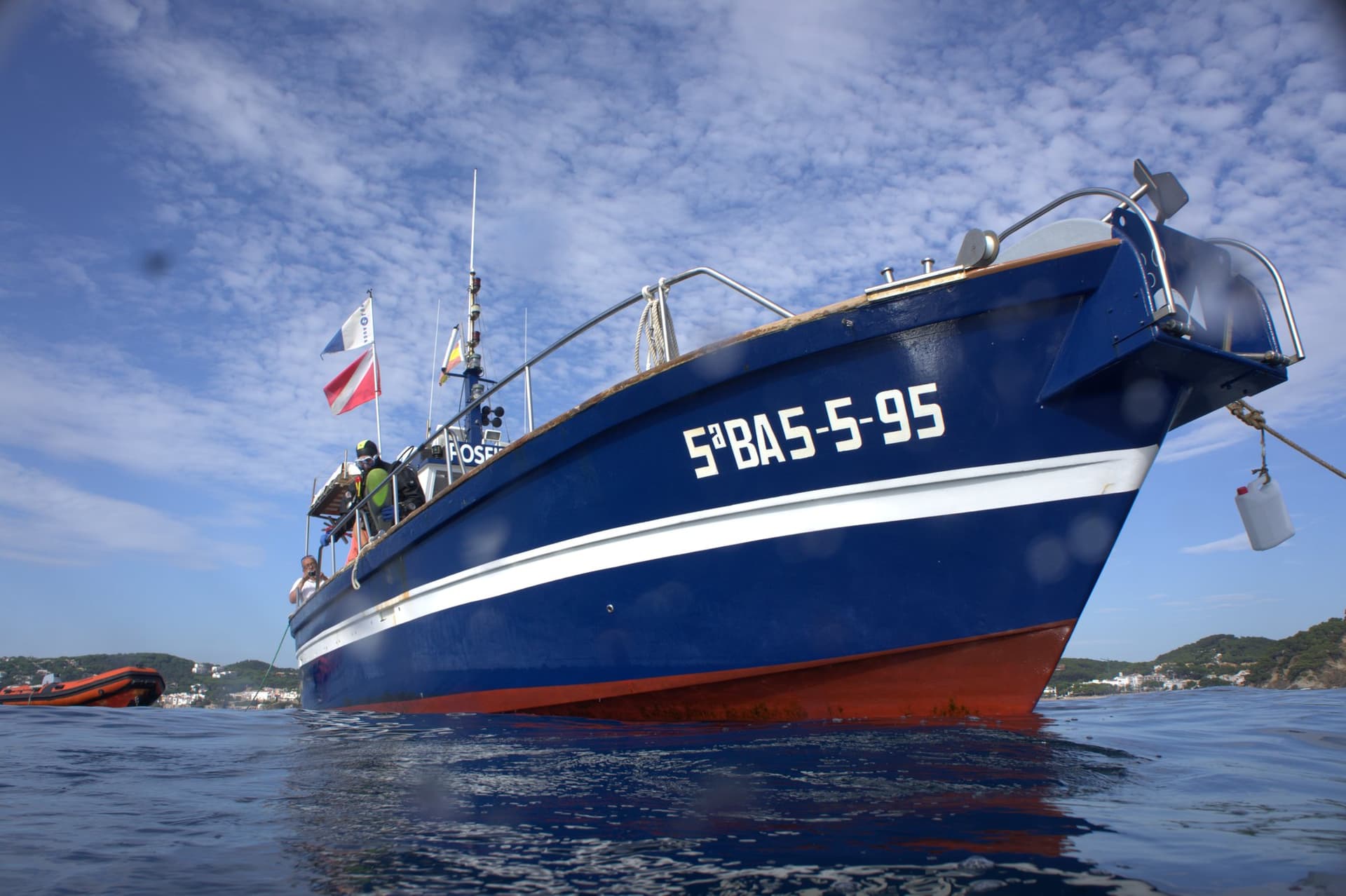
Tritón Diving Llafranc
Family-owned dive center in Llafranc since 1979, with 4.9/5 on 717 Google reviews, covering 11 sites across two Costa Brava dive areas.
SSI5 services5 languages
Also known as: Els Ullastres III, Riff I, Ullastre 3, Ullastre de afuera, Ullastre III
Outermost and deepest of the three Ullastres pinnacles off Llafranc, a near-vertical north wall to 50-55m densely covered in red and yellow gorgonians.
Last updated May 2026
The mooring buoy puts divers on a summit at 6-9m where the dive begins almost as a Ullastres I lookalike — broken rocky top, a few sea bream, scorpionfish on the ledges. Few divers linger. From the rim of the summit, the north face peels into the vertical descent the site is known for, and the dive commits to the wall. By 20-25m the gorgonian forest takes over: dense red Paramuricea clavata interleaved with yellow Eunicella cavolini, fans across every rock face the colonies can hold. The boulder field between roughly 25 and 40m breaks the wall into ledges and overhangs, and this band is where the photography time concentrates. Anthias clouds work the same column. Grouper and dentex appear out of the open water side. The wall keeps going past 40m to the 50-55m base, well beyond the day's plan for most teams. The exposed open-sea position means barracuda schools cruise the column in summer; winter brings John Dory and the chance of sunfish. The return is up the wall, gas and no-decompression time on the diver's side, often where the most considered shots happen.
Ullastres I is the crevice-hunt. Ullastres II is the all-rounder with towers and a fissure. III is the wall — "casi vertical", "repleta de grandes gorgonias", an underwater spectacle that the local Spanish-language framing reaches for unique adjectives to capture. Among the three pinnacles the gorgonian cover here is the densest. The depth is also the most committing: there is no natural bottom on the open-sea face to stop a wandering eye, and the site has a reputation among local centres as the most complicated of the trio for that reason. The trade-off is that the dive concentrates. Bottom time on the gorgonian band at 25-40m is limited, the route is the wall, and weather has more vote than at the sheltered siblings. For divers who already know I and II and want the deep, exposed end of the trio, this is what III is for.
The wall has no floor at recreational depth. Plan a maximum and set the alarm before descending. Nitrox extends bottom time on the gorgonian band at 30-40m and is recommended. Bring a wide-angle lens and a torch — the gorgonian colour drops fast at depth and the boulder field at 25-40m hides ledges and overhangs that need a beam. Expect a sharp thermocline below roughly 15-20m in summer; the wall at 40m runs materially colder than the surface even in August, so plan exposure protection for the bottom rather than the deck. The open-sea position makes Ullastres III the most weather-sensitive of the three pinnacles. When surface conditions close it out, centres swap to Ullastres I or II and try again on a calmer day.
What makes this dive site stand out.
From a 6-9m summit, the open-sea face descends almost vertically to 50-55m
Red Paramuricea clavata interleaved with yellow Eunicella cavolini blanket the wall
The most exposed of the three pinnacles, with more pelagic activity in the open water
Ledges and overhangs on the north side break the wall and concentrate photography time
41.8845°N, 3.2020°E
Peak July-August. Winter trips run for sunfish and John Dory rather than colour.
Verify current rates with dive center
OW divers can stay on the shallow summit and upper wall to 18m. AOW recommended for the gorgonian band on the wall. Deep Diver specialty or technical certification useful for the full wall.
Summary
The most committing of the three Ullastres. The wall offers no natural depth stop and runs to 55m, the open-sea position adds variable currents, and the gorgonian band sits at 25-40m where bottom time is limited.
Safety considerations
What can go wrong here, and what divers do about it. Conditions change - take the briefing from the operator on the day.
Book a guided dive at this site.
Family-owned dive center in Llafranc since 1979, with 4.9/5 on 717 Google reviews, covering 11 sites across two Costa Brava dive areas.
PADI, SSI, and CMAS center at Port Marina Palamós with year-round boat dives, small groups, and full MARES equipment. SSI Instructor Training Center.

Small SSI center on the Cala Gogo beachfront near Sant Antoni de Calonge, capping discover dives at two and courses at four, with the boat from Palamos.
Small-group dive center in Tossa de Mar with a year-round boat, max 4 divers per guide, PADI TecRec and CCR training, and on-site accommodation.

PADI 5-Star IDC Center at Port Marina Palamós with technical, recreational, and freediving programs and daily boat trips to Ullastres and the Boreas wreck.

SSI center at Port Marina Palamós, open every day of the year, with the 30-pax MANSABA boat covering Boreas, Ullastres, and Illes Formigues.
SSI and PADI center inside Port Marina Palamós, twenty-plus years operating, with a published price list and a 4.8/237 Google rating under owner Jordi.
Get in touch to add or claim your dive center listing on DiveCodex.
Upcoming trips to this dive site published by local centres.
Availability is read from each centre's public calendar and refreshed daily. Last checked September 21. Confirm with the centre before travelling.
No permits, no fees.
The three pinnacles share a habitat but read as a progression. Ullastres I is the shallow, sheltered crevice dive at 10-32m, suited to newer divers and macro work. Ullastres II is the all-rounder with 25m gorgonian towers, a lobster fissure, and routes to 42m. Ullastres III is the deepest and most exposed: a near-vertical north wall to 50-55m with the densest gorgonian cover of the three. Most divers work through the trio in order.
OW divers can stay on the shallow summit and upper wall to 18m, but the gorgonian spectacle the site is known for sits at 25-40m on the wall. Local centres recommend Advanced Open Water for the wall experience, and a Deep Diver specialty or technical certification for the full descent. OW divers wanting their first taste of the Ullastres are usually routed to Ullastres I or II first.
Sunfish are an occasional autumn-winter sighting at the Ullastres rather than a reliable summer feature. Winter dives also bring John Dory (San Pedro), which a forum diver photographed at 31m on Ullastres II in April. Summer brings barracuda schools in the open water column instead.
Experienced teams sometimes link the two pinnacles in a single dive, but the gas and depth management leaves little margin and the route is for advanced divers comfortable with deep multi-level profiles. Most divers visit each pinnacle separately on its own dive.
From a summit at 6-9m the open-sea face descends almost vertically to 50-55m. The gorgonian band concentrates around 25-40m on the wall, which is also where most non-tec dives spend their bottom time. Beyond 40m the wall continues into technical-diving territory.
Wide-angle is the dive's natural lens. The vertical gorgonian wall and the boulder ledges at 25-40m are the wide-angle subjects. The dense red and yellow gorgonians benefit from a strobe and a colour filter to bring out reds at depth.
Log your dives - notes, photos, conditions and the marine life you saw - and share them as one public diver profile. What you share helps the next diver, too.
Log every detail
Depth, duration, conditions, gear, buddy, notes — all in one place. Import from Suunto and other dive computers.
Track marine life
Record species sightings on each dive. Build a personal catalogue of everything you've seen underwater.
Your public dive profile
Share your dive history, stats, and experiences with a profile page you control. Show the world where you've been.