

Posidonia Dive
SSI Diamond Instructor Training Center at Port Balis marina, 35 km north of Barcelona, running 24 boat dive sites on the Maresme coast year-round.
SSI7 services3 languages
NE terminus of the Barra del Negre off Port Balis, with a 16m flat top carrying dense pink flatworms in cooler months and a 25m crevice flank.
Last updated April 2026
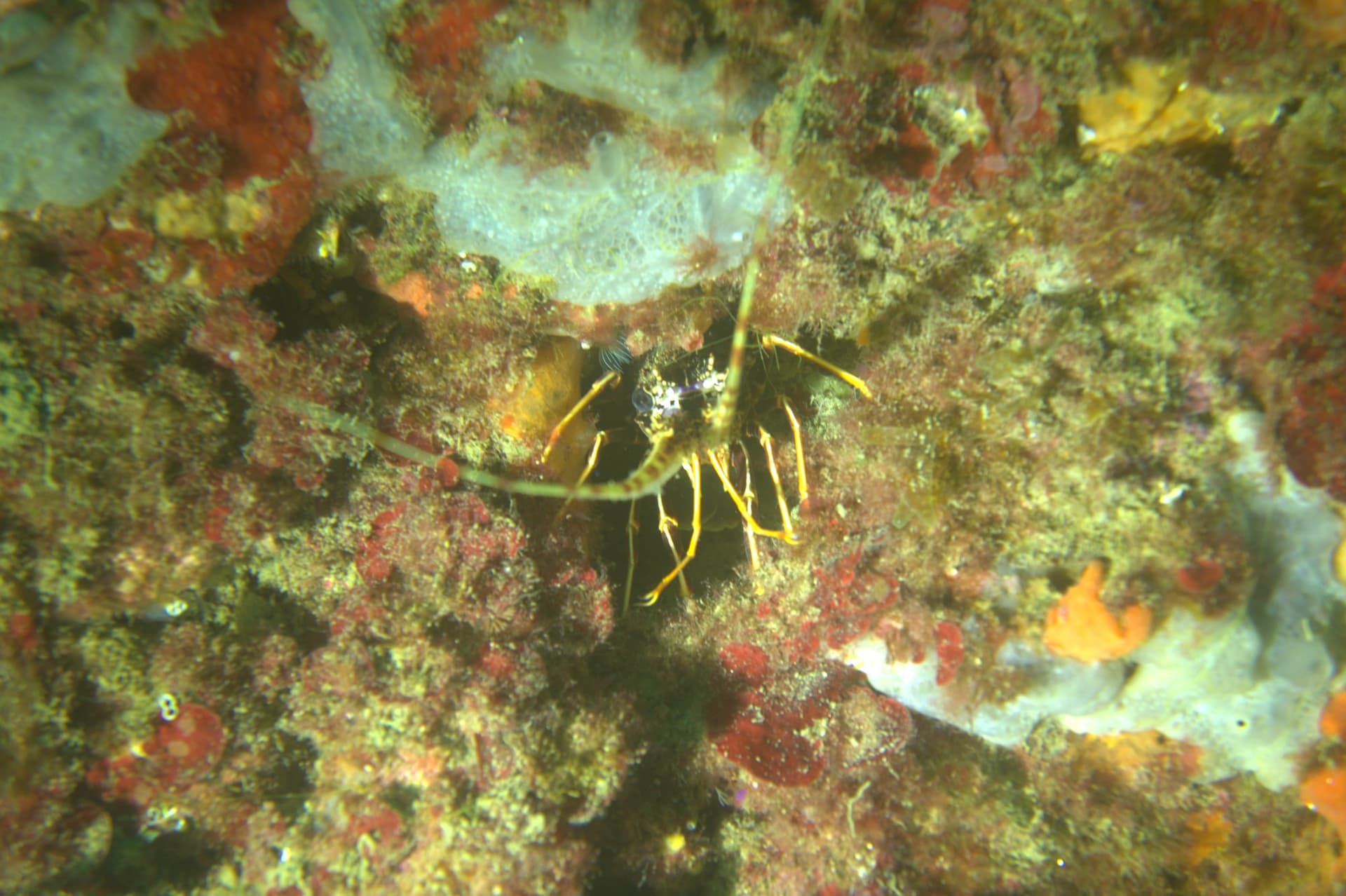
Punta Cana sits at the north-east end of the Barra del Negre, the continuous 1.5km underwater ridge that runs roughly parallel to this stretch of coast. The Posidonia boat anchors over the bookend, the centre lays a guide line across the rock, and the descent settles divers onto a flat top at about 16 metres. Two distinct legs run off that anchor. The eastern, seaward flank drops down to the sand line at 25 metres on a steeper face — that is the rock-crevice leg, with a big moray in the holes, scorpionfish on the rock, and small spiny lobsters tucked under ledges on the deeper rock-and-sand interface. The flat top of the ridge at 16 metres is the slower, lower-bottom-time leg, where the dive's most distinctive signal lives.
In April 2026, that signal was tens of pink flatworms (Prostheceraeus roseus) spread across the flat top, mixed with flabellinas and the spotted doris locally known as the vaquita suiza. The cool-water months are when this density appears; the warmer rotation does not hold the same concentration. Damselfish drift over the rock, and barracudas were observed circling the shallower top section on the same April dive. On air at the deeper end, NDL margin runs short, which is why Nitrox is the local default. EAN32-34 lets divers work the flat top patiently rather than chase NDL margin. The dive ends back at the anchor for a controlled ascent.
Two things set Punta Cana apart from the other anchorages on the same formation. First, the depth profile. The flat top at 16 metres is shallower than Ancora or Peu, and a significant slice of the dive sits in that band, which suits patient macro observation rather than fast traversal. Second, the cool-season flatworm density. The April 2026 owner observation of tens of Prostheceraeus roseus across the flat top is a site-specific signal that does not appear in the area calibration for the deeper Negre anchorages, and it gives the site a clear seasonal hook from autumn through spring. Combined with a good chance of nudibranchs on the flat top and morays on the eastern flank, the dive reads as the macro-friendly bookend of the Barra del Negre cluster.
The page on screen is not the Caribbean Punta Cana — that is a Dominican Republic resort area with no relationship to this site. Look low and look slow on the flat top, especially in cooler months when the Prostheceraeus roseus density is in season. Bring a torch for the eastern crevice flank and Nitrox for bottom time on the macro work; a computer, SMB, and compass round out the standard Maresme boat-dive kit. Pick the suit by what the bottom feels like, not the surface: 5mm with a hood for summer above the thermocline, drysuit or 7mm semi-dry through autumn and winter. Bookings run through Posidonia Dive at Port Balis.
What makes this dive site stand out.
Bookend anchorage on the 1.5km continuous formation that includes Ancora and Peu del Negre
Flat top at 16m for slow macro work; eastern flank drops to 25m for crevice-and-rock fauna
Prostheceraeus roseus observed in tens on the flat top in April 2026; cool-season concentration
The Catalan Punta Cana off Sant Andreu de Llavaneres, not the Dominican Republic resort
41.5346°N, 2.5079°E
May-October is the centre-rotation window. The flatworm and nudibranch signal on the flat top peaks in cooler months — autumn through spring.
Verify current rates with Posidonia Dive.
Working depth band 16-22m is within OW limits with a guide. Excursions to 25m on the eastern flank push toward AOW.
Summary
Navigation is straightforward — follow the ridge, return on the flat top. Depth band sets the practical floor.
Safety considerations
What can go wrong here, and what divers do about it. Conditions change - take the briefing from the operator on the day.
Book a guided dive at this site.
SSI Diamond Instructor Training Center at Port Balis marina, 35 km north of Barcelona, running 24 boat dive sites on the Maresme coast year-round.
Get in touch to add or claim your dive center listing on DiveCodex.
No. The Catalan Punta Cana is a Mediterranean rocky ridge dive off Sant Andreu de Llavaneres in Catalonia, Spain. It sits at the NE end of the Barra del Negre formation, anchored at 41.5346 N, 2.5079 E, with a 16-25m depth profile on porous rock. The Caribbean Punta Cana is a Dominican Republic resort area; the names are coincidental and the sites are unrelated.
Cooler months are the window for Prostheceraeus roseus on the flat top. An April 2026 dive logged tens of individuals concentrated on the rock at 16m. Warmer months do not hold the same density. Autumn through spring is the practical season for this signal, with drysuit or 7mm semi-dry as the appropriate exposure for the bottom band.
Open Water with a guide is enough for the working depth band of 16-22m on the flat top. Excursions to 25m on the eastern flank approach the OW boundary and benefit from AOW. Nitrox is the local norm and meaningfully extends bottom time on the macro-rich top section.
Punta Cana is the NE bookend of the 1.5km continuous Barra del Negre. The same formation carries two more named anchorages: Ancora del Negre in the middle and Peu del Negre at the SW foot. Each is a different anchorage on the same continuous ridge, with its own depth band and character. Punta Cana is the shallowest and most flat-top focused of the three.
No. The 5 EUR concession fee that some divers know from El Santuari is a private commercial concession on the sunken fish-farm site, not a Maresme-wide charge. Punta Cana is a regular boat anchorage with no permit, no quota, and no reserve fee. Standard centre dive pricing applies.
Log your dives - notes, photos, conditions and the marine life you saw - and share them as one public diver profile. What you share helps the next diver, too.
Log every detail
Depth, duration, conditions, gear, buddy, notes — all in one place. Import from Suunto and other dive computers.
Track marine life
Record species sightings on each dive. Build a personal catalogue of everything you've seen underwater.
Your public dive profile
Share your dive history, stats, and experiences with a profile page you control. Show the world where you've been.