

Blue Ocean Divers
German-owned SSI/PADI dive centre at Luz Bay Club, Praia da Luz near Lagos, running shore and boat dives across the western Algarve since 1996.
SSI / PADI5 services3 languages
Portugal's mainland Atlantic south coast, a single day-boat and shore run from Sagres's sea caves to a wreck trail off Faro.
Last updated September 2026
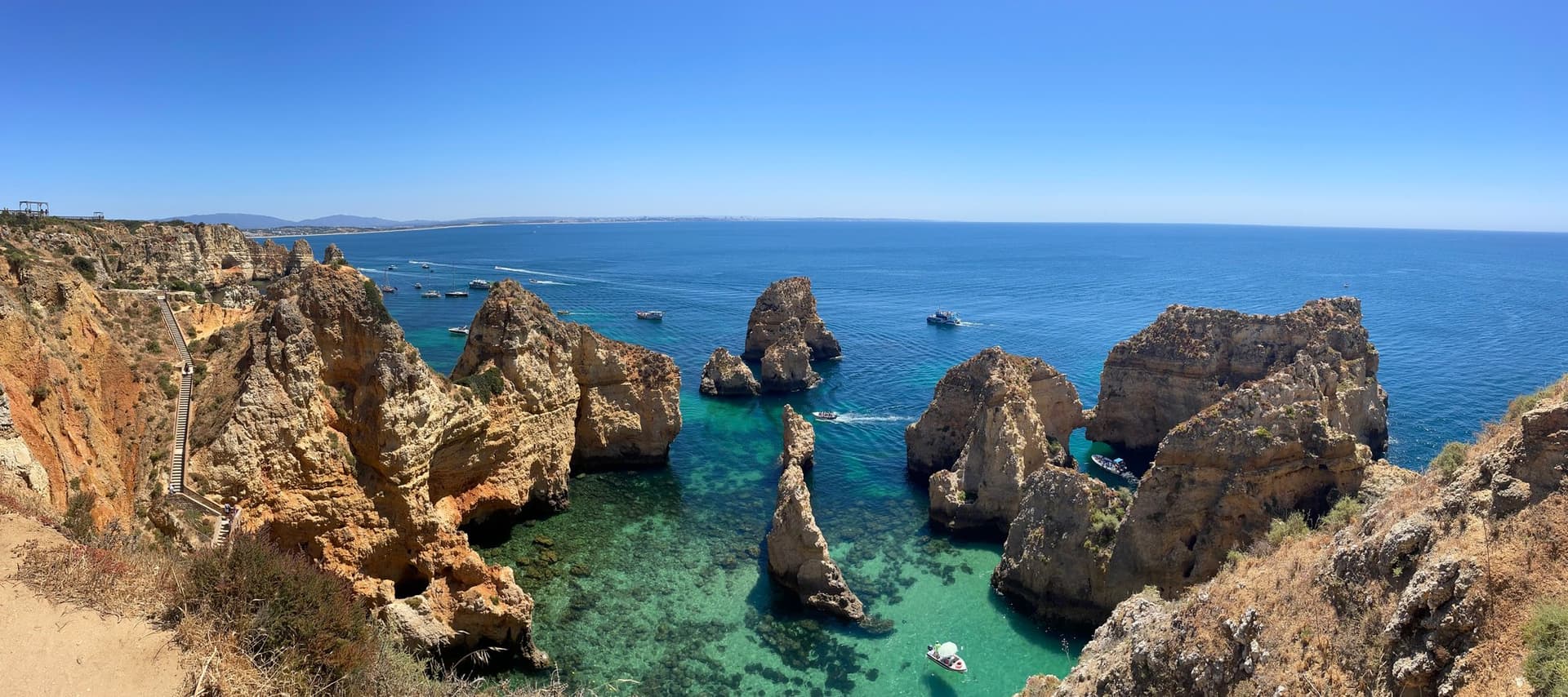
The Algarve is dived as one continuous run of Atlantic shoreline, roughly 150 km from Sagres to Faro, from day boats and beaches, without the island-hopping the Azores and Madeira require. Two identities run its length. At the western end, erosion has cut sea caves, grottoes and arches into the limestone around Sagres and Lagos. Further along runs a wreck trail, seeded first by war and then by design: Torvore and the Wilhelm Krag, a WWI coal freighter and its sister vessel, were both sunk by the same German U-boat in April 1917 between Lagos and Burgau. Off Faro, a WWII Liberator bomber that ran out of fuel and ditched during a disoriented night patrol in November 1943, killing five of its eleven crew, rests near the Navio do IPIMAR, an iron trawler scuttled in 1995 as an artificial reef. Portimao adds the coast's headline dive, Ocean Revival: four decommissioned Portuguese Navy vessels sunk together in 2009, with reported depths spanning roughly 15 to 35 metres from bridge to keel.
Since January 20241 a roughly 156 km2 marine park, the Parque Natural Marinho do Recife do Algarve - Pedra do Valado, has overlapped part of the area's dive-site inventory between the Alfanzina Lighthouse and Albufeira marina, taking in Valados, Pedra do Alto, Marinha Beach and Arriefes. Diving is reported as permitted in the park's outer zones but not inside a roughly 4 km2 integral-reserve core, and no permit fee or quota applies there; sites elsewhere on the coast sit outside the park. Shallower reefs near Lagos and Burgau, three to eight metres over rock with resident octopus, cuttlefish and moray, suit new divers, while the offshore wrecks and the Sagres caves want more current tolerance and buoyancy control. Divers arriving from warm water often describe real culture shock: cold temperatures, surface swell and murkier water than a coral-trained eye expects, though Sagres draws repeat praise for a rockier bottom and clearer water than the coast further east.
Faro Airport (FAO) sits inside the region and is the gateway, with Sagres about ninety minutes' drive west and Albufeira around forty minutes east. Diving is shore and day-boat only: no liveaboard currently runs in the Algarve, and the closest thing to a liveaboard anywhere in Portugal is a private multi-day charter catamaran running from the Azores. Expect a 7mm wetsuit with hood, gloves and boots regardless of season; even summer surface temperatures of 18 to 20C hide an 11C layer below about fifteen metres. March to May and September to November give the clearest water, and divers repeatedly name August as the coldest, murkiest month to book around. Most operators run from Sagres, Lagos, Portimao, Carvoeiro and Albufeira; Faro's own dive-shop presence is unsettled, with one operator named there in 2009 and a resident diver finding none in 2025. Diving runs year-round, and national law (Lei n.o 24/2013) requires licensed schools and recognises CMAS, PADI, SSI, SDI, DDI and GUE certification cards.
Limestone cliffs, caves and arches cut by erosion around Sagres and Lagos, giving way to rockier reef further east, with a few reported patches of volcanic rock near Albufeira.
Signposted WWII bomber debris off Faro, the Algarve's sole aircraft wreck
A quiet beginner shore reef, not the wreck 200 m up Burgau beach
A single scuttled trawler, hull cleared for a penetration route off Faro
The best-preserved of the three steel-hulled wrecks the U-35 sank off the Algarve in 1917
The Lagos sector's only wreck, sunk by the war's top-scoring U-boat ace
Albufeira's namesake anchor wall, sitting just outside the marine park
Where ships lost anchors in the reef for three centuries near Lagos
Boat-only Albufeira reef of broken rock, easy depth, macro life in the cracks
Faro's deep rock ledge and old dune, crossing into technical diving depth
A hole-riddled boulder reef off Vilamoura for seabream, moray and octopus
Storm-sunk barge off Burgau, a macro haven on otherwise bare Algarve sand
Reef and canyon dive on the Algarve's exposed west coast, weather-gated
Sagres' one dedicated cave dive, mapped in detail by a 2014 university survey
Two rock canyons off Sagres' Praia da Mareta, thick with nudibranchs
The 1759 French warship, marked by an official archaeology trail
Portugal's four-ship Navy wreck park, purpose-built for safe penetration diving
Lagos boat wall where porous rock concentrates conger eels and morays
A Praia da Luz shore reef of large fan corals and a rock-ramp entry
Sheltered Faro reef of stone-block crevices, gorgonians and low current
An Albufeira boulder reef for macro and crevice life, not depth or drama
Faro plateau reef with a resident 'Napoleon' wrasse and two satellite rocks
A shallow headland passage reachable by a 400m swim from Praia da Ingrina
A beginner beach reef paired with a boat-accessed gorgonian islet archipelago
Black volcanic-rock wall off Lagos, a nudibranch draw for photographers
A round Lagos reef whose 18 m cave exits back over the reef top
Albufeira's shore-and-boat reef with seahorses, no deeper than 13 metres
Ria Formosa's two studied seahorse species, on a snorkel tour
Named for the reef behind Albufeira's marine park, depth unconfirmed
Book online or contact a centre that dives this area.
German-owned SSI/PADI dive centre at Luz Bay Club, Praia da Luz near Lagos, running shore and boat dives across the western Algarve since 1996.
PADI/SSI dive centre in Praia do Carvoeiro, Algarve, trading since 1992, running local shore dives and boat trips to Lagos, Sagres and the Alvor wrecks.
PADI 5 Star dive centre in Sagres marina, running recreational and TecRec technical diving into the Costa Vicentina park's caves, canyons and passages.
SSI-affiliated dive centre in Armação de Pêra, central Algarve, running small-group reef trips and citizen-science dives since 1997.

PADI and SSI Instructor Training Center in Albufeira Marina, running daily boat dives, courses to professional level, and ART Reef by Vhils tours.
SSI dive club and IPDJ-licensed school in Vila Real de Santo António, eastern Algarve, running boat wreck and reef dives on the Guadiana estuary near Spain.

PADI 5-Star IDC centre in Lagos, Algarve, running daily boat trips to Ponta da Piedade and Ocean Revival, plus courses to instructor level.

Get in touch to add or claim your dive center listing on DiveCodex.
Divers repeatedly name August as the coldest, murkiest month to avoid. The south-facing coast stays calmer than Portugal's west-facing Peniche and Berlengas coast, though Atlantic swell still catches divers used to sheltered water.
What can go wrong here, and what divers do about it. Conditions change - take the briefing from the operator on the day.
Natural park
Park creation and rules (RCM 1/2024)Fishing order (Despacho 2182/2024)Checked: Oct 2026
National rules also apply: Rules and permits in Portugal
Unclear. A 2009 account names a PADI/TDI centre operating in Faro, but a Faro resident who searched in 2025 found none. Treat Faro town as a question mark and confirm with an operator before basing a trip there; Sagres, Lagos, Portimao, Carvoeiro and Albufeira all have longer-standing operator presence.
No. Diving here runs entirely from day boats and shore. The closest thing to a liveaboard anywhere in Portugal is a private multi-day charter catamaran running from the Azores, departing Santa Maria or Sao Miguel; it is a chartered product, not a purpose-built liveaboard fleet.
Reported depth varies by source: the site inventory records 27 metres for Torvore and 30 metres for the Wilhelm Krag, while independent reporting puts both closer to 29 to 36 metres. Treat the deeper figure as the more realistic maximum and confirm current numbers with your operator before planning gas and no-decompression limits.
The park, created in January 2024, is reported to allow diving in its outer zones while banning it inside a roughly 4 km2 integral-reserve core, with no permit fee or quota either way. That zoning detail comes from secondary reporting, not the founding legal text itself, so treat it as the current best understanding until an operator or the park authority confirms it directly.
Reported depths span roughly 15 metres at the shallowest bridge to 35 metres at the deepest keel, with the overall site sometimes quoted as 20 to 36 metres. Its distance from the Portimao anchorage is given as both about a mile and about three nautical miles depending on the source, so treat any quoted run time as approximate when booking.
The Liberator bomber ran out of fuel during a disoriented night patrol on 30 November 1943 and ditched at sea; it was not shot down, despite some older accounts saying so. Six of the eleven crew were rescued by Portuguese fishermen and five died or were never found. Reported maximum depth also varies by source, between 18 and 20 metres, so confirm the current figure with your operator.
March to May and September to November give the clearest water. August is the month divers most often name as the coldest and murkiest, so it is worth booking around if your dates are flexible.
A 7mm wetsuit with hood, gloves and boots is the standard recommendation for visitors, even in summer: surface water can sit at 18 to 20C while the layer below about 15 metres drops closer to 11C.
Divers who have done both consistently rate Sagres higher, pointing to its rockier bottom and often clearer water than the coast further east. The Albufeira-and-Faro stretch, which includes the wreck pair near Faro, is also the least independently documented part of the area, so confirm site character with your operator before booking there.
No. Ria Formosa is a lagoon and estuary system near Faro with its own well-documented seahorse population, not one of the Algarve's open-coast dive sites. The Sea Horses reef is a separate, open-coast site with its own reported sightings; do not treat the two as the same place or population.
Also known as: Faro, Faro District
Log your dives - notes, photos, conditions and the marine life you saw - and share them as one public diver profile. What you share helps the next diver, too.
Log every detail
Depth, duration, conditions, gear, buddy, notes — all in one place. Import from Suunto and other dive computers.
Track marine life
Record species sightings on each dive. Build a personal catalogue of everything you've seen underwater.
Your public dive profile
Share your dive history, stats, and experiences with a profile page you control. Show the world where you've been.